If you searched for 185.63.253.2001, you are probably wondering whether it is a real IP address or just a strange string of numbers that looks technical at first glance. The short answer is simple: 185.63.253.2001 is not a valid IP address. The reason comes down to how internet addressing works and the strict rules behind IPv4 and IPv6 formatting.
This guide breaks down exactly why this address fails validation, what people usually mean when they search for it, and how to identify valid IP addresses correctly.
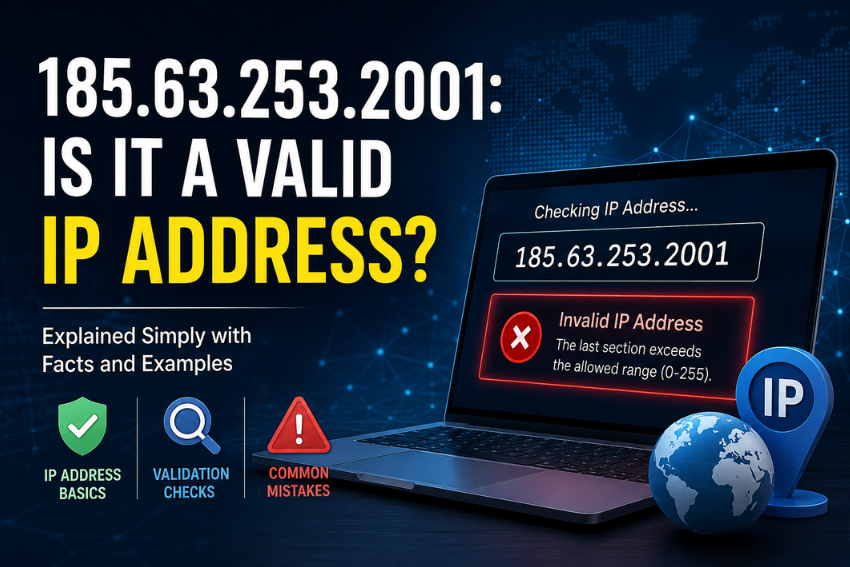
Understanding What an IP Address Is
Before deciding whether 185.63.253.2001 is legitimate, it helps to understand what an IP address actually does. Every device connected to a network receives an Internet Protocol address that allows information to move from one destination to another. Think of it as the mailing address for digital communication. Without IP addresses, websites, applications, and servers would not know where to send data.
Most internet traffic today relies on two standards: IPv4 and IPv6. IPv4 remains widely used and appears as four groups of numbers separated by periods. IPv6 was introduced later to support a much larger address space and uses hexadecimal notation separated by colons.
IP addresses also exist in public and private forms. Public addresses connect devices to the wider internet, while private addresses operate inside local networks such as homes and offices. This distinction matters because not every visible IP style is publicly routable.
Is 185.63.253.2001 a Valid IP Address?
Quick Answer
No. 185.63.253.2001 is not a valid IPv4 address and it is not a valid IPv6 address.
At first glance, it appears convincing because it follows the familiar dotted format. The first three segments look normal:
- 185
- 63
- 253
The problem appears in the final segment:
- 2001 ❌
That final value exceeds the permitted range.
Technical Breakdown
IPv4 addresses contain exactly four numerical sections called octets.
Each octet:
- Uses 8 bits
- Supports values from 0 to 255 only
- Cannot exceed 255 under any circumstances
Here is a comparison:
| Address | Valid? | Reason |
|---|---|---|
| 185.63.253.200 | Yes | All values within range |
| 192.168.1.1 | Yes | Proper IPv4 format |
| 185.63.253.2001 | No | Last section exceeds 255 |
| 999.63.253.200 | No | First section exceeds 255 |
This immediately invalidates 185.63.253.2001.
How IPv4 Addresses Actually Work
IPv4 uses a 32-bit addressing structure divided into four octets. Each octet stores eight bits, creating a maximum possible decimal value of 255. That rule forms the backbone of modern internet routing.
Think of IPv4 like a building with four floors. Each floor only supports up to 255 rooms. Once someone tries adding room 2001 on a floor, the structure stops making sense.
That is exactly what happens with 185.63.253.2001.
A standard IPv4 format looks like:
- 8.8.8.8
- 172.16.0.1
- 203.0.113.15
Each number remains inside the accepted range.
Routers and network systems reject malformed addresses automatically because they cannot determine where traffic should go.
Could 185.63.253.2001 Be an IPv6 Address?
Some people assume the appearance of the number 2001 means IPv6 is involved. That assumption is understandable but incorrect. IPv6 uses an entirely different format.
Example:
2001:0db8:85a3:0000:0000:8a2e:0370:7334
Notice the differences:
- Uses colons instead of periods
- Uses hexadecimal values
- Supports longer structures
Because 185.63.253.2001 uses decimal notation with periods, it does not qualify as IPv6 either. This leaves only one conclusion: it is invalid.
Common Reasons People Encounter 185.63.253.2001
You may wonder why invalid IP strings appear online at all.
Typing Errors
The most common explanation is simple human error.
Someone intended to type:
185.63.253.200
But accidentally added an extra digit.
Log File Formatting Issues
Applications occasionally concatenate values incorrectly.
Example:
185.63.253.200 + 1
becomes
185.63.253.2001
Port Number Confusion
Another possibility is that a port number became attached accidentally.
For example:
185.63.253.200:2001
If the colon disappears, the result becomes misleading.
Parsing Bugs
Software imports sometimes remove separators and create malformed output.
These situations happen more often than most people expect.
How to Validate an IP Address Correctly
You do not need advanced networking knowledge.
Follow this process:
- Count the segments.
- Confirm IPv4 has four sections.
- Verify every value stays between 0 and 255.
- Check formatting.
- Use an IP validator.
Quick checklist:
| Rule | IPv4 |
|---|---|
| Four sections | Yes |
| Numbers only | Yes |
| Range 0 to 255 | Yes |
| Separated by periods | Yes |
If even one rule fails, the address is invalid.
Security Implications of Invalid IP Addresses
Seeing an invalid IP is not automatically dangerous.
In many cases, it means:
- User error
- Logging issue
- Data corruption
- Formatting problems
That said, repeated malformed addresses inside server logs can justify investigation. Security analysts sometimes review malformed network entries because attackers occasionally attempt unusual formatting to bypass filters or trigger unexpected behavior.
Questions worth asking:
- Does it appear repeatedly?
- Did it originate internally?
- Is software parsing network data incorrectly?
- Is any application crashing afterward?
Context matters more than the invalid address itself.
Best Practices for Handling Unknown IP Strings
Encountering an unfamiliar IP like value such as 185.63.253.2001 can create confusion, especially if it appears inside analytics reports, server logs, application dashboards, or security alerts. Instead of assuming the value is dangerous or legitimate, follow a structured validation process. A few simple checks can save hours of troubleshooting and prevent incorrect conclusions.
Start by examining the overall format. For IPv4, confirm that the address contains exactly four sections separated by periods and that every section remains between 0 and 255. If even one value falls outside that range, treat the entry as invalid until proven otherwise.
When handling unknown IP strings, follow these practical guidelines:
- Validate structure before analysis to avoid wasting time on malformed data.
- Check whether ports were merged accidentally, such as converting 185.63.253.200:2001 into 185.63.253.2001.
- Review source logs carefully to identify whether formatting changed during export or transmission.
- Compare against IPv4 and IPv6 standards instead of relying on appearance alone.
- Use trusted IP validation tools for quick verification.
- Track repeated occurrences because recurring invalid values may point to application errors.
- Document findings to help future troubleshooting and improve internal processes.
Network administrators and security professionals rarely trust raw values at first glance. They confirm format, context, and source before making decisions. Building this habit reduces false alarms and helps identify genuine networking issues faster.
In most situations, invalid IP strings turn out to be harmless formatting mistakes rather than indicators of malicious activity. Still, a consistent validation workflow ensures better accuracy, cleaner data, and more reliable system monitoring.
Conclusion
185.63.253.2001 is not a valid IP address. Even though it resembles IPv4, the final segment exceeds the allowed range of 0 through 255, making it impossible under IPv4 rules. It also does not match IPv6 formatting requirements.
Most appearances of this number result from simple mistakes, formatting errors, or confusion between addresses and ports.
Once you understand the rules behind IP structure, identifying invalid addresses becomes surprisingly easy.
FAQs
Is 185.63.253.2001 a real IP address?
No, 185.63.253.2001 is not a real or valid IP address. While it resembles an IPv4 address because it uses periods between numbers, the final section exceeds the allowed numeric range. In IPv4, each section must stay between 0 and 255. Since 2001 is far above that limit, systems cannot interpret or route it as a legitimate address.
Can IPv6 contain 2001?
Yes, the number 2001 frequently appears in IPv6 addresses, but not in the same format shown here. IPv6 uses hexadecimal values separated by colons instead of periods. For example, many IPv6 blocks begin with prefixes that include 2001. That does not make 185.63.253.2001 a valid IPv6 address because its formatting does not follow IPv6 standards.
Why does 185.63.253.2001 look legitimate?
It appears legitimate because the first three sections follow the standard IPv4 pattern. Most users recognize IP addresses as groups of numbers separated by periods, so the unusual final segment may not stand out immediately. This is why formatting mistakes often go unnoticed until validation checks occur.
Could this indicate hacking or suspicious activity?
Not necessarily. In most cases, invalid IP addresses result from human typing mistakes, software formatting issues, logging errors, or incorrectly combined values. If the same invalid address appears repeatedly across network logs or unusual events occur at the same time, then reviewing system activity may be worthwhile.
How do I verify an IP address quickly?
Start by counting the segments and checking whether there are exactly four sections for IPv4. Next, confirm that every number stays between 0 and 255. If anything falls outside that range, the address is invalid. You can also use online IP validation tools for an instant check.
Could 185.63.253.2001 actually include a port number?
Yes, that is one possible explanation. Someone may have intended to write something like 185.63.253.200:2001, where 2001 represents a network port. If the colon disappears during copying, exporting, or logging, the value can incorrectly appear as a single invalid IP string.
What happens if I try to use an invalid IP address?
Most browsers, operating systems, and networking tools reject invalid IP addresses automatically. You may see connection errors, failed lookups, or messages indicating the address format is incorrect. Network devices depend on valid syntax to determine where traffic should go.