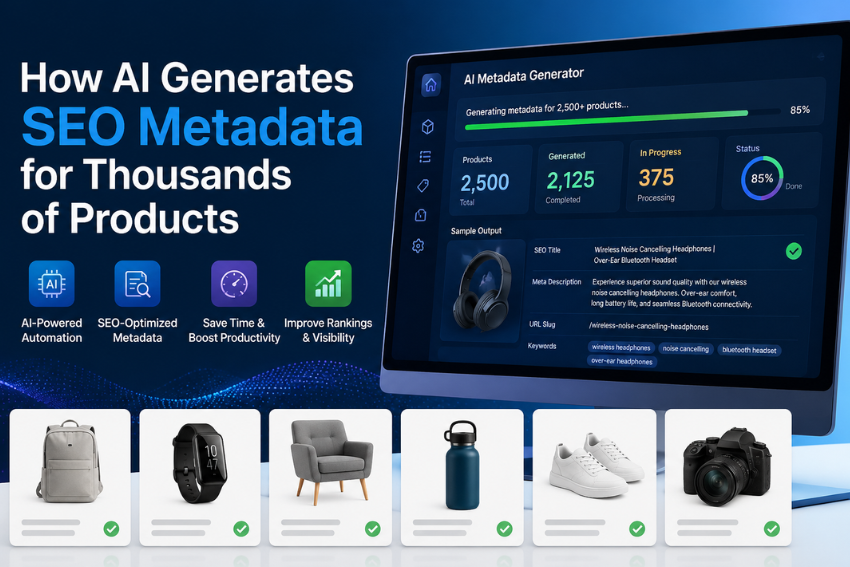
AI generates SEO metadata for thousands of products faster than any human team ever could, yet many e‑commerce managers still wonder how the technology actually pulls it off. You might picture a robot typing title tags while sipping digital coffee, but the reality is both simpler and more fascinating.
If you manage a large product catalog, you already know that writing unique, click‑worthy title tags and meta descriptions for every single SKU is a monumental task. Doing it by hand drains your marketing budget, slows your time to market, and leaves room for inconsistencies that hurt your organic visibility.
This post unpacks exactly how AI steps in, creates bulk metadata that search engines love, and frees you to focus on strategy instead of copy‑paste drudgery.
The Metadata Bottleneck No One Talks About
In the early days of a store, writing 50 product descriptions feels manageable. When your catalog hits 5,000 or 50,000 SKUs, the math turns ugly. Each product needs a unique title tag, a compelling meta description, image alt text, and often structured data markup. Multiply that by the number of variants, and you are staring at a workload that would take months of full‑time effort. Most teams either reuse the same template and risk duplicate content penalties, or they simply leave meta description fields empty and hope Google generates something decent on its own. Neither outcome serves your rankings.
I have seen marketing directors pull their hair out trying to coordinate copywriters across seasonal launches while their developers beg them to stop changing spreadsheets. The bottleneck is not talent; it is time. AI changes the equation by treating metadata generation as a pattern‑matching and language‑generation problem, not a manual writing exercise.
What AI‑Generated SEO Metadata Actually Includes
When we say AI generates SEO metadata, we mean the machine creates several distinct on‑page elements automatically:
- Title tags optimized for primary keywords and click‑through intent
- Meta descriptions that summarize the product, include a call to action, and stay within pixel limits
- Image alt attributes describing the visual content for screen readers and image search
- Open Graph and Twitter Card tags for social sharing
- Structured data (schema markup) such as Product, Offer, and BreadcrumbList, often in JSON‑LD format
The AI does not just fill blanks with generic phrases. It tailors each element to the specific product, brand voice, and search intent the page is targeting. For a running shoe, it might emphasize cushioning technology and long‑distance comfort. For a power drill, it would highlight torque, battery life, and included accessories. The output reads like something a skilled human copywriter would produce, only it appears in seconds for thousands of URLs.
How AI Understands Product Context and Intent
Old‑school automation relied on mad‑lib style templates: “Buy {product name} at the best price.” You get a grammatically correct sentence, but it carries zero persuasive power and offers no semantic connection to what buyers actually search for. Modern AI uses large language models trained on vast amounts of web content, combined with product data feeds, to grasp context deeply.
First, the system ingests your product data, typically from a PIM, a Shopify export, or an ERP. It reads the product title, description, attributes like size, color, material, technical specs, and even customer reviews. Then it maps those details to search intent signals. If your data says “waterproof Bluetooth speaker, IPX7, 12‑hour battery,” the AI knows that people searching for “best speaker for kayaking” or “shower speaker that lasts all day” might be a perfect match. It will craft a title tag that includes “Waterproof Bluetooth Speaker” and a meta description that mentions kayaking, beach trips, or long battery life, depending on the angle you choose.
Some advanced systems even analyze the product images using computer vision. The AI detects colors, textures, shapes, and settings, then adds those details to the alt text and the metadata narrative. So an image of a red backpack on a hiking trail becomes alt text like “Red hiking backpack on forest trail with mountain view,” which reinforces topical relevance without stuffing keywords.
A 5‑Step Process That Powers AI Metadata Creation
You do not need a PhD in machine learning to understand how the workflow operates. Most enterprise‑grade platforms follow a similar path:
- Data ingestion and normalization: The AI pulls product information from your existing database, cleans up missing fields, and standardizes formats. If your supplier wrote “Blk” instead of “Black,” the system corrects it.
- Keyword and intent mapping: Using NLP (natural language processing), the AI clusters related search queries, identifies high‑value commercial terms, and assigns a primary and secondary keyword to each product. This step ensures the metadata targets what people actually type into Google.
- Content generation with brand rules: You set guidelines: a maximum meta description length of 155 characters, a tone that is energetic and casual, required legal disclaimers, and mandatory brand phrases. The AI then writes title tags and meta descriptions that obey those rules perfectly across every product.
- Duplicate detection and uniqueness enforcement: The system scans the generated metadata for near‑duplicate phrases. It rephrases any item that is too similar to another, ensuring each page carries unique, non‑cannibalistic signals.
- Human review and publish: Most platforms present the suggestions in a dashboard where your team can approve, edit, or reject batches. This step keeps you in control while the AI handles the heavy lifting.
This workflow turns a process that once took a team of five writers three months into something one marketing manager can oversee in a week.
Why AI‑Generated Metadata Strengthens Your SEO
Speed is the obvious win, but the SEO benefits run much deeper. Google’s algorithms reward pages that demonstrate relevance, uniqueness, and a clear match to user intent. When AI generates metadata at scale, it creates a consistent signal layer across your entire domain. Search engines see thousands of pages, each with a crisp, keyword‑aware title tag and a meta description that actually encourages the click.
Click‑through rate from search results is a critical ranking factor. A well‑written meta description that speaks directly to the searcher’s need “Looking for a lightweight running shoe that won’t give you blisters on long pavement runs?” pulls in more clicks than “Shop running shoes online.” AI can inject empathy and benefit‑driven language without drifting into hyperbole, because it learns from the product attributes what real user problems get solved.
Also, structured data markup generated by AI helps you earn rich snippets. Product availability, price, star ratings, and breadcrumbs appear directly on the SERP, which increases your organic real estate and makes your listing more enticing. AI ensures that schema is valid, free of JSON errors, and matches the content on the page, a hygiene factor many manual processes screw up.
Fresh Insight: Dynamic Metadata That Reacts to the World
One of the most powerful applications few people discuss is time‑sensitive and intent‑sensitive metadata. Imagine you sell patio furniture. In March, the AI can subtly shift meta descriptions to emphasize early‑spring preparation: “Get your deck ready for the first sunny weekend.” Come July, it can pivot to “Host the ultimate 4th of July barbecue with durable outdoor seating.” The product stays the same, but the metadata reflects real‑world context and searches that spike seasonally.
AI can also personalize metadata based on user location or trending queries, though you need to implement this carefully. A product page for a winter coat might show a title tag mentioning “heavy down parka” to users in Chicago during a cold snap, while a visitor in Atlanta sees a lighter variation. This goes beyond traditional SEO into conversion optimization, but it all starts with AI’s ability to generate metadata on the fly.
Common Pitfalls and How to Avoid Them
Relying blindly on AI without guardrails invites disaster. I have audited sites where every meta description ended with “Buy now at the best price!” because the template override was too rigid. To stay safe, keep these practices in mind:
- Always set a unique brand tone. If your voice is witty and informal, feed the AI examples. Without guidance, it defaults to bland corporate speak.
- Watch out for keyword stuffing. A good AI respects density limits, but you should still spot‑check for awkward phrases like “cheap cheap running shoes buy cheap.”
- Monitor for factual errors. AI can hallucinate features. If your product does not have a USB‑C port, but the training data associated the category with that port, the description might lie. A quick human review catches this.
- Do not auto‑publish without preview. Run a batch of 100 products, check for quality, then scale.
- Update your data source first. Garbage in, garbage out. If your product database lists “size: large” with no measurements, the AI will guess, and Google hates inaccurate schema.
The Human Touch Still Matters
AI generates SEO metadata at an incredible volume, but it works best as a creative assistant, not a replacement for your marketing brain. You decide the keyword strategy, the conversion goals, and the emotional hook. The AI executes the tedious variation of that hook across thousands of pages. Treat the technology like a junior copywriter who never sleeps, and you will get results that feel personal at scale.
I often tell teams to invest their saved time where it counts: writing deeper category page introductions, crafting data‑driven blog content that builds topical authority, and analyzing Search Console data to refine the AI’s future output. The metadata gets taken care of, and you become the strategist, not the scribe.
What This Means for the Future of E‑commerce SEO
Google’s algorithms grow smarter every year, but they still rely heavily on the metadata you provide to understand and rank your pages. As AI becomes mainstream, not using it will put you at a competitive disadvantage. The stores that win will be those that use AI to stay nimble, update metadata for seasonal trends, expand into new languages, and keep every product page crisp and unique, all while their human teams focus on building the brand.
Adopting AI for metadata is not about cutting corners. It is about matching the scale of the internet with content that genuinely helps shoppers find what they need. When a customer lands on your page from a search result that perfectly described the product, they are already halfway to trusting you. AI makes that first impression happens thousands of times a day, without you lifting a finger.
Frequently Asked Questions
Can AI‑generated metadata hurt my SEO?
Not if you set clear brand rules and perform periodic human quality checks. Low‑quality, duplicate, or factually incorrect metadata can harm your rankings, but these are failures of implementation, not a flaw of AI itself. A well‑tuned AI produces metadata that follows Google’s guidelines and often outperforms manual efforts in terms of consistency and uniqueness.
How accurate is AI for niche or technical products?
Accuracy depends on the quality of your input data. If you provide detailed technical specifications, the AI can generate precise, jargon‑correct metadata for industrial valves, medical devices, or specialty automotive parts. Always review the first few batches of a highly technical category to ensure the model has learned the terminology correctly.
Do I still need an SEO specialist if AI writes the tags?
Absolutely. AI handles the execution, but the SEO specialist defines the keyword strategy, monitors performance in Search Console, adjusts the AI’s guidelines, and handles edge cases like seasonal campaigns or rebranding. Think of AI as the production team and the SEO specialist as the creative director.
Will Google penalize me for using AI‑generated metadata?
No. Google’s official stance is that it cares about helpful, original content, not the tool used to create it. Many enterprise e‑commerce sites already use automation for title tags and meta descriptions. As long as the metadata serves the user and accurately describes the page, the origin of the text does not cause a penalty.
How does AI handle long‑tail keywords in metadata?
AI excels at naturally weaving long‑tail phrases into metadata because it understands semantic relationships. When you feed it a product like “men’s organic cotton V‑neck t‑shirt,” it can generate descriptions that include “soft breathable tee for hot summer days” or “hypoallergenic everyday essential for sensitive skin,” capturing conversational queries without forcing awkward keyword insertion.