Azure OpenAI Service has changed how businesses build intelligent applications, automate workflows, and deliver personalized customer experiences at scale. From enterprise chatbots to AI powered content generation, companies now rely on advanced language models to solve real business problems faster than ever before.
What makes this platform stand out is the balance between innovation, security, and enterprise readiness. Organizations no longer need to choose between cutting edge AI capabilities and strict compliance standards. Microsoft combines powerful OpenAI models with the trusted Azure cloud ecosystem, giving businesses a secure environment to develop and deploy AI solutions confidently.
The growing demand for generative AI has pushed enterprises to rethink how teams work, communicate, and analyze data. Instead of spending hours on repetitive tasks, professionals can now streamline operations with AI assisted automation, smarter search experiences, and real time insights. That shift is not just improving productivity. It is reshaping entire industries.
In this guide, you will learn the key benefits of Azure OpenAI Service, common real world applications, and the best practices businesses should follow to maximize performance, security, and long-term value.
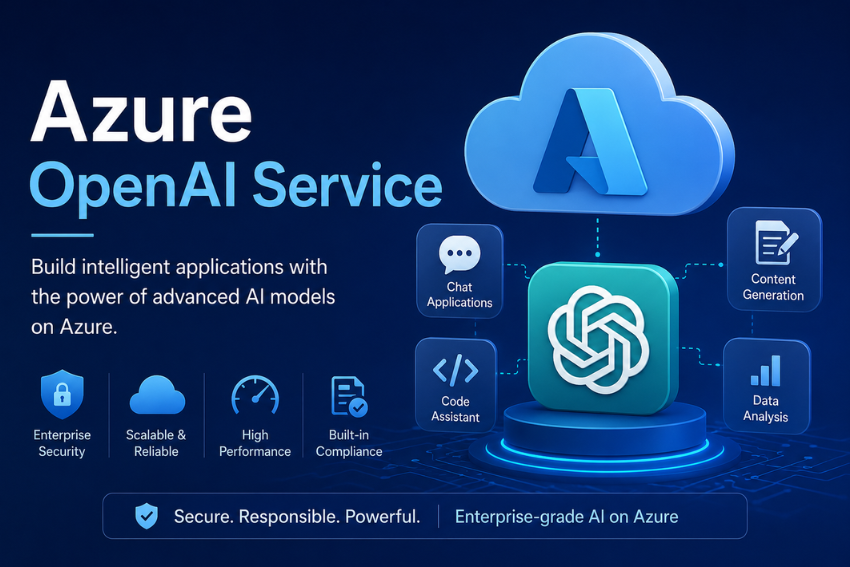
What is Azure OpenAI Service?
Microsoft’s Azure OpenAI Service is available as part of Microsoft’s cloud platform, which is hosted in its data centers. The service is available to companies that want to develop apps that are powered by advanced AI, such as chatbots, smart assistants, or automated workflows, without having to build an entire AI model from scratch.
What differentiates Microsoft Azure OpenAI Service from all other types of public cloud offerings of AI (Public Cloud AI) is its ability to provide advanced Generative AI that meets the rigorous requirements of security, regulatory compliance, and enterprise-level scalability. This is accomplished because the Microsoft Azure OpenAI Service operates in a completely secure and private hosting environment within the Microsoft Azure cloud.
Therefore, developers can deploy applications more rapidly, provide higher levels of security during deployment, and integrate their solutions more efficiently with other enterprise applications that reside within the enterprise’s cloud systems.
Benefits of Azure OpenAI Service
Here are the benefits that extend beyond technology and directly impact business performance.
Operational Efficiency
The automation of repetitive work via computers expedites many aspects of overall operations; on the other hand, automating customer service inquiries, timely processing of data, and producing content quickly and accurately is possible.
Cost Efficiency
An artificial intelligence as a service (AIaaS) can be created from scratch by any company; however, building infrastructure to use the new software application requires an initial large investment in either hardware or specialized knowledge to develop the software application. Azure OpenAI allows businesses to develop an AI system at the lowest initial cost on a pay-per-use basis.
Enhanced Customer Experience
Automated systems (like chatbots) enable customers to receive immediate, personalized answers to inquiries via an automated system rather than having to wait for a response from a human.
Innovation Enablement
Azure OpenAI provides generative AI tools that allow teams to experiment without requiring large amounts of time and effort to build new infrastructure.
Scalability
As an organization develops and adds new systems to accommodate its expanding base of customers, Azure OpenAI Services can grow with the organization.
How Azure OpenAI Service Architecture Works
There are many descriptions of the Azure OpenAI Service architecture that do not go beyond a superficial level of detail. The Azure OpenAI Service architecture consists of a restricted and formalized AI information framework (pipeline), structured for use by businesses (enterprises).
Input Layer
This is where requests are received – This could be via chatbot, internal system, or externally available via consumer interaction.
Application Logic Layer
This will be the most significant layer. Here the business will have the ability to structure how prompts are created, contextualize requests, and have certain pre-defined rules applied to prompts. This will ensure the outputs generated from prompts reflect the needs of a business as opposed to generic responses generated from the AI model based on the input only.
Azure OpenAI API Layer
The AI model will process the request through the API. A significant benefit to processing requests in this manner is that no data is ever subject to any external threats to security because all processing occurs within the secure environment of Azure.
Data Grounding Layer
Enterprise users will connect to their internal data sources (documents, databases, etc.) to provide additional contextual information for creating a contextual response (response when user requests for contextual information (response) as opposed to generating a response based on the input (non-contextual response).
Security and Governance Layer
Controls and monitors user access and usage of the Azure OpenAI Service. This layer also ensures compliance with governing organizations and their related standards for compliance to be met.
This defined Azure OpenAI architecture is what allows for reliability and scalability of implementation in the enterprise.
How Azure OpenAI Cost is Calculated
Azure OpenAI pricing can be misunderstood because it’s based on several different factors that can change over time. Azure OpenAI pricing is not standardized, and pricing will fluctuate based on how Azure OpenAI is used. Here are the four main areas:
Token Consumption
Microsoft uses tokens to determine pricing for Azure OpenAI models based on the amount of data sent to or received from the Azure OpenAI model. The more tokens that are consumed, the more expensive it will be to use Azure OpenAI. Therefore, the way you create your prompt will be one of many ways you can manage your costs.
Model Selection
Pricing varies across models based on the performance of the specific model you choose. As a result, higher-end models tend to produce better overall results and will cost more. Therefore, you will need to determine your company’s performance needs versus your abilities.
Deployment Scale
The number of businesses using AI in their day-to-day operations will continue to grow, and as more businesses use AI, it will also continue to generate additional usage fees. Ultimately, while AI will cost more to implement than previously thought, it will also deliver additional overall-valued benefits to businesses in the form of greater efficiency and automated operations.
Infrastructure and Integration
In addition to using Azure OpenAI, you will incur costs for other Azure Services, such as storage costs, API fees, and hosting costs. This will help in reducing cost and availing all the available services.
Industries Use Cases of Azure OpenAI Service
One reason that Azure OpenAI has increased significantly is that this technology is applicable across many types of industries and business models. Today, just about every industry has a high volume of data, repetitive tasks, communication with customers, and workflows that could be more efficient with AI-enabled solutions.
The Azure OpenAI Service gives organizations the generative capability of artificial intelligence combined with the security and scale that come with enterprise-level solutions, thus providing business units from many different industries with a real opportunity to leverage this as a tool in their daily operations.
Healthcare
In Healthcare, for example, organizations are finding AI solutions helpful for things like creating documentation, communicating with patients, summarizing medical data, and automating their internal workflow. The administrative departments have fewer manual processes, while the practitioners have access to the information they need more quickly, so they can spend more time caring for patients and less time performing repetitive operational tasks
Financial Service Industry
In the Financial Services industry, banks and other financial institutions are utilizing Azure OpenAI to enhance customer service, automate report writing, identify irregularities in their financial data and assist their internal teams with the preparation of regulatory compliance documentation and research. The ability to provide security and governance in highly regulated environments only enhances the value of Azure OpenAI for the financial services industry.
Retail & eCommerce
In retail & eCommerce, organizations are utilizing AI for tasks that include enhancing the customer experience through personalization; creating product descriptions; automating customer service communications; improving recommendation systems; and generating new marketing campaign ideas, understanding customer behavior & accelerating content creation across multiple digital channels (via generative AI tools).
Manufacturers
Manufacturers are utilizing AI for supply chain management, operational & financial reporting, predictive maintenance processes, and knowledge management within an enterprise’s internal systems. Automating data analysis & workflow-based activities allows companies to create a smoother process to reduce lag time & increase operational visibility.
Education
AI is being applied in education to help institutions manage administrative functions; provide automated communication support; offer access to learning resources; and facilitate greater accessibility of knowledge. Similarly, legal firms are using AI for contract review, summarization of documents, assistance with research, and automation of workflow.
Technology
Companies involved with technology and teams that create software are among the fastest users of the Azure OpenAI Service. Developers have begun to use AI as part of code creation, debugging code, documenting software, providing support for testing, and helping improve productivity. These capabilities help engineering teams decrease the time required for development while reducing the need for repetitive coding.
The other reason Azure OpenAI Service is becoming popular in different industries is that it has a lot of flexibility. Companies do not need to recreate their entire infrastructure to realize the benefits of AI capability. Companies are able to begin using AI gradually by integrating AI into their current systems, workflows, and enterprise applications. This approach provides a more practical and less disruptive transition for larger organizations that have defined complex digital ecosystems.
As the use of AI continues to mature, there is a growing trend among businesses to look at generative AI as a long-term business capability rather than just as a technology trend. Companies that can successfully integrate AI into their operating processes will likely see an increase in their productivity, efficiency, customer engagement, and innovation in the future.
Best Practices for Azure OpenAI Service
To acquire genuine output from implementations, it’s important to structure your implementation upon the following best practices:
Start with Clear Use Cases
Prior to starting to use Azure OpenAI Service, it is best practice to establish a use case. You can do this by creating solutions that will address specific pain areas, such as decreasing the time it takes for support requests to be resolved or making automated workflows for tasks that have already been done. Defined use cases will also enhance your ability to establish Key Performance Indicators (KPIs) needed to measure meaningful results. This will help in reducing the delays and reaching the goals faster.
Build a Strong Data Foundation
The entire AI solution’s outcome will depend on the input (data) used. Therefore, to receive an accurate and relevant output/contextual output from the AI solution, you must provide it with structured, clean, and relevant data. If you are going to use enterprise data to build an AI solution, this is particularly important! A strong data foundation can help in reducing the risks associated with businesses and taking measures beforehand.
Implement Governance Early
Before using Azure OpenAI Service, have established Access Control, Monitoring Procedures, and Data Utilization Policies. This will help ensure compliance, prevent the misuse of the service(s), and develop confidence surrounding the use of AI solutions.
Optimize Prompts
The quality of AI output is greatly improved using clearly articulated prompts while also using the least number of tokens possible. To accomplish this, it is important to include well-defined instructions and contextual information. This will significantly improve consistency and overall quality of your results!
Monitor and Optimize Costs
Continuously track token usage and look for opportunities to optimize usage by using practices like caching, limiting tokens returned, and selecting optimal models to manage the cost of using Azure OpenAI. Monitoring and optimizing costs will help in reducing costs by settling on a pre-decided cost.
Work with an Azure OpenAI Implementation Partner
The right partner can help you build an architecture, integrate, and scale the Azure OpenAI Service, resulting in shorter implementation times and alignment to your long-term business plan. An experienced implementation partner can provide direction and lead to informed decision-making in the long-run.
Conclusion
The Azure OpenAI Service is emerging as one of the primary drivers of enterprise artificial intelligence transformation. This is due to its combination of state-of-the-art generative AI capabilities with the enterprise security, governance, scalability, and integration support required by businesses. The transition of organizations from experimentation to large-scale AI implementations will depend on the availability of platforms that support enterprise-level implementations for long-term success.
Organizations and businesses that have a well-defined plan for their AI adoption and the appropriate technological infrastructure will be better positioned to enhance productivity, speed innovation, and remain competitive in an increasingly AI-driven marketplace.