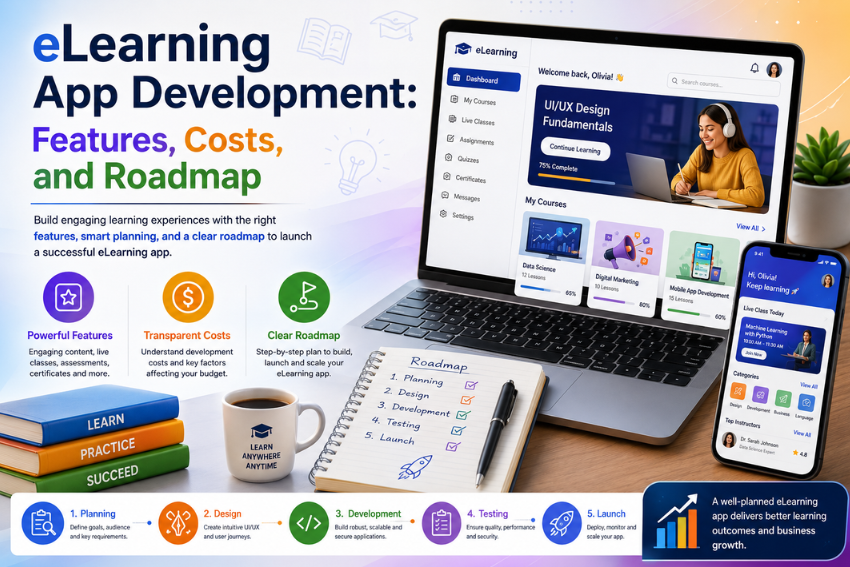
eLearning app development starts with defining a focused minimum viable product. An eLearning minimum viable product is likely to cost anywhere between $40,000 and $80,000. A medium company can expect to spend around $80,000 and $150,000 to build a platform with several roles for its users, besides all other features. Some basic features of the platform are course delivery, assessments, tracking user progress, administrative functionality, and reporting.
Successful eLearning app development focuses on guiding learners from their first lesson to measurable progress with minimal friction. The number of features is less important than a smooth learning flow, effective content delivery, and reliable assessment tools.
An experienced eLearning app development company can define that flow before developers write code. Early product decisions influence the budget, roadmap, technical architecture, and future scalability.
What Should an eLearning App Achieve?
An eLearning application is designed to assist its users with certain educational activities. For instance, a language app could be used to gain knowledge of vocabulary on daily basis, while a corporate education platform can help employees complete their mandatory certification.
Prior to starting to develop the product, the development team should answer four basic questions:
- Who is going to use the platform?
- What do they need to learn and which skills should be acquired?
- How is the platform going to deliver the educational material?
- How is it going to evaluate and measure learning outcomes of users?
The answers to all these questions will determine what features should be included in the product. For instance, if an app will provide self-paced courses, it will need to have smooth video streaming and reporting on learning process. If a company is going to create a corporate training platform, it should have certification procedures, compliance reports, and user access control.
A clear learning model for the app is a measure which avoids excessive expansion of the project scope. Product managers will be able to assess any new feature against one criterion, whether it advances the educational goals of the users or not.
Which Type of eLearning Product Should You Develop?
The right product type depends on your audience, content model, and revenue plan. Four formats cover most commercial and institutional projects.
Course Delivery Apps
Learning platforms allow Students to experience structured classes with videos, reading materials, and exams with the learning platforms. Most of the time, it operates according to a subscription model, a one-time payment for the course, or freemium access to the learning content.
This type of app is ideal for independent trainers or training organizations. The initial release may include such functionality as course catalog, media player, quizzes, progress tracker, and payment integration.
Learning Management Systems
An LMS (learning management system) enables organizations to exercise greater control over course processes. An administrator is able to assign programs, oversee users and their activities, track their progress, and award certificates to users.
Both schools and companies require different roles operating within the same system: learners who are taking their courses, instructors who manage content, and administrators who monitor the results.
Course Marketplaces
An online marketplace links teachers with students. All instructors are able to create courses, choose prices, and earn money from various courses using this platform.
However, creating a marketplace is not limited to just implementing the courses. The product must also provide features for onboarding instructors, moderating the content, different commission logic, payment processing, reviews of content, and resolution of disputes.
Corporate Training Platforms
Corporate platforms facilitate the onboarding of employees as well as their compliance training and development. In many cases, they cooperate with HR-related software, identity management systems, and internal knowledge bases.
The platform should produce reports on department operations. These reports allow managers to monitor completion of compulsory training and to find skill gaps between teams.
Which Features Should an eLearning App Include?
A practical feature set starts with the tasks that learners, instructors, and administrators must complete. Each role needs a separate interface and permission level.
What Features Do Learners Need?
Learners have a need for a simple process that begins with registration and ends with the completion of their program. They are also looking for an interface where they can easily find course material, proceed with the progress in their lesson, submit their homework, and evaluate their results.
Essential learning features are user profiles, a course search tool, lesson viewing options, quizzes, tracking progress, and receiving alerts. Mobile applications also require offline operation due to unstable internet connection.
Assessment deserves special attention as studies show that retrieval practice enhances knowledge retention more than mere learning. Thus, an e-learning application can support this technique in the form of mini-quizzes, review sessions, and planned knowledge checks. But what about instructors’ needs?
Instructors require solutions for the reduction of routine administrative processes. A course creator should provide them with the option to upload any media, organize the modules, and create tests independently.
The instructor dashboard shows the course completion, test results, and user activities. Some of the communication tools include lesson comments, private messages, or notifications.
Automation takes less time. The platform can make subtitles, assess objective test questions, and notify instructors when a learner has missed a deadline. However, complicated answer texts should be reviewed by a human specialist and not simply accepted from the AI educational program.
What Features Do Administrators Need?
The administrators manage all content, users, payments, and system policy. They will make use of the platform’s admin panel that needs to provide a full view of operations without requiring direct access to the database.
The admin panel may possibly be equipped with tools for user role management, courses moderation, statistics, notifications settings etc. A commercial platform may require tools for refunds, coupon management, reporting and payment receiving.
Admin statistics will focus on decision making. Course completion, lesson exit, the number of active users and exam results are of more value than the big dashboard full of unrelated numbers.
Which Advanced Features Provide Real Value?
Progressive traits need to address an existing issue faced by users. AI suggestions can recommend appropriate courses, while personalized testing can shift the level of difficulty of the questions depending on the student.
Other applications that can be useful are webinars, game-like process of studying, and voice recognition technology. The introduction of these features will be pricey and require more time for testing, so they should be included in the action plan only if the team verifies the main learning model.
A small AI test project can assist in finding out if the solution is financially reasonable. For instance, the developers can check if the AI tutor gives accurate answers using the officially approved library of the course materials.
Which Technical Requirements Matter from the Start?
Technical decisions affect performance, security, accessibility, and future product growth. Teams should document these requirements during product discovery rather than after the first release.
Content Delivery and Offline Access
Video frequently has a substantial load on the infrastructure used in an eLearning solution. The team that works on the solution has to choose the cloud storage, the content delivery networks, and the settings for streaming based on the anticipated volume of traffic.
For offline access, additional logic will be needed. The app has to provide secure downloading, control access after the subscription has expired, and synchronize achievements when the user is back online.
The developers also have to support different media formats. The flexible content module enables teachers to mix different media forms in one course.
Integration Standards
There is a consistent need for external learning tools or institutions by many education platforms. Special connections can become expensive due to the complexities involved with the different integrations.
Learning Tools Interoperability (LTI) is a specification provided by 1EdTech that enables learning platforms to connect with different tools and content in a standardized way. Version 1.3 of LTI also has a better authentication model compared to previous versions. The standards that would apply depend on the particular types of products involved. For LMS platforms, LTI, SCORM or xAPI may be used. Education systems are likely to have student information systems as another requirement.
Accessibility
The concept of accessibility should be included among the interface requirements. The presence of color contrasts, keyboard navigation, captions, text clarity, and any ability to scale text content increases the number of users who can use the content.
The World Wide Web Consortium has created a set of Web Content Accessibility Guidelines, which include WCAG 2.2. In these guidelines, the organization suggests what teams should do to make their digital content accessible for people having visual, hearing, motor, or cognitive disabilities. As a result, implementing accessibility should minimize the cost of reworking. It is possible to retroactively upgrade the navigation, controls, and media content after the product launch if extensive design and front-end work are performed.
Student Data Privacy
Education applications may process users’ names, contact information, course participation data, assessment results, and other information. The architecture should restrict the access to data based on the user role.
Products in the United States working with educational organizations may also be subject to the requirements of the Family Educational Rights and Privacy Act. The Department of Education provides specific resources for technology companies that gather or use students’ data. These security methods include encrypting information, using two-factor authentication, creating logs describing data access, and conducting regular vulnerability assessments. The team also needs to set the procedures for data retention and account deletion.
How Much Does eLearning App Development Cost?
The development costs of an eLearning app range from $40,000 for an MVP with a narrow focus to over $250,000 for a more sophisticated enterprise solution. The final price will vary depending on the number of user roles, platforms being used, integrations, video technologies, compliance, and advanced features. A simple MVP would cost between $40,000 and $80,000.
A simple MVP would normally serve only one main user group (e.g., students). The functionalities of the MVP can include registrations, access, passing of tests, keeping track of user progress, sending notifications, and a simple admin panel.
At this stage in the project’s life cycle, the MVP can be a good option for a startup looking to test the market demand or for a company wishing to have a website replacing a simple brochure-style site. After the app can provide information on its practical usage, the product team can implement different features, including live classes, AI tools, and advanced reporting.
Mid-Sized Platform: $80,000 to $150,000
A mid-sized solution is capable of allowing learners, instructors and administrators learn effectively. It may be inclusive of subscriptions, advanced analytics, certificates, offline content, and third-party integrations.
Developing such a platform entails more effort in terms of design and QA. Each of the involved user roles must have its own workflows, permissions, test cases, and interface states.
Enterprise eLearning System: $150,000 to $250,000+
A business enterprise platform may be used by multiple divisions, institutions, or customers. A system like this often needs a single sign-on, in-depth reporting capabilities, high-load architecture, and integration with internal systems.
AI capabilities and live video may further increase costs. Complicated accessibility requirements and compliance requirements additionally increase the work for analysis and testing.
Numbers outlined above should be viewed as budget references, but do not provide final estimates. Accurate estimation is only possible after getting approved feature list, architecture design, interface scope, and delivery timeline.
Which Factors Increase Development Costs?
The feature list has the most visible effect on the budget, but several less obvious decisions can add substantial effort.
Number Of User Roles
Each role requires dedicated permissions and workflows. A product for learners alone costs less than a platform for learners, instructors, parents, administrators, and corporate managers.
The team must design and test each role separately. Complex permission rules also require more backend work.
Web And Mobile Platform Coverage
A web application can be an affordable way to start providing desktop-based training. Native iOS and Android apps need to be developed and tested separately.
Cross-platform frameworks can minimize redundancy for a lot of products. But testing on different types of devices, screens, and operating systems is still necessary.
Video And Live-Class Infrastructure
Video that is recorded has expenses related to storage, encoding, establishing content, and managing access. A live classroom will have extra costs related to video conferencing, chatting, tracking student attendance, and ensuring the quality of the connection.
Using third-party services could make development easier but adds additional fees that depend on the number of learners and minutes of class.
Integrations
Payment gateways, human resources systems, calendars, and video services come with their own technological dependencies. The development team will have to connect, manage errors and track changes in the external API.
Using standard education protocols will save money in later integrations. They might require more preparation for the first release but give greater flexibility afterward.
AI Functionality
A tutor based on artificial intelligence must have access to reliable educational materials and specific boundaries for responses. The team should evaluate quality of the answers, safety of the data, and risk of unwarranted responses.
Budget also depends on the utilization of the model. Companies should calculate the number of learner requests and establish limitations prior to the public presentation.
What Roadmap Leads from Idea to Launch?
A structured roadmap reduces budget surprises and helps the team test the highest-risk assumptions first.
Validate The Product Concept
Identify the target demographic, the pain point in learning, and the anticipated result. Conduct interviews with possible users and analyze competitor products, ensuring the issue is indeed a problem needing a custom product.
The team also needs to validate the payment model. A subscription can work well for ongoing learning, while a single payment can work well for a fixed course with a certificate.
Complete Product Discovery
In the stage of discovery, business analysts keep track of roles, features, interfaces, and non-functional specifications.
The solution architect establishes the technical strategy and recognizes possible threats.
After that, the team presents a ‘features breakdown’ that is ranked in the order of importance.
Design The Learning Experience
The user journey from onboarding through to course completion is mapped out by UX designers. They create wireframes and put major workflows on test before visual design begins.
Prototypes can reveal confusion in navigation or steps missing to avoid expensive coding.
Develop The MVP
The developers are working on the backend, user interface, integrations and administration tools to be completed in short intervals. The team is able to present the full functionality at the end of every sprint.
The product owner needs to keep the first release focused. New ideas can wait in a separate backlog till the team validates the main units of usage.
Test and Release the Product
Quality assurance should check for the functions of the product, compatibility of devices, security, usability, and performance. The quality assurance team should also test the role permissions and money transaction scenarios.
Running a pilot on a limited scale can help to identify problems that can be resolved before large-scale rollout. An educational institution or a corporate organization may put the product into use in just one classroom or a division or among selected customers.
Improve The Product Through Evidence
After release, it is possible to see from analytics where in the lessons users drop off or the registration is abandoned. Interviews can provide an explanation for this problem.
The roadmap must take into account this evidence. Owners of the product can then fix the weakest operation procedure before rolling out another major feature.
How Can You Reduce eLearning Development Risk?
Begin your work on an MVP with the simplest functionality necessary to test your learning hypothesis. A tight MVP yields better insight than a bigger first launch based on assumptions.
Before you green-light any production work, request a breakdown of the functionalities to be included, the architecture, and the cost.
The vendor must demonstrate expertise in EdTech. Go over the projects with the same kinds of educational models, integrations, and user roles, not software with just a general name in the industry.
And, finally, plan how you are going to operate the content. Even the best software can’t overcome the poor quality of lessons, evaluations, and feedback.
What Should You Decide Before Development Starts?
An effective eLearning application begins with a clear outcome in education and a defined learning path for users. This journey must be made possible through efficient delivery of information, practical testing, and easy-to-understand reporting.
The first step is to determine who will use the product, how the process will be organized, what minimum viable product is needed, and how the product will make money at this stage.
Only after that, the development technology should be chosen to realize all future educational programs without requiring huge investments from the company at the start.