Java vs JavaScript remains one of the most common points of confusion for beginners, recruiters, and business owners entering software development. Despite sharing the word “Java,” these two technologies are distinct entities designed for completely different tasks. Comparing them is like comparing a car to a carpet. Both have their place, but you cannot drive a carpet down the highway, nor can you cover your living room floor with a car.
Sun Microsystems created Java in May 1995 as a heavy-duty programming language for cross-platform systems. Later that year, Netscape introduced a lightweight scripting tool called LiveScript. Netscape renamed it to JavaScript in a strategic marketing move to capitalize on Java’s rapid popularity surge. That branding choice created decades of mix-ups.
Understanding the fundamental distinctions between Java and JavaScript helps you choose the right language for your project, career path, or technical architecture.
What is Java?
Java is a class-based, object-oriented programming language designed for long-term stability and platform independence. Its core philosophy, “Write Once, Run Anywhere” (WORA), means developers write code on one operating system and run it on any device equipped with a Java Virtual Machine (JVM).
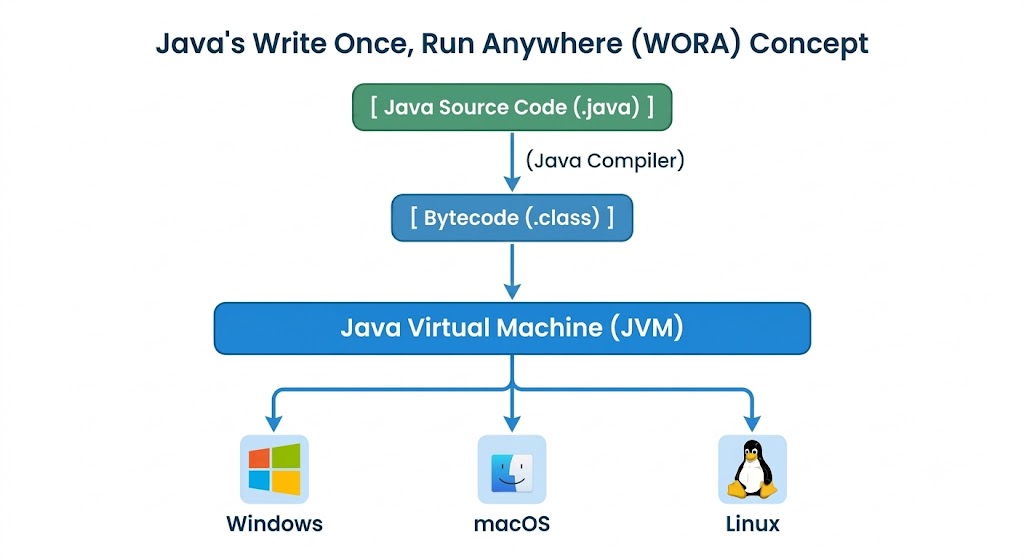
Java enforces strict structural rules. You must explicitly declare data types, build classes, and handle memory allocation through organized frameworks. Enterprise applications favor Java because its architecture scales gracefully under heavy traffic.
Common uses for Java:
- Banking systems and financial trading applications
- Android mobile application development
- Large-scale enterprise backends (using Spring Boot)
- Big Data processing frameworks like Apache Hadoop and Apache Spark
- Embedded devices and Internet of Things (IoT) systems
What is JavaScript?
JavaScript is a high-level, lightweight scripting language built to make web pages dynamic and interactive. When you view an animated carousel, submit an instant search query, or update a live feed without refreshing your browser, JavaScript powers that experience.
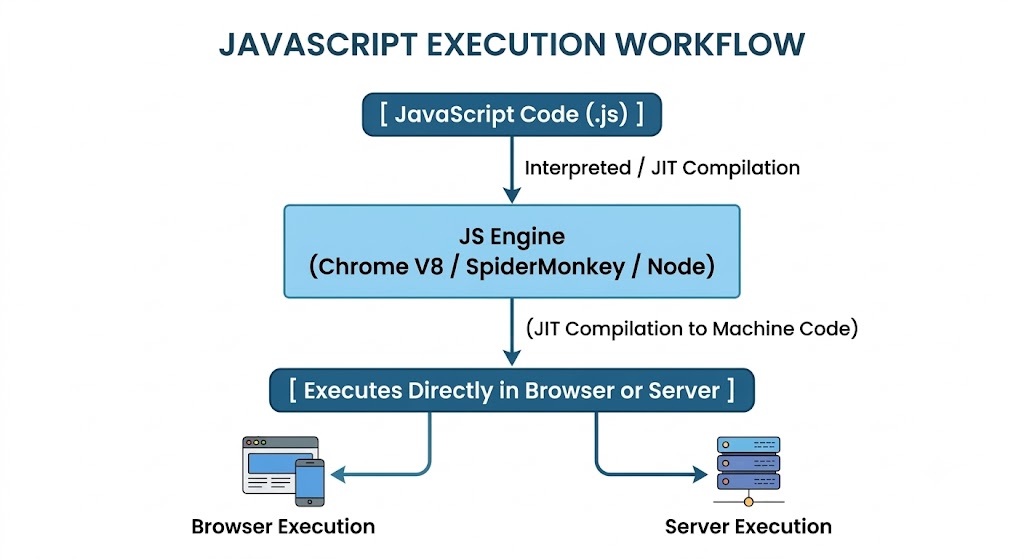
JavaScript was traditionally a client-side tool running inside web browsers like Chrome and Firefox. However, the release of the Node.js runtime environment expanded its capabilities to server-side backend development. Today, software teams use JavaScript to write complete, full-stack applications using a single syntax.
Common uses for JavaScript:
- Interactive user interface features on modern web applications
- Full-stack web application development (Node.js, Express)
- Cross-platform mobile applications (React Native, Ionic)
- Desktop applications (Electron, used by VS Code and Slack)
- Browser-based 3D graphics and games
Java vs JavaScript: 8 Core Technical Differences
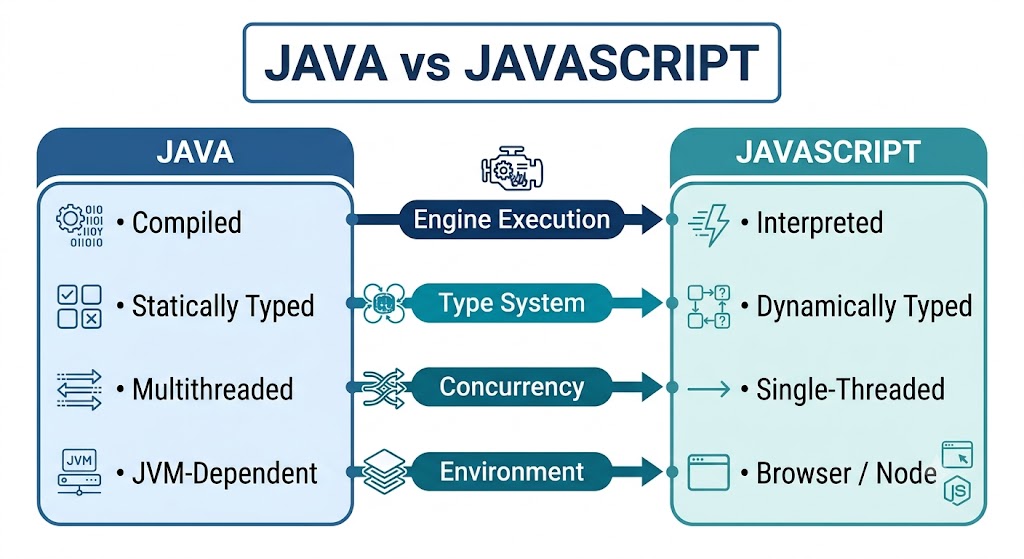
Compiled vs. Interpreted Execution
Java uses a two-step execution model. Developers compile human-readable Java code into bytecode via the javac compiler. The Java Virtual Machine then reads this bytecode and converts it into native machine instructions. This pre-compilation phase catches bugs long before your application enters production.
JavaScript runs as an interpreted, just-in-time (JIT) compiled language. Web browsers or JavaScript runtime engines compile and execute the code on the fly as the user opens a webpage or hits an API endpoint. This eliminates compilation delays during development.
Static Typing vs. Dynamic Typing
Java enforces strict static typing. You must explicitly define every variable type when writing code, and that type remains permanent throughout execution.
Java
// Java – Static Typing Example
String userRole = “Admin”;
int accountBalance = 500;
// accountBalance = “Five Hundred”; // This throws a compile-time error!
JavaScript uses dynamic typing. Variables can hold numbers, strings, objects, or arrays, and their types change dynamically at runtime.
JavaScript
// JavaScript – Dynamic Typing Example
let userRole = “Admin”;
let accountBalance = 500;
accountBalance = “Five Hundred”; // Totally valid in JavaScript
Static typing prevents runtime data type errors in Java, while dynamic typing gives JavaScript immense rapid-prototyping speed.
Multithreading vs. Single-Threaded Event Loop
Java supports true multithreading out of the box. It spawns multiple threads to execute several complex operations simultaneously, making full use of modern multi-core processor architectures.
JavaScript uses a single-threaded model powered by an asynchronous Event Loop. It handles thousands of simultaneous connections by delegating heavy input/output tasks to the browser or server OS, ensuring the main execution thread never freezes.
Class-Based OOP vs. Prototype-Based Architecture
Java strictly enforces class-based Object-Oriented Programming (OOP). You structure code within classes, blueprints, and explicit inheritance rules using objects, interfaces, and encapsulated methods.
JavaScript uses prototype-based inheritance. Objects inherit properties directly from other objects through a hidden chain of prototypes. While modern ES6 JavaScript introduced the class keyword syntax, it remains a clean syntactic overlay on top of standard prototypes.
Execution Environment
Java applications require a standalone Java Virtual Machine (JVM) environment installed on the target machine or server.
JavaScript runs inside any modern browser right out of the box. Outside the browser, JavaScript runs within desktop wrapper environments or server runtimes like Node.js, Deno, and Bun.
Syntax and Verbosity
Java uses a rigid, verbose syntax that demands structured declarations. Printing a simple line of text requires defining a class and a main method:
Java
public class HelloWorld {
public static void main(String[] args) {
System.out.println(“Hello, World!”);
}
}
JavaScript offers a lightweight syntax that gets straight to the point:
JavaScript
console.log(“Hello, World!”);
Memory Consumption
Java consumes significantly more system memory than JavaScript. Running the JVM and storing object state overhead requires higher hardware capacity.
JavaScript has a much lighter memory footprint. Its engines optimize lightweight script execution, making it fast and efficient for resource-constrained web browsers.
Security Model
Java incorporates built-in enterprise-grade security features like bytecode verification, sandboxed memory allocation, and fine-grained access controllers.
JavaScript client-side scripts run directly in the browser’s isolated sandbox to protect local hardware. However, because client-side JavaScript source code remains publicly viewable in browser developer tools, developers must handle critical authentication logic securely on the server backend.
Java vs JavaScript Feature Comparison
| Feature | Java | JavaScript |
|---|---|---|
| Language Type | Compiled, Statically Typed | Interpreted, Dynamically Typed |
| Primary Platform | Enterprise Servers, Android, Desktop | Web Browsers, Web Servers, Mobile |
| Execution Tool | Java Virtual Machine (JVM) | JavaScript Engines (V8, SpiderMonkey, Node.js) |
| Object Model | Pure Class-based OOP | Prototype-based OOP |
| Concurrency | True Multithreading | Single-Threaded Event Loop |
| File Extension | .java (compiled to .class) | .js |
| Learning Curve | Moderate to Steep | Gentle to Moderate |
| Primary Focus | Heavy backend processing, high stability | Web interactivity, rapid development |
Performance and Execution Speed
Performance comparisons between Java and JavaScript depend entirely on the workload involved.
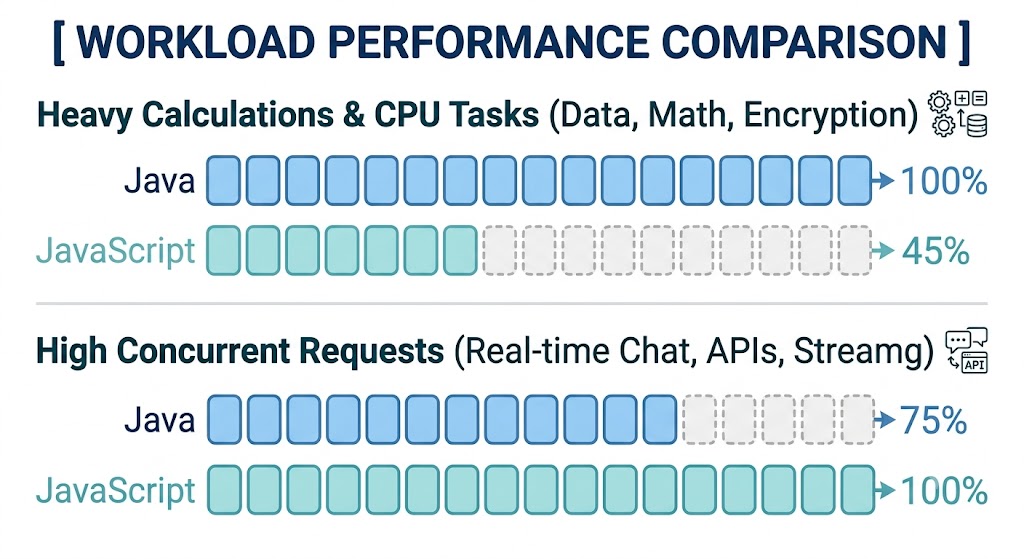
Java excels in raw computational power, CPU-bound tasks, heavy math calculations, and parallel processing. Its Just-In-Time compiler optimizes bytecode down to native code instructions, allowing it to complete heavy computational workloads rapidly.
JavaScript shines in input/output (I/O) bound operations, real-time applications, and asynchronous web tasks. Node.js handles tens of thousands of concurrent client API connections with minimal CPU overhead by leveraging non-blocking execution.
For early-stage startups building Minimum Viable Products (MVPs), JavaScript offers faster overall development speed. Teams build full web interfaces using a single development team, speeding up time-to-market significantly.
Ecosystems, Libraries, and Frameworks
Both technologies feature vast, active developer communities and mature ecosystems.
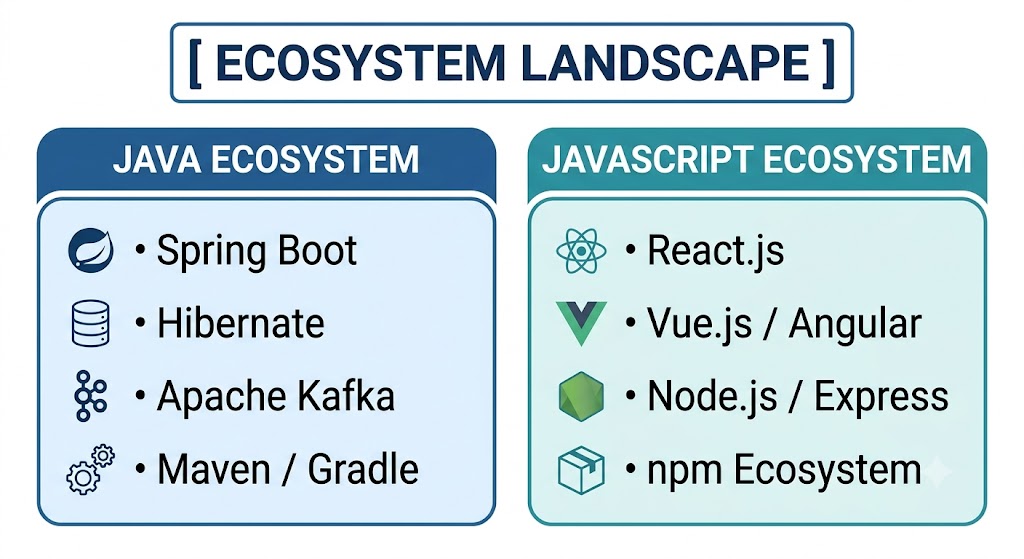
The Java Ecosystem
Java relies on battle-tested frameworks designed to manage complex infrastructure, database transactions, and high-security systems:
- Spring Boot: The dominant Java framework for enterprise backend APIs, microservices, and web services.
- Hibernate: An object-relational mapping (ORM) framework that simplifies database interactions.
- Apache Kafka & Spark: Tools built for streaming real-time data pipelines and processing huge analytical workloads.
- Maven & Gradle: Powerful build automation tools that manage complex software dependencies.
The JavaScript Ecosystem
JavaScript houses the largest software library registry in the world via npm (Node Package Manager):
- React, Vue, Angular: Premier frontend frameworks for constructing modular single-page web applications.
- Node.js & Express: Lightweight environments for creating scalable server APIs.
- Next.js: A full-stack React framework optimized for server-side rendering and search engine indexing.
- React Native: A cross-platform framework that compiles JavaScript code into native mobile applications for iOS and Android.
Career Paths, Salary Expectations, and Industry Demand
Both options offer excellent, high-demand career paths across the software development industry.
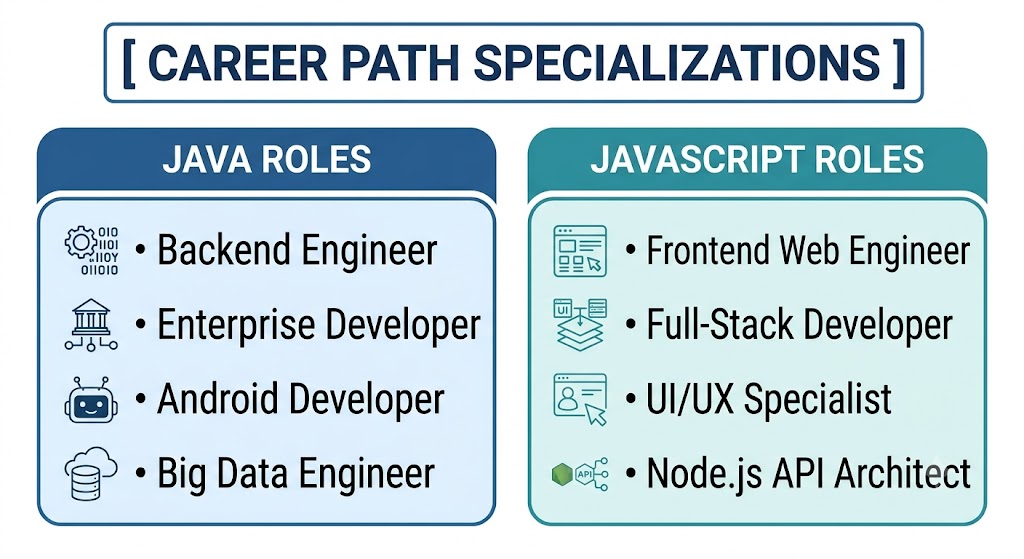
Java developers often work with large corporations, financial institutions, insurance conglomerates, and cloud infrastructure companies. Common job titles include:
- Enterprise Java Engineer
- Backend Systems Architect
- Android Application Developer
- Big Data Engineer
JavaScript developers work across startups, digital marketing agencies, SaaS companies, and full-stack software teams. Typical roles include:
- Frontend Developer
- Full-Stack JavaScript Engineer (MERN / MEAN Stack)
- Web UI/UX Engineer
- Node.js Backend Developer
JavaScript frequently holds the top spot for overall language usage among professional developers. Meanwhile, Java consistently ranks among the top languages for high-salaried enterprise backend roles.
When Should You Choose Java vs JavaScript?
Choose Java if you are:
- Building complex enterprise software that requires tight security and transaction reliability.
- Developing native Android applications.
- Designing microservices that handle complex data transformations or high-CPU computations.
- Constructing data processing pipelines that integrate with tools like Hadoop or Spark.
- Working in traditional corporate environments, insurance platforms, or banking institutions.
Choose JavaScript if you are:
- Building dynamic modern websites or client-side user interfaces.
- Creating lightweight real-time apps like messaging platforms, streaming sites, or collaborative whiteboards.
- Developing full-stack applications using a single language for front and back end.
- Launching a web startup that requires rapid prototyping and fast release cycles.
- Targeting cross-platform deployment across browsers, mobile devices, and desktop systems.
Conclusion
While Java and JavaScript share part of a name, they serve completely different software engineering roles. Java provides the disciplined, compiled, and statically typed structure required for high-performance enterprise systems, banking platforms, and native Android applications. JavaScript provides the dynamic, flexible, and interactive foundation that runs every web browser on Earth, along with scalable full-stack Node.js backends.
Neither language is inherently superior to the other. Software teams often combine both tools: leveraging Java to run heavy core backend infrastructure and using JavaScript to power user-facing interfaces. Understanding these differences ensures you select the optimal tool for your development project or career path.
Frequently Asked Questions
Is Java harder to learn than JavaScript?
Yes, Java generally presents a steeper learning curve for complete beginners. You must understand strict Object-Oriented concepts, data types, class structures, and compilation tools right from day one. JavaScript offers a gentler entry point because you can write functional code directly inside any web browser console without pre-compiling.
Does JavaScript require Java to run?
No, JavaScript does not depend on Java in any way. They are completely separate software products built on distinct engines. JavaScript runs independently on web engines like V8 or SpiderMonkey.
Can you use Java for frontend web development?
While historical tools like Java Applets existed years ago, modern browsers no longer support them. Today, web developers rely almost entirely on JavaScript (or TypeScript) for client-side frontend browser execution.
Which language is better for building web backends?
Both excel depending on your software architecture. Java with Spring Boot is ideal for large-scale, highly structured enterprise applications that handle complex calculations. JavaScript with Node.js is ideal for fast, event-driven microservices, real-time messaging apps, and rapid API development.