For growing businesses, the choice between Pipedrive vs HubSpot is pivotal, as it can either impede revenue growth, cause costs to rise or hinder the process if done incorrectly.
In today’s day and age, CRM software has undergone a huge transformation from merely keeping customer contact details. Today, CRM systems are used to manage sales processes, automate follow-up efforts, follow customer interactions, create reports and reports, and, more recently, leverage AI in decision-making. The consistent contenders in the shortlists are Pipedrive and HubSpot.
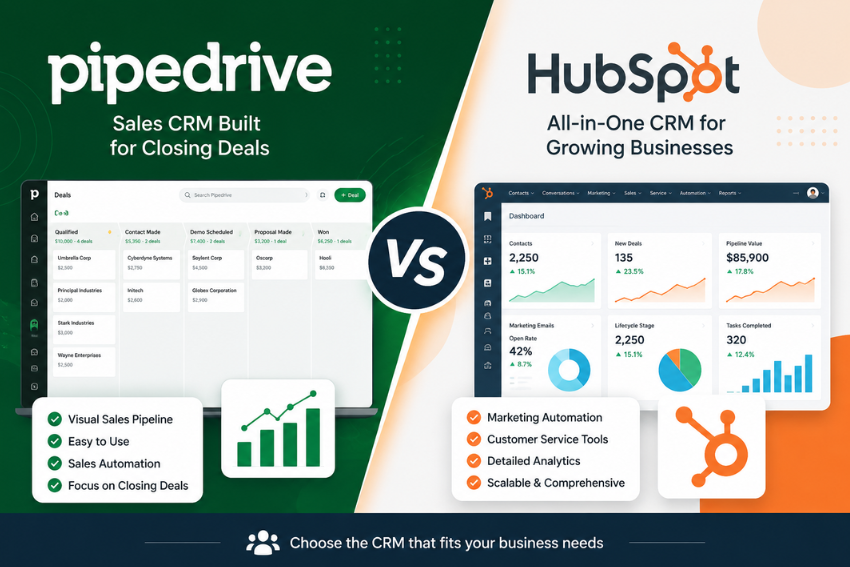
On the surface, they appear to be the same. Both are used for lead and close management. Both provide automation, integrations and reporting. Their philosophies are vastly different, however.
Pipedrive was designed to be a sales execution platform. HubSpot went from inbound marketing to a customer platform.
So, which one is it really for your business?
This guide does a comparison of both platforms based on pricing, usability, automation, integrations, scalability and real-life business scenarios.
Understanding Modern CRM Requirements
Adopting a CRM today is a bit like picking an operating system for your business. Switching in the middle of the game can be costly as well as disruptive. Businesses should consider not only their current needs but also their future plans, which is why it is essential to consider their future plans.
A CRM is used by the business in almost every customer interaction now. It is used by sales representatives for deal movement. Attribution and Segmentation are crucial to Marketing Teams. Leadership demands forecasting and dashboards.
If your organization primarily requires cleaner deal management and quicker sales execution, then complexity can end up being a burden. If your company is using content marketing, lifecycle automation, and service operations, then a small CRM can cause an issue down the road.
That difference is the crux of the Pipedrive vs HubSpot debate.
Pipedrive vs HubSpot: Quick Overview
What Makes Pipedrive Different
Pipedrive focuses on helping sales teams move opportunities from first contact to closed deal quickly. Its interface revolves around visual pipelines and activity driven selling. Users often describe it as easier to adopt because it keeps attention on daily sales execution rather than broad platform administration.
The platform emphasizes:
- Visual pipeline management
- Deal tracking
- Email synchronization
- Workflow automation
- Sales forecasting
- AI assisted selling
Pipedrive generally appeals to organizations that want sales productivity first.
What Makes HubSpot Different
HubSpot approaches CRM from a wider business perspective. Instead of focusing only on sales, it combines CRM, marketing, customer service, operations, content, and automation under one environment. HubSpot also maintains a free CRM tier that remains attractive for startups and growing teams.
Core strengths include:
- CRM functionality
- Marketing automation
- Customer service workflows
- Content and campaign tracking
- Attribution reporting
- Unified customer data
HubSpot becomes attractive when multiple departments need shared visibility.
Pipedrive vs HubSpot at a Glance
| Category | Pipedrive | HubSpot |
|---|---|---|
| Best For | Sales focused teams | All in one growth teams |
| Starting Price | Around $14 per user monthly | Free plan available |
| Ease of Use | Excellent | Very Good |
| Pipeline Management | Excellent | Strong |
| Marketing Tools | Limited | Excellent |
| Automation | Strong | Advanced |
| Integrations | Extensive | Very Extensive |
| Learning Curve | Low | Medium |
| Scalability | Good | Excellent |
Pricing and capabilities vary by plan and region.
Pipedrive vs HubSpot: Pricing Comparison
Price influences CRM decisions more than most businesses admit.
Entry Level Costs
HubSpot immediately attracts attention because of its free CRM tier. Businesses can begin without upfront software investment and upgrade later. Starter pricing remains approachable for smaller teams.
Pipedrive starts with paid plans but offers predictable user-based pricing from the beginning. That simplicity appeals to sales leaders who dislike layered pricing structures.
Scaling Costs
This is where things change.
As companies expand usage across marketing, service, and advanced automation, HubSpot pricing can rise significantly depending on seats, hubs, and contact volume. Community discussions frequently mention monitoring expansion costs carefully.
Pipedrive typically remains more predictable at scale for sales teams because its structure stays closer to user licensing.
If budget certainty matters most, Pipedrive often wins.
If platform consolidation matters more, HubSpot may justify higher costs.
Ease of Use and Adoption
Software only works if people actually use it.
Pipedrive earns strong praise for usability because sales reps can understand the workflow almost immediately. Drag deals. Schedule follow ups. Track movement. Repeat. That simplicity reduces onboarding friction and accelerates adoption.
HubSpot offers a polished interface too, but because the platform extends across multiple functions, administrators often need more setup and governance.
For organizations with limited operations resources, this difference matters.
A CRM with fewer features but stronger usage frequently outperforms a sophisticated system nobody updates.
Sales Pipeline Management
Sales execution is where Pipedrive shines.
Its pipeline experience feels purpose built for moving deals through stages. Teams gain visibility into stalled opportunities, upcoming activities, and conversion patterns.
Features include:
- Drag and drop pipelines
- Deal stage automation
- Activity reminders
- Forecasting
- Email tracking
- AI recommendations
HubSpot includes capable pipeline functionality but balances it alongside broader customer lifecycle management.
If your sales team spends all day inside the CRM, Pipedrive often feels faster.
Marketing Capabilities
This category creates the clearest separation.
HubSpot was born from inbound marketing and still dominates in this area.
Capabilities include:
- Email campaigns
- Landing pages
- Lead nurturing
- Campaign attribution
- Contact segmentation
- Marketing analytics
Businesses that generate leads through SEO, paid media, and content marketing benefit from this unified approach.
Pipedrive supports marketing workflows but does not attempt to replace dedicated marketing platforms.
If marketing drives revenue, HubSpot becomes difficult to ignore.
Automation Features
Automation determines how efficiently teams’ scale.
HubSpot enables workflow creation across departments with triggers, reporting, lifecycle actions, and communications. Higher tiers unlock more advanced capabilities.
Pipedrive focuses automation more tightly around sales execution.
Examples include:
- Automated deal movement
- Follow up reminders
- Task creation
- Activity scheduling
- AI insights
Businesses seeking operational automation across departments generally prefer HubSpot.
Teams seeking sales acceleration often prefer Pipedrive.
Reporting and Analytics
Data without interpretation becomes noise.
HubSpot delivers extensive reporting capabilities that connect marketing, sales, and customer activity. Leaders gain broader visibility into customer acquisition and lifecycle performance.
Pipedrive offers reporting optimized for sales outcomes.
Questions it answers well:
- Which deals are closing?
- Which reps perform best?
- Where do opportunities stall?
- What revenue is expected?
If executives want a companywide view, HubSpot has the advantage.
AI Features
AI now influences CRM buying decisions.
HubSpot introduced AI capabilities that support prospecting, content creation, lead qualification, and automation workflows.
Pipedrive invested heavily in AI through sales-oriented experiences such as deal recommendations, workflow assistance, enrichment, and predictive support.
Think of the difference this way:
HubSpot uses AI to support the customer lifecycle.
Pipedrive uses AI to help reps sell faster.
Integrations and Ecosystem
No CRM exists in isolation.
HubSpot maintains one of the largest ecosystems and frequently reduces dependency on separate tools through native functionality.
Pipedrive supports hundreds of integrations and connects smoothly with common productivity systems.
If your stack already includes multiple specialized tools, Pipedrive fits naturally.
If you want fewer platforms overall, HubSpot becomes attractive.
Customer Support and Learning Resources
Support quality often becomes visible only after implementation.
HubSpot invests heavily in educational resources and onboarding experiences. Knowledge bases, learning paths, and certification content help accelerate adoption.
Pipedrive emphasizes simplicity and guided onboarding.
Organizations with lean internal teams may appreciate easier deployment.
Best CRM by Business Size
The right CRM depends heavily on company size, internal processes, and long-term growth goals. A platform that works perfectly for a five-person sales team may become restrictive for a company managing marketing, service, and revenue operations across multiple departments. Instead of choosing based on popularity alone, evaluate how each CRM supports your current workflows and where your business expects to be in the next two to three years.
Startups
Startups typically prioritize affordability, quick setup, and flexibility.
Choose HubSpot if:
- You want to start with a free CRM
- Marketing and lead generation are major growth channels
- You need contact management and automation in one place
Choose Pipedrive if:
- Closing deals quickly is the main objective
- Your team prefers a simple sales workflow
- Fast onboarding matters more than advanced functionality
For early-stage companies, ease of adoption often matters more than having every possible feature.
SMBs
Small and medium sized businesses usually need a balance between operational efficiency and budget control.
- Choose Pipedrive when sales performance and pipeline visibility drive revenue growth. Its straightforward interface helps teams stay productive without requiring dedicated CRM administrators.
- Choose HubSpot when multiple departments need shared customer data and coordinated campaigns. Businesses investing in content marketing, lead nurturing, and customer retention often benefit from HubSpot’s broader ecosystem.
Mid-Market Teams
As businesses grow, CRM requirements become more complex. Reporting, automation, integrations, and cross functional collaboration start carrying more weight.
- HubSpot often becomes the stronger choice for organizations looking to unify sales, marketing, customer support, and operations into one connected platform.
- Pipedrive remains highly effective for larger sales organizations that want streamlined pipeline management without adding unnecessary complexity.
The best choice at this stage depends less on team size and more on how connected your customer journey needs to become.
Real World Decision Framework
Ask these five questions:
- Does marketing generate most opportunities?
- Will support teams use CRM data?
- How complex are workflows?
- What budget growth is acceptable?
- How quickly must adoption happen?
If you answered yes mostly to growth, marketing, and centralization, choose HubSpot.
If you answered yes mostly to speed, pipeline clarity, and sales productivity, choose Pipedrive.
Final Verdict
Pipedrive and HubSpot are not trying to solve the exact same problem.
- Choose Pipedrive if you want a focused, intuitive sales CRM that gets reps productive quickly and keeps costs predictable.
- Choose HubSpot if you want a broader customer platform that connects sales, marketing, service, and automation under one system.
- For pure sales performance, Pipedrive remains one of the strongest options.
- For building a connected growth engine, HubSpot often delivers more long-term flexibility.
The right CRM is not the one with the longest feature list. It is the one your team actually uses every day.
FAQs
Is Pipedrive better than HubSpot?
Pipedrive is better for sales focused organizations. HubSpot is better for businesses needing marketing and customer lifecycle capabilities.
Is HubSpot really free?
HubSpot offers a free CRM tier with useful features, though advanced functionality requires paid upgrades.
Which CRM is easier to use?
Pipedrive is generally considered easier for sales teams due to its visual workflow and simpler setup.
Can small businesses use HubSpot?
Yes. Many startups and SMBs begin with HubSpot because of the free entry point.
Which CRM scales better?
HubSpot usually scales more broadly across departments, while Pipedrive scales efficiently inside sales operations.