By prioritizing practical skills over traditional qualifications, skills-based hiring has revolutionized the way organizations recruit, hire and retain the very best talent. With the changing nature of industries and the changing nature of the jobs that are being pursued, companies are finding demonstrated skills are a better sign of job performance than degrees or years of experience. It is a contemporary hiring strategy that assists employers to expand their talent pools, enhance hiring results, and construct more flexible groups.
In this article, we will discuss the significance of skills-based hiring, its advantages, and some best practices to ensure the successful application of this approach.
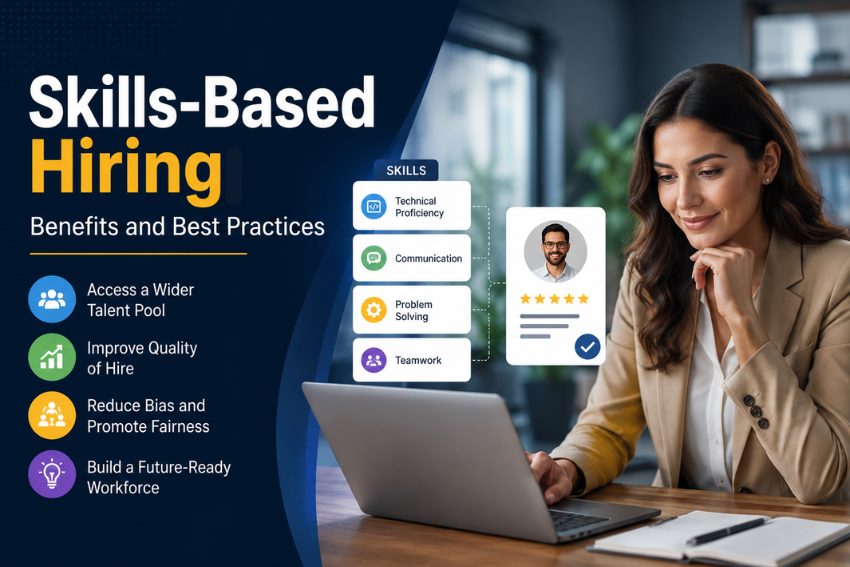
What is Skills-Based Hiring?
Think of it this way. Two candidates apply for the same role. One has a well-known degree and a tidy career progression. The other dropped out, freelanced for three years, built a portfolio, earned some certifications, and can demonstrate exactly the skills the job demands. Traditional hiring filters out the second person before anyone speaks to them. Skills-based hiring puts them in the same room.
The idea is to evaluate what someone can genuinely do – not to make inferences based on what school they attended or which companies previously employed them. Technical skills, problem-solving ability, communication, adaptability – these become the real criteria, defined specifically for each role and assessed as directly as possible.
It sounds obvious when you say it out loud. The surprising thing is how rarely it was actually practiced.
Why Skills-Based Hiring Is Gaining Popularity
Partly it’s necessity. In technology, healthcare, cybersecurity, and data roles, there simply aren’t enough candidates who clear traditional bars to fill the demand. Organizations facing genuine talent shortages have had to rethink what those bars are actually measuring – and in many cases, they’ve discovered the bars weren’t measuring job performance as much as they assumed.
There’s also the credential shelf-life problem. A degree earned five or six years ago in a fast-moving field increasingly tells you less about current capability than it once did. The person who’s been learning continuously through hands-on work, self-directed study, and real projects may be far more current – and never gets surfaced because a filter removed them in the first pass.
Both pressures point in the same direction: look at what people can do, not just where they’ve been.
Benefits of Skills-Based Hiring
Access to a Wider Talent Pool
When organizations remove requirements that were never truly connected to job performance, the candidate pool changes noticeably. People who built expertise through boot camps, contract work, open-source projects, or years of self-teaching start appearing – people who were always capable but were being filtered out by criteria that didn’t actually predict their success.
In competitive hiring markets, this matters more than it might seem. The companies consistently finding strong candidates are often simply looking in places their competitors aren’t – or partnering with the right recruitment agency for startups and growing teams that already understands skills-first evaluation. The best recruitment agency for startups knows that early-stage companies can’t afford credential-based guesswork; they need people who can actually deliver from week one.
Improved Job Performance
Hiring someone because they demonstrated a skill produces better alignment than hiring someone because their background suggested they might have it. That’s not a complicated insight, but it has real downstream effects – faster onboarding, stronger early results, and better retention because both sides had a clearer picture of what they were agreeing to.
When the evaluation is grounded in actual capability, the gap between expectation and reality tends to shrink. That gap is where a lot of expensive mis-hires live.
Increased Workforce Diversity
This one is worth being direct about. Degree requirements often function as socioeconomic filters. They don’t intend to – but they do. First-generation college students, people from under-resourced communities, career changers who couldn’t afford to go back to school – many of them develop genuine competence through routes that traditional hiring never surfaces.
Removing barriers that aren’t connected to job performance doesn’t lower standards. It redirects them toward what actually matters. The diversity that tends to follow – in backgrounds, perspectives, and problem-solving approaches – usually strengthens teams rather than weakening them.
Better Adaptability for Future Roles
Specific technical skills go stale. The ability to learn, adapt, and transfer knowledge across changing contexts doesn’t. When skills-based hiring is done well, it surfaces candidates with genuine learning agility – people who don’t just know how to do the current job but who will figure out the next one as requirements evolve. Over a two- or three-year horizon, that quality often matters more than any specific technical proficiency.
Best Practices for Implementing Skills-Based Hiring
Define Skills Clearly
Before you can hire for skills, you need honest clarity on which skills actually matter – not a carried-forward list from the last job description, but a genuine analysis of what the work requires day to day.
This includes the obvious technical competencies and the less obvious interpersonal ones. How much does clear communication matter in this role? What about collaboration under pressure, or the ability to exercise judgment without much direction? Getting specific here makes the entire evaluation process more consistent – and more defensible when decisions get questioned.
Use Skills Assessments Thoughtfully
A well-designed work sample or case study reveals things that no interview reaches. It shows how someone actually thinks through a problem, not how they narrate their experience with similar ones. Portfolio reviews, simulations, and role-specific exercises can all do real work in an evaluation process.
The key word is “thoughtfully.” Assessments that take several unpaid hours to complete tend to filter out people who have options – often the exact candidates you’re most trying to attract. Keep them focused, make them mirror actual job tasks, and respect candidates’ time. An overly burdensome assessment process says something about your organization that you probably don’t intend to say.
Reevaluate Job Descriptions
Most job descriptions weren’t designed – they accumulated. Requirements got added over years without anyone stopping to ask whether they still made sense. Degree requirements in particular tend to persist through sheer inertia.
Go through them deliberately. For each requirement, genuinely ask: does removing this make it harder to identify someone who can do the job well? If the honest answer is no, remove it. You’re not relaxing standards – you’re clarifying what your standards are actually for.
Train Hiring Managers
A well-designed process still fails if the people making decisions haven’t shifted how they think. Hiring managers who’ve spent years pattern-matching on credentials – consciously or not – need practical support to evaluate competencies consistently. Structured rubrics, calibrated scoring, and regular calibration conversations across the team all help.
This isn’t about making hiring mechanical. It’s about making the judgment more accurate and less dependent on shortcuts that may never have been reliable.
Balance Skills With Potential
Complete readiness on day one isn’t the only thing worth hiring for. Some of the strongest long-term team members arrive with clear fundamentals and a demonstrated track record of figuring things out – not every skill already developed.
When evaluating candidates, it’s worth holding two questions at once: what can they do right now, and what does their trajectory suggest about where they’ll be in a year or two? Intellectual curiosity, coachability, and a genuine history of growing into new challenges deserve real weight in that evaluation.
Challenges Organizations Should Consider
Assessing skills accurately takes more effort than reviewing a resume. Some competencies – judgment, leadership instinct, emotional intelligence – are genuinely hard to evaluate objectively. There’s a real risk of building an assessment process so focused on technical execution that it misses the interpersonal qualities that often determine whether a hire actually works out long term.
Skills should be central to hiring decisions. They shouldn’t be the only thing. Good hiring has always required human judgment – skills-based approaches sharpen that judgment; they don’t replace it.
The Future of Recruitment
The direction here is fairly clear. AI-powered assessment tools are improving, workforce analytics are getting more sophisticated, and more organizations are building genuine internal capability to evaluate skills at scale. Credential-based filtering is simultaneously becoming harder to justify and less effective at finding the right people.
Companies building this capability now – the processes, the rubrics, the hiring culture – are positioning themselves better for a talent market that’s only going to get more competitive.
Final Thoughts
Underneath all the framework language, skills-based hiring is really just a return to the most honest question in recruiting: can this person do the work?
Getting that answer right – consistently, fairly, across a broad range of candidates – takes real organizational effort. Job definitions need to be clearer. Assessment processes need to be more deliberate. Hiring managers need support to shift how they evaluate people. And a lot of assumptions that have been quietly shaping decisions for years need to be examined.
Organizations that do this work seriously tend to find that the effort pays off. Broader pools, better hires, more adaptable teams – these aren’t just promises from a trend piece. They’re outcomes that follow when evaluation is genuinely grounded in capability.
The question for any organization isn’t whether skills-based hiring is a good idea. In most roles, it clearly is. The question is whether you’re willing to build it properly – or whether you’ll treat it as a branding update while leaving the actual process unchanged.