Maintaining product data quality has been an operational constraint in eCommerce since long before AI arrived. The reasons are structural. Catalogs grow by thousands of SKUs. Supplier data shows up incomplete. Every sales channel sets its own attribute requirements.
When key attributes are missing, products may fail to appear in filtered site-search results, be rejected or suppressed by marketplaces during feed validation, and convert poorly because buyers lack the details needed to purchase with confidence.
These product data quality gaps persist because manual enrichment cannot keep pace at scale. Most teams enrich their high-revenue products first and leave the much larger set of low-priority SKUs incomplete. This is less a choice than a constraint: as the catalog grows and changes, there are more products than any team can keep updated manually.
AI product data enrichment closes that gap by working at the catalog’s pace of growth. It reads supplier files, extracts the missing attribute values from them, and completes records across the whole catalog instead of a prioritized set of products. The result is a complete catalog that surfaces in site search and passes marketplace checks, without a person having to manage every SKU.
The rest of this guide covers what AI enrichment involves, where it works best, and how to use it without losing control of data accuracy.
What Is AI Product Data Enrichment?
AI product data enrichment is the use of artificial intelligence to extract, structure, classify, and complete product information. The AI suggests, derives, or generates missing values from approved inputs, such as supplier data, product images, specification sheets, existing records, and brand rules.
It does this faster and at lower cost than manual enrichment. An entire catalog can be brought up to standard in the time a team would spend on a fraction of it, and because the same automated process runs across thousands of records at once, the cost per record falls as the catalog grows.
Enrichment is frequently grouped with two other processes, though the three are not the same:
| Term | What it Actually Means |
|---|---|
| Cleansing | Fixing inaccurate values, duplicate records, and outdated information. |
| Standardization | Putting everything into a consistent format, whether it is units of measure or naming conventions. |
| Enrichment | Adding what’s missing, including attributes, content, and context. |
The distinction matters because a catalog can be clean and consistently formatted yet still incomplete, i.e., accurate titles with no material specifications or correct categories with no filterable attributes.
AI-powered enrichment fills those gaps by adding the missing product details that make catalog data more usable across commerce channels.
Where Does AI Apply in Product Data Enrichment?
AI does not apply at a single stage; it runs across the entire enrichment workflow. What changes in every stage is the tasks AI does on its own. The table below maps each stage to the work AI and automation handle and the decisions that stay with human experts:
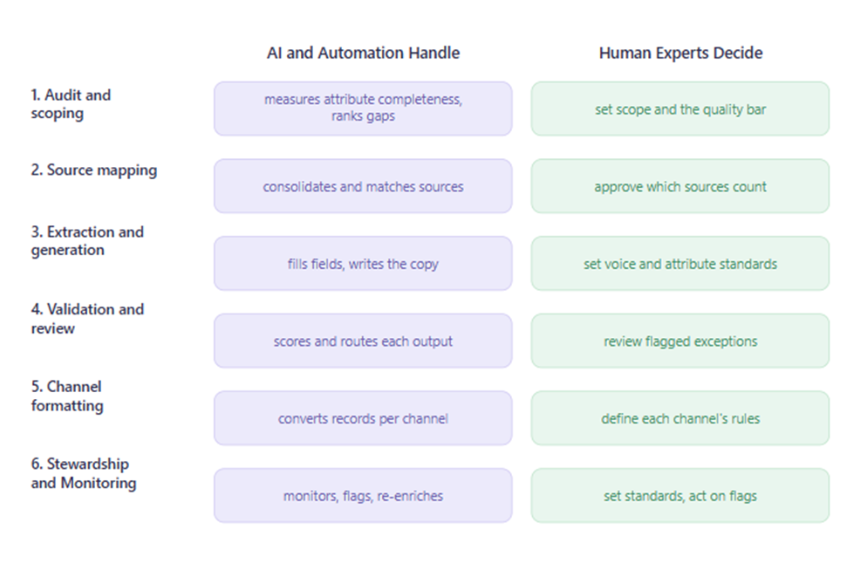
Across the six stages, AI handles the high-volume work that would otherwise slow enrichment down: reviewing records at scale, finding where data is missing, applying approved rules, producing structured outputs, and flagging anything that needs manual review.
The change for the team is what they spend their time on. Instead of inspecting every SKU manually, they set the rules, thresholds, taxonomy, and approval paths. AI works inside those limits and extracts details from existing source data. Clean, high-confidence updates move through automatically. The incomplete, ambiguous, or high-risk records are routed to human experts.
How Does AI Enrich Each Part of a Record?
Three technologies divide the work:
- Large language models, which process text
- Computer vision, the image-analysis branch of AI
- Semantic classification, which interprets what a product is from its information.
The table below shows which technology applies to each part of a product record:
| Part of the Record | AI’s Function in Data Enrichment | Technology |
|---|---|---|
| Attributes and specifications | Extracts attribute values from manufacturer/ supplier provided files, including specification sheets, manuals, scattered notes, and product images. | Language models; computer vision |
| Titles and descriptions | Generates channel-specific copy from the structured attributes, within specified length and format limits | Language models |
| Taxonomy and product categorization | Assigns each product to the correct category based on the meaning of its product information, rather than on predefined keyword rules. | Semantic classification |
| Image metadata | Generates alt text and descriptive tags from product photographs | Computer vision |
| Search metadata | Adds long-tail and intent-based keywords to backend fields | Language models |
| Semantic tags | Structures information, ensuring site search and AI shopping assistants can match natural-language queries to the right products | Semantic classification |
| Variant and relationship data | Identifies and links size and color variants, replacement parts, and compatible accessories | Semantic classification |
Together, these technologies let AI-powered data enrichment tools complete every part of a record (text, images, and category) in one automated pass.
The Business Case: What AI Product Data Enrichment Measurably Improves?
Product records with accurate, structured, and detailed information improve commerce performance in three measurable areas:
- Search visibility: Google’s Merchant Center documentation lists missing or incorrect attributes as common reasons products fail validation and are excluded from results. On the storefront side, site search and faceted filters read the same attribute fields.
- Rich results: Google’s structured data documentation confirms that product data makes listings eligible for enhanced search appearances, including price, availability, and ratings, which are shown directly on the results page.
- Conversion: 77% of shoppers say product information drives their decision, and 62% will pay more when the detail is there (GS1 US).
All three outcomes depend on the completeness of the product records. Reaching that completeness across an entire catalog is where AI offers clear advantages:
Coverage and Time To Market
AI brings the entire catalog up to a consistent standard of completeness, not just the bestsellers a manual team has time for. And because each record is complete before it goes live, channels reject fewer listings, and new SKUs publish in days rather than weeks.
Staying Up-To-Date
Channel and regulatory requirements keep changing. For example, a marketplace may add a required field, Google may change its feed requirements, or a regulation like the EU Digital Product Passport may ask for new details such as material origin and recyclability.
When that happens, records that were complete last quarter can quietly become outdated or non-compliant. Automated re-enrichment helps refresh the catalog as requirements change. A periodic manual cleanup simply cannot keep up.
Improved Visibility Across AI Shopping Assistants
Product data is no longer read-only by people. Half of consumers now use AI when shopping online. AI assistants and shopping agents select products straight from attribute data.
A record that is invisible to a search filter is just as invisible to these tools, so completeness now governs machine recommendations as much as human browsing.
These three advantages are what AI-powered data enrichment promises in principle. The case study below shows how they are delivered in practice, across a catalog of more than two million SKUs.
AI-Powered Data Enrichment in Practice
An industrial-goods reseller with more than 7,000 brands needed clean, usable records for over two million SKUs. But much of its supplier data was incomplete, pulled from scraped listings with missing descriptions, weights, and category details.
A custom GPT-4-based workflow was developed to fill in these gaps from the available source material, with every output validated by human reviewers before publication.
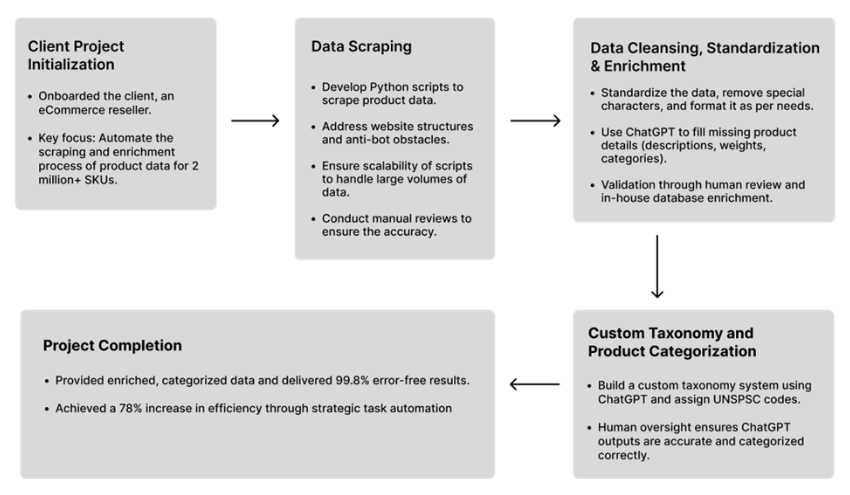
The result was a complete, consistently structured product data at a scale no team could reach with only manual efforts. The strategic task automation helped achieve 78% of process efficiency while receiving 99.8% accurate product data.
When Complete Reliance on AI for Product Data Enrichment Goes Wrong
A business may consider handing over the entire workflow to AI for the speed and cost savings. However, when the final output produced by AI goes live to a sales channel without human supervision, this reliance can go wrong.
Here are the six major risks of AI product data enrichment and how humans-in-the-loop at every stage address these issues:
| AI-Added Risks | Why It Happens | Human Checkpoint to Prevent These Risks |
|---|---|---|
| Fabricated specifications | A language model produces probable text, not retrieved facts. When source data is absent, it generates a plausible value, instead of leaving the field empty. | Reviewers handle every flagged field. Text is written only from confirmed field values; missing sources go to a person, never to the model’s imagination. |
| Wrong category assignment | An AI model trained on general data can place niche or non-standard products into broad or adjacent categories, where they no longer appear in category browsing and faceted search. | Any category the model is unsure of is routed to a person, who checks it against the channel’s taxonomy and the product’s nature. |
| Plausible but ineligible data | A model has no built-in knowledge of which product attributes a marketplace requires or which values it will accept. The output can read well and still get the listing rejected. | Human specialists define the channel’s validation rules (allowed values, formats, and required fields), and every record is checked against them before publication. |
| Compliance exposure | Generated text can include claims that the product was never tested for, such as certifications, safety ratings, and health benefits. In regulated categories, that risks legal proceedings, not just a copy error. | Regulated categories go to human review regardless of how confidently the AI tool responds. |
| Generic AI product descriptions | When many brands rely on the same AI models and default prompts, all descriptions sound alike. Shoppers see the same phrasing they have already read on five other sites, and search engines see nothing worth ranking one listing over another. | An editor rewrites anything that sounds generic, checks the facts, and adds the detail the model may miss out on, such as how the product is actually used. |
| Errors at scale | Automation multiplies whatever it is given. One faulty enrichment rule replicates across thousands of SKUs in a single publish. | Experts roll out the work in stages. They move to the next category only after they have reviewed the accuracy and consistency of the previous batch. |
These challenges do not mean AI has no place in product data enrichment. They simply show that AI works best when human experts stay involved.
Is AI Product Data Enrichment Right for Your Business?
Whether AI product data enrichment is worth adopting depends on the scale and complexity of your catalog. The economics shift when any of these situations become true:
- Your catalog grows past a few hundred SKUs.
- When you sell across multiple channels, such as Amazon and Google Shopping, you have a separate storefront, and each requires different attributes.
- Supplier data often comes in or changes faster than your team can keep up with.
When several of these apply, adopting AI for data enrichment becomes the practical choice. Here’s how you can integrate AI into your product data enrichment workflow:
Platform-native AI
Now, many Product Information Management (PIM) software come with default data enrichment features. If you are a brand already using such PIM or feed-management platforms, this is often the easiest starting point because the AI works within the existing data model. You won’t need to invest in a separate integration.
However, the platform may still evolve on the vendor’s timeline, and a feature designed for broad use may not support the specific attributes a niche category your brand might need.
In-house Development
A business can create its own data enrichment system using language model APIs, with custom data pipelines and integrations with the catalog. This fits brands with category knowledge and sustained volume. The real challenge is to maintain and update this system, as the channel rules, AI models, and prompts change constantly.
Service Provider
A managed eCommerce product data enrichment service runs the entire enrichment workflow for you. It covers every stage, from auditing the catalog to channel-specific formatting and human review, and includes bulk enrichment for large catalogs.
This route is for brands where enrichment never really stops. Think large catalogs, several marketplaces with conflicting data rules, and no spare time to build a pipeline, let alone maintain one.
The service provider updates and maintains the AI models and prompts and stays updated with the channel rules, which gives them the capability to scale as your catalog grows.
Test AI-Enrichment on One Product Category
Do not roll AI product data enrichment across the whole catalog on day one. Start with one category. Test it on your own data and see whether the gain is big enough to scale.
Choose a category that drives revenue but also contains data gaps (missing attributes, thin product descriptions, products not appearing in filtered searches, etc.). As you begin data enrichment, record baseline metrics such as:
- Attribute fill rate
- Site-search conversion
- Return rate
- Number of SKUs rejected by sales channels
Then enrich that category with the right safeguards in place. Send regulated claims and uncertain outputs to human review. Publish your product listing in phases, and if source data is missing, flag it for sourcing.
Post the 30-45 day period, compare your results against the baseline. If the enriched category shows better:
- Discoverability
- Channel acceptance
- Conversion signals
…then expand the same process to more categories.
With a focused pilot, your brand can find out whether AI product data enrichment is working, human review is required, and the standards it needs to set for any updates to the catalog in the future.
Only when you have tested it out on one category will you have the confidence to integrate AI into your enrichment workflow for the entire catalog.