The Debt Snowball vs Debt Avalanche topic is one of the biggest stopping points or choices for anyone who is seeking to get out of debt. Both methods offer a path to get out of the red—one’s different. One is on feelings and actions. These other hits will bite you in the wallet with numbers. So, which one is better for real people who have to pay their credit card bills, student loans, car payments, etc.?
Let me tell you this, no bullshit, just real practical tips from someone who has successfully helped many clients pay off thousands of dollars in debt.
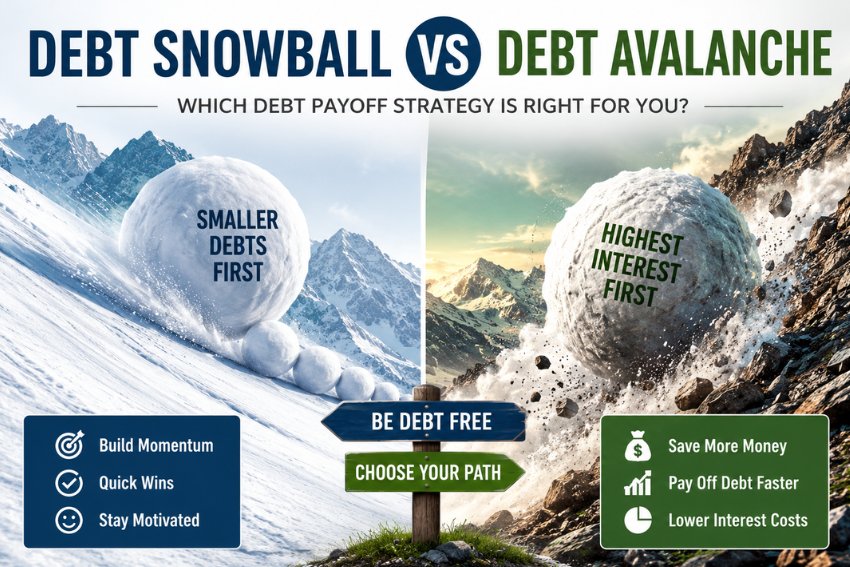
What is the Debt Snowball Method?
The debt snowball method is based on human nature. You write all the debts from the smallest to the largest, with interest rates totally ignored. You then pay minimum payments on your large debt and use all your extra money to pay off your small debt. After paying off the smallest debt, add its amount to the next smallest debt. The concept is that the quick wins keep you motivated.
Here is how it works step by step:
- List all debts from lowest balance to highest balance.
- Make minimum payments on every debt except the smallest one.
- Put every spare dollar toward wiping out that smallest balance.
- Celebrate the win when you pay it off.
- Move that entire payment amount to the next smallest debt.
- Repeat until you have zero debt left.
For example, say you owe $500 on a store card, $2,000 on a credit card, and $10,000 on a personal loan. The snowball method tells you to kill that $500 store card first, even if its interest rate sits at 0%. You get a psychological rush from closing out an account fast, and that rush pushes you to keep going.
What is the Debt Avalanche Method?
The debt avalanche method is the logical, numbers driven cousin in this Debt Snowball vs Debt Avalanche matchup. You do not consider balances; you sort your debts by annual percentage rate (APR) from highest to lowest. You pay off the debt that has the highest interest rate first and the minimum amount on the other debts. This is the easiest way to save money over the long haul, as a high interest rate will work against you.
Here is the avalanche method in plain steps:
- List every debt from highest interest rate down to lowest.
- Pay only the minimum on all debts except the highest rate one.
- Pour all extra cash into that high interest debt until it disappears.
- Then shift your focus to the next highest rate debt.
- Continue the process until you finish the entire list.
Let us reuse the same example. You have $500 at 0%, $2,000 at 22%, and $10,000 at 15%. The avalanche method says ignore that tiny $500 debt completely. Go after the $2,000 credit card at 22% first. That aggressive interest costs you real money every single month. Paying it down fast saves you far more than celebrating a small balance payoff.
Key Differences Between Debt Snowball and Debt Avalanche
Now that you understand the basics, let me highlight the major differences that actually matter for your wallet and your sanity.
| Feature | Debt Snowball | Debt Avalanche |
|---|---|---|
| Ordering Method | Sort debts from smallest balance to largest balance | Sort debts from highest interest rate to lowest interest rate |
| Primary Focus | Emotional wins and quick motivation | Mathematical efficiency and saving money |
| First Debt Payoff | Usually happens within weeks or a few months | Can take many months if the highest rate debt also has a large balance |
| Total Interest Paid | Higher overall interest cost | Lowest possible total interest |
| Time to Debt Freedom | Potentially longer due to ignoring high interest rates | Fastest mathematically (same payment amount assumed) |
| Complexity | Very simple; no need to track rate changes | Requires monitoring interest rates, especially on variable debt |
| Best For | People who need psychological momentum to stay on track | Disciplined individuals who can delay gratification for maximum savings |
| Risk of Quitting | Low; early wins build confidence and habit | Higher; slow visible progress can cause burnout |
The Psychological Edge of Debt Snowball
Here is a unique insight most financial experts miss. The debt snowball method hijacks your brain’s reward system in a way that sheer logic cannot match. Every time you pay off a debt, your brain releases dopamine, that feel good chemical. When you score a win early and often, you build a streak. And humans hate breaking streaks. I have seen clients transform from overwhelmed spenders into debt crushing machines simply because they tasted success within the first month.
Think about it. If you have four credit cards with balances of $300, $1,500, $4,000, and $7,000, the snowball method lets you wipe out that first $300 debt in maybe two weeks of side hustling. You feel invincible. Then you go after the $1,500 with renewed energy. The avalanche method would make you tackle the highest interest debt, which might be that $7,000 card at 24%. Imagine staring at a $7,000 mountain for months with no mini victories. Most people give up. They miss a payment, then another, then they slide back into old habits.
The Mathematical Superiority of Debt Avalanche
Numbers do not lie. The debt avalanche method will save you the most money. Period. A 25% credit card debt will grow by 25% per year each time you make a payment. Spend that same dollar on a 5% student loan and you just save 5% interest. A difference of thousands of dollars can make a difference in two or three years.
Think about a real-life situation. You carry $5,000 on a card at 22%, $10,000 on a card at 18%, and $2,000 on a medical bill at 0%. Minimum payment is $400 per month and you have a budget to pay $300 more per month. The avalanche method first takes the $5,000 at 22%, then the $10,000 at 18%, and finally the medical bill. The total interest paid is approximately $1,800. The snowball method is to pay off the lowest balance (the $2,000 medical expense), then the next lowest, the $5,000, and so on, until the $10,000 is paid off. Total interest increases to approximately $2600.00. This is the $800 cost of seeking mental profits.
Debt Snowball vs Debt Avalanche: Pros and Cons
Let me lay out the strengths and weaknesses so you can see which side of the Debt Snowball vs Debt Avalanche argument fits your life.
Snowball Pros
- Builds momentum quickly through early wins.
- Reduces the number of creditors you owe faster.
- Provides clear emotional rewards that prevent burnout.
- Works great for people with many small debts.
Snowball Cons
- Costs more in interest over the long run.
- Can keep high interest debts alive for longer.
- Feels counterintuitive to mathematically minded people.
Avalanche Pros
- Minimizes total interest paid.
- Gets you debt free the fastest in terms of time and money.
- Uses pure logic, no emotional tricks needed.
Avalanche Cons
- Requires patience because first payoff takes longer.
- Demands regular attention to interest rate changes.
- Can feel discouraging if your highest rate debt also has a huge balance.
Which One Should You Actually Choose?
Here is the truth that most bloggers will not tell you. The best method is the one you will actually stick with until the end. I have watched people start the avalanche method with perfect spreadsheet discipline, only to quit three months later when they saw zero progress. I have also watched snowball users pay off $30,000 in debt simply because the system kept them addicted to winning.
So, ask yourself these three questions before you decide.
- Have you failed to pay off debt before because you lost motivation? If yes, choose snowball.
- Do you track every dollar and love optimizing for efficiency? If yes, choose avalanche.
- Is your highest interest debt also your smallest balance? Then congratulations, both methods agree.
My professional advice after years in this industry? Start with the debt snowball if you have more than three debts or if you feel any shame or anxiety about your situation. Get those quick wins under your belt. Pay off one or two small balances in the first 60 days. Then, once you build unstoppable momentum, consider switching to the avalanche method for the remaining larger debts. This hybrid approach gives you the best of both worlds. You get the emotional fuel from early victories and the long-term savings from attacking high interest rates.
Real Life Example: Two People, Two Results
Here’s a friend of mine, Sarah and Mike. They had four separate accounts and owed $15,000 on each. Sarah decided to go the snowball route. She paid off $400 in utilities, $1,200 on a store card, $4,300 on a personal loan and $9,100 on a credit card. It took 18 months and she paid a total interest of $1,200. More important, she didn’t miss any additional payments, as each small win took her one step closer.
Mike selected the avalanche method. The most expensive loan he had was the 24% credit card balance, which amounted to $9,100. He confronted that monster for ten uninterrupted months till he was silenced. During the past 10 months, he made no more payments on other debts. He was tired, and almost quit twice. But he persevered and paid all debts in 16 months in interest of only $800. Mike saved $400 compared to Sarah, but he almost derailed his entire plan due to lack of motivation.
Who won? Both did. However, if Mike had Sarah’s personality he would have failed. But if Sarah were as disciplined as Mike, she could have saved more. The idea is to get to know yourself.
Common Mistakes to Avoid
Whichever path you pick, do not fall into these traps.
- Ignoring minimum payments.Missing a minimum payment triggers late fees and hurts your credit score. Always pay at least the minimum on every debt every month.
- Stopping your emergency fund.You need at least $1,000 set aside before you aggressively pay debt. Otherwise, one flat tire or medical bill sends you right back into borrowing.
- Closing paid off credit cards immediately.Keep them open but cut up the physical card or lock it away. Closing accounts shortens your credit history and raises your credit utilization ratio.
- Switching methods every month.Pick one and commit for at least 90 days. Jumping back and forth kills momentum and confuses your budget.
The Verdict on Debt Snowball vs Debt Avalanche
Now let’s bring this to a conclusion with a very clear message. The debt snowball method is the one that is best for changing behavior and keeping you emotionally invested. The debt avalanche method is best for financial efficiency. If you have been in debt for years and feel like you can’t catch up, begin with the snowball. Make it the first win within 30 days, then gallop it to the finish line. Go with the avalanche, save every dollar possible – if you have a steady income, a detailed budget and the patience of a monk, go with the avalanche.
You’re not looking for the perfect strategy mathematically. The ultimate objective is to be debt free. But the only way that’s going to happen is if you select a technique, and you don’t give up. Prepare your debt list, choose your fighter and get busy on paying off those debts today! You’ll be grateful to future you.