AI product catalog management is changing how online retailers, marketplaces, and brands handle thousands or even millions of product listings. You no longer need to manually type descriptions, match categories, or fix inconsistent attributes. Instead, intelligent systems take over the heavy lifting. They learn from your data, spot patterns, and automate nearly every step of catalog maintenance. This guide walks you through everything you need to know. You will learn what it is, why it matters, how to implement it, and which tools deliver real results.
Let us be honest. Managing a product catalog by hand is a nightmare. Spreadsheets get messy. Teams argue over taxonomies. Customers get frustrated when they search for “black sneakers” but find red boots. That is where AI steps in. It cleans, enriches, and optimizes your product data so your customers find exactly what they want. And you get to focus on growth instead of data entry.
What Is AI Product Catalog Management?
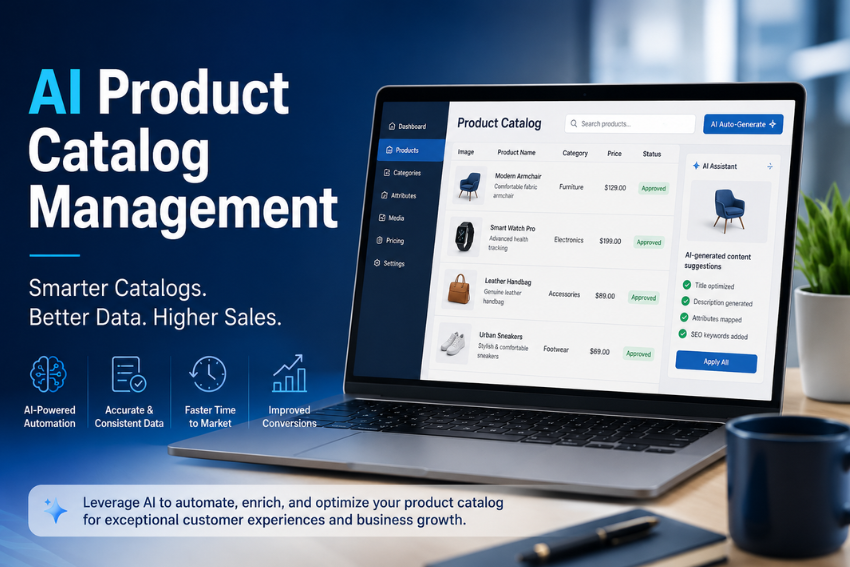
AI product catalog management uses machine learning, natural language processing, and computer vision to automate the creation, organization, and enrichment of product information. The system automatically extracts attributes from images, corrects spelling errors, maps products to the right categories, and even generates SEO friendly descriptions.
Think of it as a smart assistant that never sleeps. It scans every product entry, compares it against your rules, and suggests improvements. Over time, it learns from your corrections and becomes more accurate. You do not need to be a data scientist to use it. Most tools come with simple dashboards and one click automation.
Traditional catalog management relies on manual entry or basic bulk editing. That approach fails when you have hundreds of SKUs. With AI, you scale without adding headcount. You also reduce human errors like missing units, wrong prices, or duplicate listings.
Why Your Business Needs AI Product Catalog Management Right Now
Customer expectations have changed. Shoppers want accurate, detailed, and consistent product information across every channel. If your Amazon listing says “10 oz” but your website says “10.5 oz,” you lose trust. AI eliminates these inconsistencies.
Here are the top reasons to adopt AI product catalog management today.
- Speed up time to market: You upload raw product data, and the AI returns a complete, polished catalog in minutes instead of weeks.
- Improve search and discoverability: AI adds synonyms, long tail keywords, and related terms so your products show up for more customer queries.
- Reduce cart abandonment: Complete and accurate product details reduce uncertainty. Shoppers buy when they trust the information.
- Lower operational costs: Automate data entry, validation, and enrichment. Your team stops fixing typos and starts working on strategy.
- Enable multichannel selling: AI reformats your catalog for Amazon, eBay, Walmart, Shopify, and Google Shopping automatically.
- Catch errors before they go live: Real time validation flags missing sizes, invalid prices, or broken links.
One clothing retailer cut their catalog cleanup time from 40 hours per week to just 4 hours after implementing AI. Their product findability on site search improved by 35 percent. That is the kind of return you can expect.
How AI Powers Product Catalog Management
Behind the scenes, AI product catalog management relies on three core technologies. Let us break them down in plain English.
Natural Language Processing (NLP)
NLP reads your product titles, descriptions, and bullet points. It understands context and meaning. For example, if your title says “stainless steel water bottle 32oz,” the AI knows that “material” equals stainless steel, “capacity” equals 32 ounces, and “product type” equals water bottle. It then fills those fields automatically.
NLP also fixes grammar and spelling. It can rewrite weak descriptions to be more compelling. Some tools even generate entirely new descriptions based on a few keywords.
Computer Vision
Computer vision analyzes product images. It detects colors, shapes, patterns, and even brand logos. When you upload a photo of a handbag, the AI identifies it as a “leather tote bag” and extracts attributes like “brown,” “shoulder strap,” and “metal zipper.” You no longer need to type those details manually.
This technology works especially well for fashion, furniture, electronics, and auto parts. It also flags low quality images that hurt conversion rates.
Machine Learning
Machine learning studies your historical catalog changes and customer behavior. It learns which categories drive the most sales and which attribute combinations work best. Over time, it suggests category mappings and attribute values that improve conversion.
For example, if the system notices that “water resistant” jackets sell better than “water repellent” jackets, it will update your catalog accordingly. It also detects duplicates and merges them automatically.
Key Features to Look for in an AI Product Catalog Management Tool
Not all AI solutions are equal. When you evaluate software, focus on these features.
- Automated attribute extraction: Pulls specifications like size, weight, material, color, and brand from titles, descriptions, or images.
- Category mapping and classification: Automatically assigns each product to the right category and subcategory based on your taxonomy.
- Data validation and error detection: Flags missing required fields, mismatched units, invalid characters, and duplicate SKUs.
- Bulk enrichment: Enriches hundreds or thousands of products at once with one click.
- Multichannel syndication: Reformats and exports your catalog to different marketplaces and shopping engines.
- Real time syncing: Updates your product data across all channels instantly when you make a change.
- Image optimization: Detects low resolution images, missing alt text, and even suggests better image angles.
- SEO suggestions: Recommends keywords, meta titles, and meta descriptions that rank higher on Google.
Avoid tools that force you to build complex workflows or write code. The best solutions offer drag and drop interfaces and pre built templates for popular eCommerce platforms.
A Guide to Implementing AI Product Catalog Management
Implementing AI does not have to be difficult. Follow these steps for a smooth rollout.
Step 1: Audit Your Current Catalog
Take a hard look at your existing product data. How many products have missing descriptions? How many have inconsistent sizes or colors? Use a spreadsheet to track error rates. This audit gives you a baseline to measure improvement.
Step 2: Define Your Taxonomy
Your product categories and attributes need a clear structure. Decide on standard attribute names. For example, use “color” instead of “colour” or “shade.” Stick to consistent units like “ounces” instead of mixing “oz” and “ounce.” This consistency helps AI learn faster.
Step 3: Choose the Right Tool
Research three to five AI product catalog management platforms. Request demos and test them with a sample of 100 products. Pay attention to accuracy, speed, and ease of use. Some popular options include Plytix, Akeneo PIM with AI plugins, Saleslayer, and Catsy. Look for native connectors to your eCommerce platform.
Step 4: Clean Your Data First
Garbage in, garbage out. Run your catalog through basic cleanup before feeding it to AI. Remove duplicate rows, fix obvious spelling errors, and standardize date formats. Most AI tools have pre-processing features that help with this.
Step 5: Train the AI on Your Products
Upload your cleaned catalog and let the AI learn. It will start mapping categories and extracting attributes based on your existing data. Review its first batch of suggestions. Correct any mistakes. The system learns from each correction.
Step 6: Set Up Automation Rules
Define rules for common scenarios. For example, “If product type is t shirt, then required attributes are size, color, and material.” Or “If brand is Nike, then category must be footwear or apparel.” Rules prevent the AI from making silly guesses.
Step 7: Run a Pilot on One Category
Do not roll out to your entire catalog at once. Pick one product category with medium complexity, like kitchen gadgets or mens shoes. Run the AI on that category for two weeks. Compare error rates and time saved against your manual process.
Step 8: Monitor and Optimize
After launch, check weekly reports. How many products did the AI enrich automatically? How many corrections did your team make? Adjust your rules and retrain the model quarterly. AI product catalog management improves over time if you feed it feedback.
Common Challenges and How to Overcome Them
No technology is perfect. Here are real challenges you might face and practical solutions.
- Poor quality source data: If your original product data is a mess, AI will struggle. Solution: Run a basic data cleansing step before AI processing. Use regular expressions to fix common issues like extra spaces or inconsistent units.
- Rare or custom attributes: AI might miss unique attributes like “vintage 1970s button style.” Solution: Create custom attribute extraction rules. Most tools let you define patterns and keywords for unusual specifications.
- Multilingual catalogs: If you sell in multiple countries, translation errors happen. Solution: Use an AI tool with built in translation memory or integrate with a neural machine translation service.
- Team resistance: Your catalog team might fear job loss. Show them how AI handles repetitive tasks, freeing them up for creative work like writing better product stories. Involve them in the tool selection process.
Best Practices for Long Term Success
To get the most out of AI product catalog management, follow these best practices.
- Start small and scale gradually – Begin with one product line or one sales channel. Prove value before expanding.
- Maintain a golden record – Keep one master version of each product. AI should update that master record, and then push changes to channels.
- Run monthly quality audits – Randomly sample 50 products and manually verify attributes. Use that audit to retrain your AI model.
- Keep human oversight – Always have a human review the most expensive or high-volume products. AI handles the rest.
- Document your taxonomy changes – When you add new categories or attributes, update your AI training data accordingly.
- Measure ROI continuously – Track hours saved, error reduction, and search conversion lift. Share these metrics with leadership.
Real World Results: What Brands Achieve
Let me share some numbers from actual implementations. A home goods brand with 15,000 SKUs reduced product data errors from 12 percent to under 1 percent. Their team spent 90 percent less time on catalog cleanup. Search clicks from Google Shopping increased by 27 percent after AI optimized their product titles.
An electronics distributor used AI to enrich 50,000 products in one day. The same task used to take three full time employees two weeks. They recovered 400 hours of labor per quarter.
A fashion marketplace saw duplicate product listings drop by 85 percent after AI began detecting and merging duplicates. Customer support tickets about “wrong size shown” fell by 40 percent.
These results are not outliers. They happen when you combine clean data, a well configured AI tool, and consistent oversight.
The Future of AI Product Catalog Management
What comes next? Expect three major shifts in the next two years.
First, generative AI will write entire product listings from a single image. You snap a photo, and the system generates title, description, bullet points, and even suggested pricing. Early versions already exist, but accuracy will improve dramatically.
Second, real time attribute extraction from video will become common. Retailers will upload 360-degree product videos, and AI will extract every measurable detail automatically.
Third, predictive catalog management will emerge. AI will forecast which products will go out of stock and automatically adjust related product recommendations. It will also suggest attribute changes based on seasonal trends and competitor data.
If you start implementing AI product catalog management now, you will be ahead of most competitors. The technology is mature enough for immediate ROI, yet still early enough to give you a strategic advantage.
Final Thoughts
AI product catalog management is not a luxury anymore. It is a necessity for any business selling more than 500 products. The manual approach simply cannot keep up with customer expectations for accuracy, speed, and consistency across channels. You lose sales when product information is wrong or incomplete. You lose time when your team cleans up the same errors over and over.
Start small. Pick one category or one channel. Test an AI tool for 30 days. Compare your error rates and time spent before and after. The numbers will convince you to expand. And remember, AI works best as a partner, not a replacement. Your team brings creativity and brand voice. The AI brings speed and precision. Together, you build a product catalog that drives sales instead of frustration.
Now go audit your current catalog. The sooner you start, the faster you reclaim your time and grow your revenue.