Marketing has evolved more in the past two years than it did in the last ten years. On top of that, Gartner predicts 80% of marketing teams will run autonomous AI systems by 2030. This stat sums up the future direction perfectly. If you’re still running campaigns manually, writing every email, scheduling every post, pulling every report by hand, you’re already behind. The top AI marketing automation tools aren’t just nice-to-haves anymore. They’re the difference between a team that scales and one that burns out.
This guide breaks down the best AI marketing automation tools available right now. Whether you’re exploring AI tools for digital marketing or just trying to figure out where to start, this is for you.
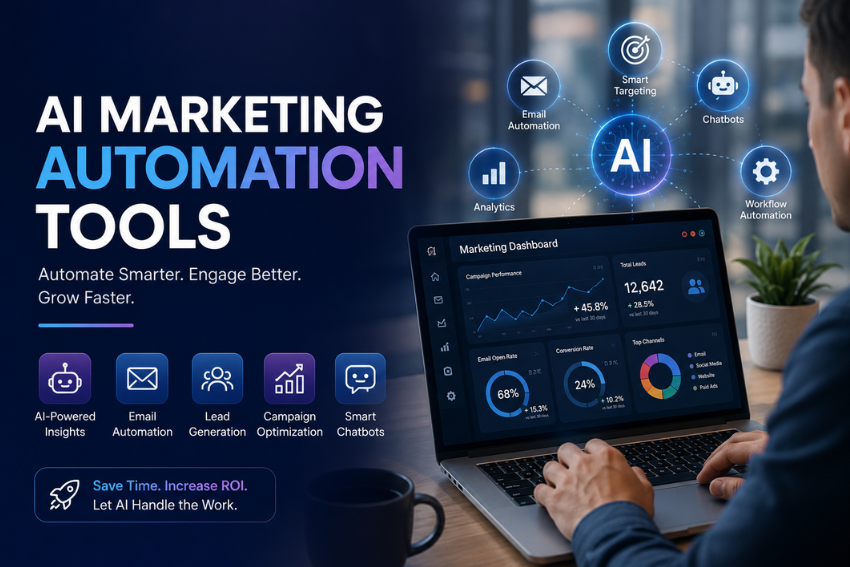
Why AI Marketing Automation is No Longer Optional
Let’s be honest. Marketing teams are being asked to do more with less. Smaller budgets, leaner headcounts, higher expectations from leadership.
AI doesn’t replace your team. It removes the stuff that was eating your team alive, the repetitive tasks, the manual segmentation, the guesswork in campaign timing.
The shift isn’t just operational either. The way consumers interact with brands has changed fundamentally. They expect personalized experiences, instant responses, and relevant messaging at every touchpoint. Delivering that manually across multiple channels is simply not sustainable for any team, regardless of size.
Here’s why marketers are making the switch:
- Automating repetitive tasks saves 6–10 hours per week per marketer
- AI personalization increases email open rates by up to 29%
- Real-time data decisions reduce wasted ad spend
- Lower cost per acquisition across paid and organic channels
The brands winning right now aren’t the ones with the biggest budgets. They’re the ones using smarter AI marketing automation tools. And those tools cost less than a single freelancer invoice.
How We Picked These Tools
Not every AI tool deserves a spot on this list. The selection came down to a few non-negotiable criteria.
First, does it actually work for marketers, not just for developers or data scientists? Second, does it integrate with tools you’re already using? Third, is there a best free ai tools for marketing tier worth mentioning for smaller teams or those just getting started?
Every tool on this list passed those filters.
Top 10 AI Marketing Automation Tools
Below are the top AI marketing automation tools to streamline campaigns, boost engagement, improve targeting, and drive faster business growth.
HubSpot AI
HubSpot has been a CRM and marketing staple for years. In 2026, its AI features have matured into something genuinely powerful, not just bolted-on gimmicks.
Best For
Mid-size to enterprise teams that want everything under one roof. HubSpot is strong when it comes to the best marketing strategy, it helps you plan campaigns, score leads, and automate nurture sequences all from one dashboard.
Key Features
- AI-powered email writer that matches your brand voice
- Smart CTAs that adapt based on visitor behavior
- Predictive lead scoring to prioritize your hottest prospects
- Workflow automation with hundreds of pre-built templates
Pricing
HubSpot has a solid free tier, making it one of the best free ai tools for marketing for teams that are just getting started or testing the waters before committing to a paid plan.
Jasper AI
Jasper is purpose-built for content. It’s the tool copywriters either love or feel threatened by, and it’s genuinely impressive at what it does.
Best For
Content marketers, agencies, and anyone producing high volumes of written content. As one of the go-to ai tools for digital marketing, Jasper handles ad copy, landing pages, blog drafts, and social content without breaking a sweat.
Key Features
- Brand voice training so content always sounds like you
- 50+ templates for every content format imaginable
- Jasper Chat for conversational content creation
- Native SEO integrations with tools like Surfer
Pricing
Jasper is a paid tool with a limited free trial. Worth the investment if content is your primary marketing channel and output volume is high.
Mailchimp (with AI Features)
Mailchimp has been around long enough to earn trust, and recent updates have made it genuinely competitive in the AI space.
This is one of the best ai tools for business for e-commerce brands and small businesses that rely on email as their primary revenue channel.
Best For
Small businesses, newsletters, and online stores that want smart email automation without a steep learning curve.
Key Features
- AI subject line optimizer that tests and improves open rates
- Send-time optimization based on individual subscriber behavior
- Audience segmentation that gets smarter over time
- Pre-built customer journey automations
Pricing
Mailchimp’s free plan is generous for smaller lists, one of the best free ai tools for marketing for solo operators and early-stage businesses.
Surfer SEO + AI
If organic search is part of your growth plan, Surfer needs to be in your toolkit.
Best For
SEO-focused content teams and agencies. Surfer is built for those who treat search as a core pillar of their overall marketing approach, not an afterthought.
Key Features
- Content score that tells you exactly how to optimize each page
- SERP analyzer that breaks down what’s working for competitors
- AI outline generator that builds content briefs in seconds
- Keyword clustering to plan topic authority across your site
Pricing
Paid plans with a limited trial. A must-have if organic traffic is a major acquisition channel and you’re playing a long-term growth game.
Zapier (AI-Powered Automations)
Zapier isn’t a marketing tool in the traditional sense, but it might be the most valuable one on this list.
Think of it as the connective tissue between every tool your marketing team uses. And with its AI features now fully mature, it’s become a genuine time-saver. It’s one of the best ai tools for business for teams running complex, multi-tool marketing operations.
Best For
Marketing ops teams, agencies managing multiple clients, and any business that has tools that don’t talk to each other natively.
Key Features
- AI Zap builder, describe what you want to automate, and it builds it
- Multi-step automations with conditional logic
- 6,000+ integrations across virtually every platform
- Automated reporting, lead routing, and CRM updates
Pricing
Zapier has a solid free tier, another one of the best free ai tools for marketing for those looking to automate without spending anything upfront.
Manychat
Conversational marketing is having a real moment right now. People want to engage, not just receive. Manychat makes that scalable.
Best For
DTC brands, coaches, course creators, and social-first businesses. Manychat sits firmly in the category of AI tools for digital marketing, automating conversations across Instagram, WhatsApp, and Facebook Messenger.
Key Features
- Visual flow builder for designing automated chat sequences
- AI-powered replies that handle common questions instantly
- Lead capture flows integrated directly into social DMs
- Drip sequences that nurture leads on autopilot
Pricing
Manychat has a free plan that covers core features ideal for businesses testing conversational marketing for the first time before scaling into paid tiers.
Canva AI (Magic Studio)
Not every marketer has a designer on call. Canva’s Magic Studio has quietly become one of the most useful AI tools for visual content creation, and the speed at which it keeps adding features is genuinely impressive.
Best For
Solo marketers, small agencies, and social media managers who need great-looking content without a full design team.
Key Features
- Magic Write for AI-generated copy inside your designs
- Text-to-image generation for custom visuals
- One-click background remover
- Brand kits that keep everything consistent across your content
Pricing
Canva’s free plan is genuinely powerful, making it one of the best free ai tools for marketing for visual content creation. The Pro tier unlocks even more AI features for a low monthly cost.
Notion AI
Notion has become the operating system for modern marketing teams. With AI built in, it’s even more powerful.
Best For
Marketing teams managing content operations, campaign planning, and cross-functional collaboration. Notion AI is particularly useful when building out a best for marketing strategy, helping teams document plans, maintain briefs, and keep campaigns aligned from start to finish.
Key Features
- AI-generated summaries of long documents and meeting notes
- Auto-fill database entries from raw information
- Action item extraction from briefs and strategy docs
- Pre-built marketing templates for campaigns, calendars, and SOPs
Pricing
Notion AI is available as an add-on to existing plans. Well worth it for teams that already live in Notion.
SEMrush AI Tools
SEMrush is a powerhouse for competitive intelligence, and its AI features have made it one of the top AI marketing automation tools for data-led campaign planning.
Best For
Digital agencies, in-house SEO teams, and anyone running performance-driven content campaigns.
Key Features
- AI writing assistant integrated directly into the content workflow
- Keyword clustering and topical authority mapping
- Competitive gap analysis that shows exactly where rivals are winning
- AI-powered content recommendations based on live SERP data
Pricing
SEMrush is a premium tool with higher pricing, but for agencies and serious content teams, the ROI justifies it quickly.
ActiveCampaign
ActiveCampaign quietly powers some of the most sophisticated email and CRM automations in the market. Trusted by over 180,000 businesses globally, it’s one of the best ai tools for business that combines depth with usability.
Best For
B2B companies, SaaS businesses, and e-commerce brands that need serious automation without the enterprise price tag.
Key Features
- Predictive content that adapts emails based on individual user behavior
- AI-powered segmentation that identifies patterns humans would miss
- Lead scoring tied directly to CRM actions and deal stages
- Deep integration with Salesforce, Shopify, WooCommerce, and more
Pricing
No permanent free plan, but a 14-day trial gives you full access to evaluate the platform before committing, plenty of time to stress-test the automations.
How to Build Your AI Marketing Stack Without Overwhelm
Here’s the honest truth, you don’t need all ten of these tools. Trying to implement everything at once is a fast track to confusion and wasted money.
Start lean. Pick the one area where your team is losing the most time right now and solve that first.
A simple 3-step approach:
- Step 1: Identify your biggest time drain, is it content creation, email, social, or reporting?
- Step 2: Pick one free tool from this list and test it for two weeks
- Step 3: Only add paid tools once you’ve seen measurable results from your free ones
It’s also worth thinking about how your tools work together. A great AI stack isn’t just a collection of individual tools. It’s an ecosystem where data and actions flow between platforms without friction. For example, Zapier connecting your lead forms to ActiveCampaign, which then triggers a personalized email sequence, is more powerful than either tool working in isolation.
The teams getting the most out of AI right now are the ones treating it as a system, not a set of disconnected experiments.
Remember, your AI marketing automation tools should serve the best marketing strategy, not replace it. AI is the engine. Strategy is still the driver.
Final Thoughts
The marketing landscape isn’t waiting for anyone. The gap between teams using AI and teams that aren’t is growing wider every quarter.
The top AI marketing automation tools covered in this guide aren’t about replacing human creativity or strategic thinking. They’re about removing the friction that stops good marketers from doing their best work.
One thing worth remembering, AI tools evolve fast. The tool that works best for your business today might be replaced by something better six months from now. Staying curious, testing regularly, and being willing to switch when something genuinely better comes along is part of the job now.
Start with one tool. Build a habit. Then layer in more as your confidence grows. The goal isn’t to have the most tools, it’s to have the right ones working together in service of a clear, intentional best for marketing strategy that actually moves your business forward.
The marketers who thrive won’t be the ones who work the hardest. They’ll be the ones who work the smartest. The tools are ready. The question is whether you are.