Agentic AI and Generative AI are two forms of Artificial intelligence. They both work similarly but with different strategies and goals. Let’s picture this to understand; imagine you walk into a futuristic workshop late at night. On one side of the room sits a brilliant artist. Give them a prompt, and within seconds they paint a masterpiece, write a poem, compose music, or design or logo. They don’t ask questions, they simply create.
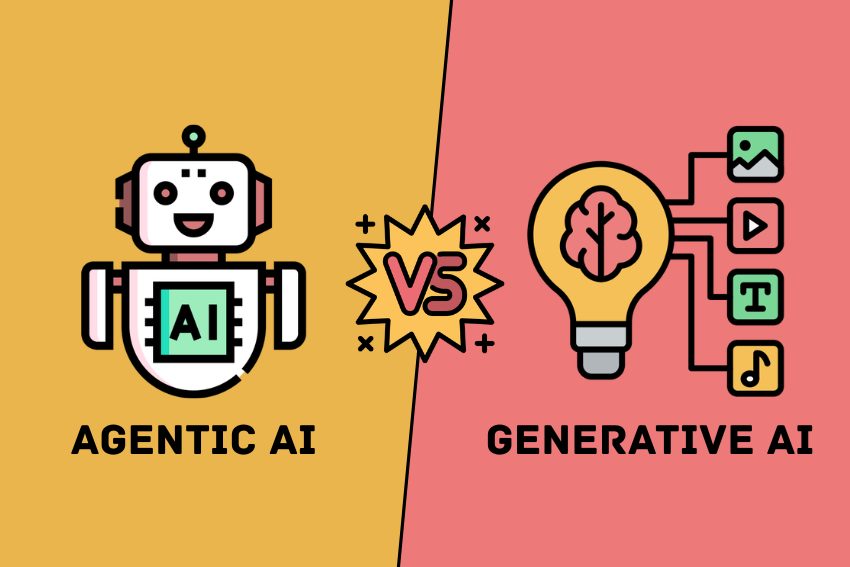
On the other hand, stands a strategic project manager. This one doesn’t just create plans, decides, checks progress, adjusts strategy, and keeps working until the goal is achieved. So, here the artist is Generative AI, and the project manager is Agentic AI.
If you are looking at how Generative AI and Agentic AI are different from each other, you have landed on the right page! In this blog we will let you walk through a comprehensive guide for Agentic AI Vs Generative AI comparison. Let’s explore!
Quick note:
- Generative AI market is going to reach USD 91.57 billion to USD 161 billion.
- Generative AI helps to create content, text-to-image, and code generation whereas, agentic AI helps to make projects with decision making.
- Features of Generative AI include content creation, reactive behavior, and no independent goals, while Agentic AI includes autonomous planning, self-monitoring.
- Creating blog posts, writing code, and creating practice questions are some use cases for Generative AI.
- Managing emails, monitoring sales performance, analyzing trends are use cases for Agentic AI.
- Multimodal models, Industry specific models, On-device AI, are generative AI trends whereas, autonomous task automation, goal-driven AI agents are some of the top Agentic AI trends.
- ChatGPT and DALL-E are top examples for Generative AI. Autonomous execution, and decision-making are some examples of Agentic AI.
Let’s move further and know how Agentic AI and Generative AI differ from each other. As, in today’s fast-moving AI development landscape, distinguishing between Gen AI and Agentic AI can help organizations build smarter, future-ready systems.
Agentic AI vs Generative AI: Quick Comparison
| Criteria | Generative AI | Agentic AI |
|---|---|---|
| Core Purpose | Creates content such as text, images, videos and code. | Works autonomously to plan, decide and complete tasks until the goal is achieved. |
| How It Works | Responds to prompts and produces creative outputs without questioning. | Breaks tasks into steps, analyzes options and executes the best actions. |
| Behavior Type | Reactive and prompt driven. | Proactive, goal oriented and adaptive. |
| Key Abilities | Content creation, fast output, creative variations, pattern learning. | Multi step planning, decision making, tool usage, adaptive behavior. |
| Examples | ChatGPT, DALL E, Midjourney. | Autonomous execution and decision-making agents. |
| Use Cases | Content writing, design, marketing, product prototyping, customer support automation. | Customer service, healthcare workflows, finance risk analysis, automated business operations. |
| Trends | Multimodal creation, personalization at scale, productivity support, better ethics and safety. | Autonomous workflows, tool chaining, long term contextual memory, enterprise adoption. |
| Primary Outcome | Help users generate creative output quickly. | Help complete tasks with minimal supervision. |
Key Difference Between Agentic AI and Generative AI
Generative AI is artificial intelligence. Generative AI helps to create image, content, video and writing code which feels complex to users. These tasks are done without questioning. They just follow your prompts and give outperforming results. ChatGPT, DALL-E, Midjourney are some of the great examples of Generative AI.
Agentic AI is a system of artificial intelligence. They are designed to autonomously make decisions and act, with the ability to pursue complex goals with limited supervision. It brings together large language models (LLMs), with accuracy of traditional programming. These models are trained by natural language processing and machine learning. Agentic AI gives results by analyzing the tasks, breaking them into points, choosing actions and continuing the tasks until they’re completed.
Overall, Agentic AI is AI that can independently plan and execute tasks to achieve a goal, while Generative AI is AI that creates. Generative AI helps to create content while Agentic AI helps to complete it.
Now, let’s move further and know the key features of Agentic AI and Generative AI.
Agentic AI vs Generative AI: Key Features
Agentic AI and Generative AI have aims and different attributes that make them unique from each other. Below we have listed some of the top features, let’s delve!
Key Features of Generative AI
Content creation
Imagine you have got a priority task to do, but also you have tomorrow’s deadline for completing your assignment. But your friend makes you familiar with ChatGPT. This will help you write a creative assignment in minutes. Generative AI turns ideas into reality. It allows you to write a prompt, and it writes stories, designs and images. Just like a digital artist.
Key benefits:
- Fast idea-to-output
- Saves writing/design time
- Boosts creativity
- Reduces repetitive work
- Supports brainstorming
Prompt-Driven
It waits for your instructions. It’s like a talented assistant, who does all your work without being delayed, without disrupting its quality. For example, you need to create a creative image for your project, you write a prompt and instantly get to work.
Key benefits:
- Easy to use
- No deep expertise needed
- Flexible for any task
- Interactive learning
- Encourages experimentation
Fast Output
It offers results in seconds, with quality. To write code, content and create images or videos this might take time to create by humans. But with Generative AI like ChatGPT, Gemini you can create in minutes without compromising its quality.
Key benefits:
- Immediate results
- Increases productivity
- Supports rapid prototyping
- Reduces project delays
- Ideal for time-sensitive tasks
Creative Variations
You can turn up your answers every time in a different way. Just like when you ask the same questions to different people, but they all answer differently which means the same. For example, you ask, “write a quote about success.” it gives prompts like “success begins with courage”, “small steps create big victories”. “Discipline today builds freedom tomorrow”. That flexibility is called creative variations.
Key benefits:
- Offer multiple variations
- Sparks innovation
- Avoids repetitive results
- Personalizes outputs
- Encourages exploration
Pattern Learning
As there are millions of prompts everyday Generative AI experiences. With this they learn data provided by users, and by this they recognize patterns and help to predict what comes next.
Key benefits:
- Produces realistic outputs
- Learning style and tone
- Enhances accuracy
- Adapts to new trends
- Supports data-driven creativity
Key Features of Agentic AI
Goal Oriented Thinking
With Agentic AI, you give it an objective, not just a question. It focuses on achieving the result, not just generating information. These Agentic AI provides results with deep analysis.
Key benefits:
- Ensures outcome-focused work
- Aligns with business objectives
- Reduces wastes effort
- Prioritizes important tasks
- Supports strategic planning
Multi-Step Planning
It converts big goals into smaller tasks. Like planning a trip, it figures out each step before taking action. For example, you ask about “how to treat knee pain” but it offers a “comprehensive guide for knee pain” that consists, cure tips, best surgical tips, and how much does it cost your pocket.
Key benefits:
- Handles complex workflows
- Breaks tasks into manageable steps
- Improves efficiency
- Reduces errors
- Supports long-term projects
Decision-Making Ability
It evaluates options and chooses the best path. Instead of waiting for directions, it decides what should happen next.
Key benefits:
- Choosing optimal actions
- Minimizes human interventions
- Save time on choices
- Adapts to changing conditions
- Reduces operational risk
Tool Usage
This AI allows users to interact with apps, APIs, and systems. It doesn’t just suggest booking a ticket, it can actually help to book it.
Key benefits:
- Automates repetitive systems
- Integrates across software
- Execute tasks directly
- Reduces manual work
- Enhances productivity
Adaptive Behavior
If something goes wrong, or mistakenly disrupts anything, It adjusts. Missed deadline? Changed conditions? It recalculates and continues.
Key benefits:
- Adjusts to failures
- Learn from experience
- Maintains progress despite changes
- Reduces oversight needs
- Improves reliability
Agentic AI vs Generative AI: Use Cases
There are many Generative AI applications, however many applications of agentic AI are still in process and experimental phase. Let’s grab some of the top use cases for both.
Agentic AI Use Cases
Customer Service
It’s difficult to manage 1000 queries in a day for business with customer interventions. With AI chatbots, organizations can handle more than thousand queries, and round-the-clock service. With AI agents, the model can quickly understand what a customer’s intent and emotion is and takes steps to resolve the issue.
Build Loyalty
AI chatbots benefit organizations as well as customers, businesses build trustworthiness and generate more revenue. While customers feel more comfortable and interactive. These systems can reduce human intervention, so they can freely be more focused on prioritized things.
Healthcare
AI technology has been used in the healthcare industry, including in patient care, administrative tasks and diagnosis. The system runs with collecting real time data, from patient medication to outside factors like air quality. The device helps doctors to diagnose allergies, consults patients through systems, helps to manage administrative tasks like reducing manual paperwork and managing files on systems.
Automated Workflow Management
Agentic AI can handle business processes autonomously and manage complex tasks like reordering supplies and optimizing supply chain operations. It manages all the internal workflows, without any human interventions.
Financial Risk Management
With Agentic AI systems financial institutions can track fraudulent transactions before any misleading activity happens. Financial institutions are looking to protect their clients’ investment while also making smart and strategic decisions that result in higher returns.
Generative AI Use Cases
Content Creation
With Generative AI like ChatGPT, users can easily create content and make creative designs. As companies with gen AI tools to write high-quality SEO-optimized content, such as blogs and landing pages that help to drive organic traffic to the website.
Marketing Sales
Sales teams are often loaded by administrative tasks, where their main task is to find and develop sales leads. Sales teams have been a generative AI use case for a while now through chatbots and virtual assistants. The AI tools can use specific tasks and drive optimization on a sales team, along with generation outreach.
Product Design and Development
With Generative AI tools organizations now can create new product concepts or designs based on market research, trends and user preference. Which might speed up to development cycle. Users can create designs for products with minimal downtime and without compromising quality.
Customer support automation
Generative AI helps organizations automatically generate responses for customer service inquiries. The tools can craft answers for common questions and resolve issues in real-time, without any frustration and delaying tasks.
Agentic AI vs Generative AI: Latest Trends
As we know with generative AI, it helps us to think and create faster while Agentic AI performs work for you. For generative AI you need well written prompts, data for context while Agentic AI systems need task planning, integration, safety frameworks and real time monitoring.
By this we understand that generative ai and agentic ai are evolving systems, which modernize themselves with modern trends. Below we have listed some of the trends, let’s explore!
Generative AI: Trends in Creation
- Explosion of Modalities: Generative AI aren’t just for text, but they are more than that. Gen AI tools help users to craft images, videos, audio, and even 3D models. This reduces human intervention, so they can prioritize productive work.
- Mainstream Productivity Boost: Gen AI tools can write mails, summarize meetings, design visuals, and brainstorm ideas. Gen AI isn’t just a futuristic approach but it’s like tea, which is essential for everyday life.
- Personalization at Scale: Gen AI aren’t context aware, but they are now more context aware. They provide solutions by reading past data sets, chats, and remembering user preferences. This helps users to have answers accurately and with proper datasets.
- Real-Time and Interactive Outputs: Models generate responses instantly and can adapt during conversations. For example, live coding help, instant slide generation, and on-the-fly marketing adults.
- Ethics and Safety Aren’t Afterthoughts: Gen AI platforms are now more concerned about users’ data. They prevent hallucinations, biases in output, and misleading deepfakes. These are central and perfect for roadmaps.
Agentic AI: Trends in Action
- Multi-step Autonomous Workflows: Agentic AI isn’t just reactive; it plans and executes. They can be helpful for analyzing financial risks and trends, automated sales outreach cycles, and order fulfillment with human interventions. Instead of writing it also provides why and when to write.
- Tool-Chaining: Agentic AI systems work like smart assistants for organizations. They can help read out CRM data, build strategy, send emails, track responses, and adjust future actions. It’s not just one task; it’s like a workflow.
- Contextual Understanding and Long-term Memory: Agentic AI are smart to keep past data securely and give answers with understanding the contextual purpose. This trend is moving Agentic AI toward long-term goal achievement.
- Safety, Guardrails and Human Control: Agentic AI is learned from humans only. So, they are understanding human behavior, preference, which can replace humans.
- Enterprise Adoption First: Agentic AI is currently leading industries like finance and customer lifecycle support. Mostly used where automation yields high ROI.
Final Thoughts
Agentic AI and Generative AI are two systems of artificial intelligence. These systems have made humans’ work life easier, and smoother, so humans prioritize more productive work. Agentic AI decides the flow of operations by asking questions to provide solutions with quality. While Generative AI you can create quality content within minutes. So, they must be apart from each other, but they are shipping on the same boat. Overall, Agentic and Generative AI isn’t future approach, but it is a modern trend which is adopted by every industry, including finance, supply chain and even healthcare.