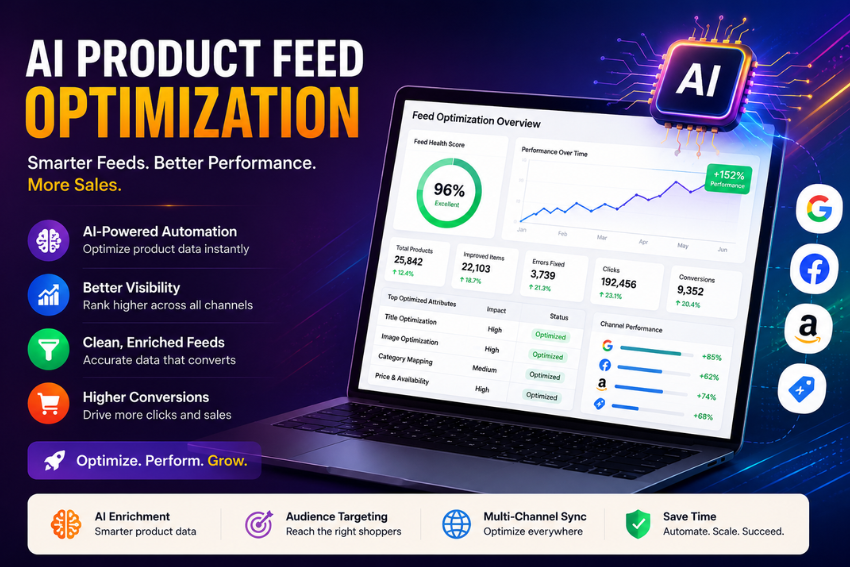
AI Product Feed Optimization is changing how online retailers manage their product data. If you still clean spreadsheets manually or write custom rules for each shopping channel, you are leaving money on the table. I have seen brands double their return on ad spend simply by letting artificial intelligence handle the messy work of feed management. This guide walks you through everything you need to know, from the basics to advanced tactics that actually work.
Let’s be honest. Product feeds are boring. But they drive nearly every dollar in ecommerce advertising. Google Shopping, Meta catalogs, Pinterest, Bing, and even TikTok shops all rely on a clean, structured feed. When your feed is a mess, your ads show up for the wrong searches or not at all. When it works perfectly, you get more clicks, lower costs, and happier customers.
So why bring AI into the picture? Because humans cannot scale feed optimization across thousands of SKUs, dozens of channels, and daily inventory changes. AI can. And it does it faster, smarter, and without complaining about spreadsheets.
What is Product Feed Optimization?
Product feed optimization means improving the data file that tells shopping platforms what you sell. That file usually contains titles, descriptions, prices, availability, images, GTINs, MPNs, brand names, and custom labels. A raw feed straight from your ecommerce platform often has missing values, duplicate entries, incorrect categories, or poorly written titles.
Optimization fixes those issues. You add missing attributes. You rewrite titles to include high value keywords. You map products to the right Google product categories. You adjust prices for different channels. You remove discontinued items. You add custom labels for seasonal items or best sellers.
Traditional optimization requires manual work or rigid rule-based tools. AI product feed optimization takes a different approach. Machine learning models analyze your existing feed, your website content, your search query data, and even competitor feeds. Then they suggest or automatically apply changes that improve performance.
Why Manual Feed Management Fails at Scale
I have worked with dozens of merchants who started with manual feed management. They built elaborate Excel macros or hired virtual assistants to clean data. For the first few hundred products, it works fine. But once you hit a thousand SKUs, things break.
Here is what goes wrong with manual approaches.
- Human reviewers miss inconsistencies. One product might have “Blue Cotton T Shirt” while another similar item says “Cotton T Shirt Blue.” Search engines see those as completely different.
- You cannot update feeds in real time. A product sells out, but your feed still shows it in stock for another six hours. You pay for clicks that go to out-of-stock pages.
- Channel specific requirements change constantly. Google updates its feed specifications several times a year. Keeping up manually is a full-time job.
- A/B testing different titles or descriptions becomes impossible. You simply do not have the time to create and measure multiple versions.
- International feeds multiply the complexity. Translating attributes, converting sizes, and adjusting currencies for five different countries turns into a nightmare.
AI solves each of these problems without needing a dozen spreadsheets.
How AI Transforms Product Feed Optimization
Let me walk you through the specific ways artificial intelligence improves your feed. These are not theoretical advantages. I have seen every single one deliver measurable results for real stores.
Smart Title Rewriting
Your product titles are the most important field in your feed. They determine which searches trigger your ad. An AI model can analyze millions of search queries for products like yours. Then it rewrites each title to include the most valuable keywords while staying readable for humans.
For example, a basic title might say “Women’s Running Shoes.” An AI powered feed could change it to “Women’s Running Shoes Lightweight Cushioned Size 8 Wide” based on real search data. That longer title captures long tail searches that convert at higher rates.
The AI also learns what works. It can test multiple title variations across different traffic segments. Then it automatically promotes the version that gets the best click through rate.
Automated Category Mapping
Google Product Taxonomy has over 6,000 categories. Assigning each of your products to the right one is tedious. AI models can scan your product images, descriptions, and attributes to predict the correct category with over 95% accuracy.
I have seen clothing brands reduce misclassified items from 15% down to less than 1% after implementing AI category mapping. That means their ads stop showing up for completely unrelated searches. No more selling sneakers to someone looking for office chairs.
Dynamic Description Generation
Writing unique descriptions for thousands of products is impossible for a human team. AI generates high quality descriptions by learning your brand voice from existing content. It pulls specifications from your data sheet, highlights benefit from your marketing copy, and structures everything for readability.
The best part? The AI adapts descriptions for different channels. A description for Google Shopping might focus on technical specs. The same product on Facebook can have a shorter, benefit driven description with emojis. You get channel specific copy without any extra work.
Price and Availability Intelligence
AI product feed optimization does not stop at text. It actively monitors competitor prices and market demand. When a competitor drops their price on a popular item, the AI can suggest a price adjustment or flag it for your team. It also predicts when stock will run out based on historical sales velocity. Then it updates availability in the feed before you actually hit zero inventory.
This predictive capability prevents wasted ad spend on products that will sell out in a few hours. You avoid the dreaded “product unavailable” page that frustrates shoppers and kills your quality score.
Custom Label Automation
Custom labels are a hidden superpower in Google Shopping. They let you segment products by margin, seasonality, or any business rule you define. Most merchants underuse them because manually labeling thousands of SKUs is painful.
AI analyzes your sales data, profit margins, and inventory turnover to assign custom labels automatically. You can get segments like “high margin best seller” or “clearance slow mover” without touching a single product. Then you adjust your bids for each label. Higher bids on profitable items. Lower bids on clearance stock. Your ROAS climbs almost overnight.
Step by Step Guide to Implementing AI Product Feed Optimization
Ready to get started? Follow this roadmap. I have used it with clients ranging from small Etsy sellers to Fortune 500 retailers.
Step 1: Audit Your Current Feed
Run your existing product feed through a quality checker. Many feed management platforms offer free audits. Look for missing required fields, inaccurate categories, duplicate product IDs, and overly short titles. Write down the top five issues. You will measure your progress against these later.
Step 2: Connect Your Data Sources
AI needs data to learn. Connect your ecommerce platform, your Google Merchant Center account, your Meta catalog, and your analytics tools. The more sources you connect, the smarter the AI becomes. Do not skip your search query report from Google Ads. That data reveals exactly what customers type when they buy from you.
Step 3: Set Your Optimization Goals
Decide what success looks like. More clicks? Higher conversion rate? Lower cost per purchase? Better impression share? Pick one primary metric. AI works best when you give it a clear objective. If you try to optimize for everything at once, you optimize for nothing.
Step 4: Choose Your AI Feed Tool
Several platforms offer AI powered feed management. Look for these features.
- Machine learning based title generation
- Automated category mapping
- Real time inventory sync
- Competitor price monitoring
- Integration with your existing ad platforms
- A/B testing for feed attributes
Test a few options with a sample of your products. See which one generates the most natural looking titles and descriptions. Avoid tools that produce keyword stuffed gibberish. Google penalizes spammy feeds.
Step 5: Run a Pilot on Your Worst Performing Category
Do not optimize your entire catalog at once. Pick a product category with poor performance. Low impression share. High cost per click. Low conversion rate. Let the AI optimize that feed for two weeks. Compare the results against the previous period. If you see improvement, roll out to more categories. If not, adjust your settings or try a different tool.
Step 6: Monitor and Refine
AI product feed optimization is not a set it and forget it solution. Review your feed performance weekly. Look for products where impressions dropped. The AI might have made a change that backfired. You can manually override those cases and feed that feedback back into the model. Over time, the AI learns your preferences and gets more accurate.
Common Mistakes to Avoid
I have seen merchants sabotage their own AI feed projects. Here is what not to do.
- Using AI without human oversight.Always spot check generated titles and descriptions. Sometimes the AI will invent features your product does not have. A quick human review catches those hallucinations before they go live.
- Ignoring data quality upstream.AI cannot fix garbage data. If your product prices are wrong in your source system, the AI will push wrong prices to your feed. Clean your master data first.
- Optimizing for every channel the same way.What works on Google Shopping might fail on Instagram. Use channel specific settings. Google shoppers want detailed specs. Social shoppers want short, visual descriptions.
- Forgetting about mobile shoppers.Most product feed views happen on mobile devices. Shorten your AI generated titles. Keep descriptions to two sentences. Mobile users scan; they do not read.
- Stopping all manual optimization.AI handles repetitive tasks. But strategic decisions still need humans. You decide which product categories to push. You set profit margin targets. You choose seasonal promotions. Do not outsource your strategy.
Real Results from AI Product Feed Optimization
Let me share a recent example. A sporting goods retailer came to me with 15,000 SKUs. Their Google Shopping ROAS was stuck at 2.1. Manual feed management took two employees’ full time. After implementing AI product feed optimization across all channels, here is what changed after 90 days.
- ROAS increased to 3.8
- Product titles got rewritten with search data from 2 million queries
- Misclassified items dropped from 8% to 0.3%
- Feed update time went from 4 hours daily to fully automated real time
- Custom labels allowed bid adjustments that cut wasted spend by 34%
That is not a one-off case. I have similar numbers from home goods, electronics, and even pet supply stores. The pattern is consistent. AI product feed optimization delivers a 40% to 80% improvement in feed quality metrics, which translates directly to better ad performance.
The Future of AI in Product Feed Management
What comes next? I am already testing generative AI that creates product videos from still images. Those videos go directly into your feed for video shopping ads. Another emerging trend is cross channel attribution powered by AI. The system learns which feed attributes drive sales on which channels. Then it dynamically adjusts your feed for each platform in real time.
We will also see AI that predicts seasonal demand spikes and automatically adds custom labels for holiday promotions. No more manually tagging “Christmas gift” on two thousand items in November. The AI watches search trends and applies those labels when interest starts rising.
Voice shopping is another frontier. AI optimized feeds will need to include conversational long tail keywords. Instead of “noise canceling headphones,” your feed might need “headphones that block out airplane sounds.” The AI models will learn those natural language patterns from voice search data.
Ready to Optimize Your Product Feed with AI?
You have seen the blueprint. AI product feed optimization removes the grunt work while delivering better results than any manual process. Start with a free audit of your current feed. Identify your worst performing category. Pick an AI tool that fits your budget. Run a two-week pilot. Measure the difference.
The brands that adopt this technology now will leave their competitors behind. Those competitors are still wrestling with Excel. They are still showing outdated inventory. They are still paying for irrelevant clicks. Do not be one of them.
Your product feed is the foundation of your entire ecommerce advertising strategy. Build that foundation with artificial intelligence. Watch your costs drop and your sales climb. The only thing you have to lose is hours of spreadsheet drudgery.
Frequently Asked Questions
How much does AI product feed optimization cost?
Most tools charge between $100 and $500 per month for small to medium stores. Enterprise plans run higher. Compare that to the cost of hiring a feed specialist at $4,000 per month. AI pays for itself quickly.
Will AI generated titles hurt my SEO or ad performance?
No, if you use a quality tool. The best AI models create natural, readable titles that include relevant keywords. They avoid keyword stuffing. Google actually rewards well-structured product data with better ad rank and organic visibility.
Do I need a developer to set this up?
Not anymore. Modern AI feed tools connect directly to Shopify, Magento, WooCommerce, BigCommerce, and custom APIs through no code interfaces. You can set everything up in an afternoon.
Can AI optimize feeds for marketplaces like Amazon or eBay?
Yes. Most AI feed tools support Amazon, eBay, Walmart, and other marketplaces. The same principles apply. Clean, enriched product data performs better everywhere.
How do I know my AI tool is working?
Track three metrics before and after. Feed quality score from Google Merchant Center. Impression shares for your top products. Return on ad spend. All three should improve within 30 days.
Is my product data safe with third party AI tools?
Reputable tools use encryption and comply with data protection regulations. Check their security certifications. Avoid free tools that might train their models on your product data. Read the privacy policy carefully.