There are additional aspects to take into account while picking out your preferred fragrance than only your personal preferences. The difference in formulas is also significant and affects the wearing experience, the development of the scent, and even the application method. Sprays and oils may contain an equal number of aroma ingredients, but the additional substances in the volatile solution and the carrier oil serve different purposes.
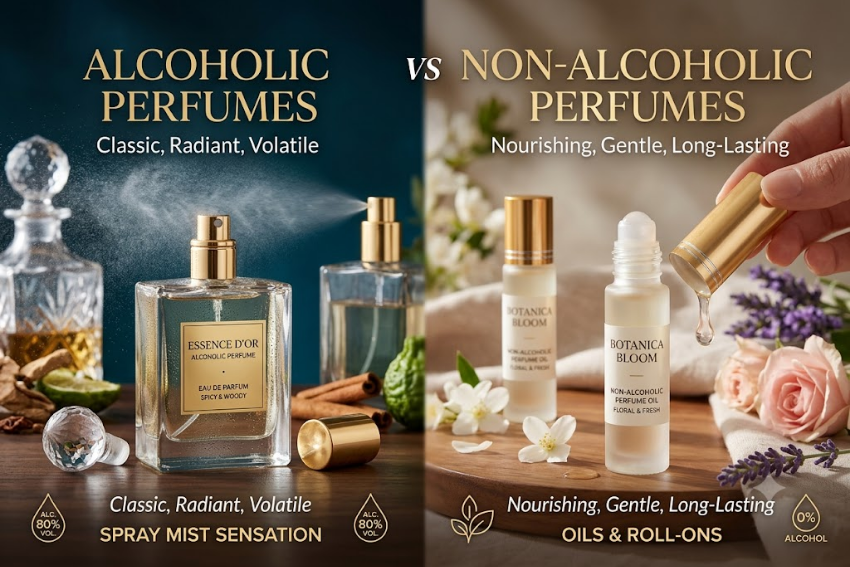
The decision between alcoholic and non-alcoholic perfumes becomes significantly simpler if one is familiar with the principles of their operation. For a more in-depth analysis of the differences, the reader may want to consult the guide to the perfume oils vs. sprays before proceeding to the following section.
The information provided below highlights the differences between the alcoholic and non-alcoholic perfumes and serves as objective material for comparison before buying.
Alcoholic Perfume: Definition and Features
An alcoholic perfume is a fragrance with ethanol as a base or one of its variants. This substance is responsible for the evaporation of the product after spraying on the skin, which explains the brief duration of its scent. Due to the volatility of alcohol, the perfume quickly reaches the top notes and the middle notes, revealing more complex flavors. Common types of alcoholic perfumes are
- Eau de Toilette
- Eau de Parfum
- Eau de Cologne
- Parfum, or Extrait
which essentially differ in terms of scent concentration, although there are exceptions to the rule. High concentration does not necessarily correlate with a longer-lasting aroma. These properties are somewhat different from each other, although similar patterns can be seen.
Non-Alcoholic Perfume: Definition and Features
A non-alcoholic perfume is a scent that uses something other than ethanol as its base. This distinction allowed perfumers to come up with the idea of creating an oil-based product so that the scent clings closer to the skin. Such perfumes are often called oil-based, and they are applied with a rollerball to specific areas, giving the room less of a lingering aroma.
At the same time, this does not mean that all such products have a weaker scent or stay on the skin less long. This characteristic varies depending on the concentration and the ingredients used. In addition, the method of application and the features of the skin also affect the performance.
Alcoholic vs Non-Alcoholic Perfumes: Main Differences
The characteristics of the listed types of perfumes become clear from the information above. However, to better understand the difference between an alcoholic spray and an oil-based roll-on, it is necessary to examine their characteristics in everyday use.
| Characteristic | Alcoholic Perfumes | Non-Alcoholic Perfumes (Oil / Water / Wax) |
|---|---|---|
| Solvent Base | Ethanol (Ethyl Alcohol) | Plant oils, water, silicone, or wax |
| Sillage & Projection | High (Alcohol evaporates quickly, lifting scent notes outward) | Low to Moderate (Stays closer to the skin, creating an intimate aura) |
| Longevity | Short to Moderate (Fast evaporation rate) | Moderate to Long (Oils and water bases bind to skin longer) |
| Scent Profile | Sharp initial top notes; rapid transition to heart notes | Subtle, consistent scent evolution from start to finish |
| Skin Sensitivity | Can cause drying, irritation, or stings on sensitive/shaved skin | Gentle, moisturizing, and safe for sensitive skin or eczema |
| Sun Sensitivity | Photosensitizing risk under direct sunlight | Safe for sun exposure (non-phototoxic bases) |
| Shelf Life | Long (Alcohol acts as a natural preservative, up to 3–5 years) | Shorter (Oils can go rancid over 1–2 years if unpreserved) |
| Staining Risk | Dries fast, minimal risk on fabric | Can leave oily residue or stains on clothes if applied directly |
| Cultural/Religious Use | Restricted in Halal, Kosher, or strict alcohol-free traditions | Halal-compliant and widely preferred in traditional attar cultures |
Is Alcohol-Free Perfume Safer for the Skin?
Alcohol-free options are not always beneficial for people with sensitive skin, in the same way that oil-based options do not automatically mean irritation. The reason for this is that the ingredient known as alcohol may be present in the product in various forms besides ethanol.
In other words, when the manufacturer indicates alcohol-free cosmetics, this does not mean the absence of other alcohols but specifically ethanol due to its high volatility. According to the FDA, note that fragrances may contain allergens and irritants that affect the skin and the mucous membrane of the respiratory tract.
Therefore, in the case of allergies or intolerances, it is usually more relevant to study the composition of the product and take into account recommendations from manufacturers
How to Choose a Perfume
When choosing a product, the issue of individual preference arises since the taste of each is unique. Nevertheless, when comparing the two perfumes described, the person will always find one more suitable for them than the other.
For example, someone who does not want to spend a lot of time on their morning routine and enjoys the quick and even distribution of scents will prefer sprays. People who want to control the application process and have a close and intimate aroma will choose rollers in oil.
The best perfume for men, women, or any other person is the one who chooses the product according to their own needs and tastes. After determining them, it will be much easier to make a decision in the case of a large offer and a wide range of concentrations.
Which One Should You Choose?
There is no universal answer because fragrance preferences are highly personal.
Choose Alcoholic Perfumes If:
- You enjoy fragrances with immediate impact.
- You like your scent to project into the surrounding space.
- You frequently attend social gatherings or formal events.
- You prefer traditional spray bottles.
Choose Perfume Oils If:
- You want a longer-lasting fragrance.
- You prefer alcohol-free formulations.
- You enjoy fragrances that stay closer to the skin.
- You travel frequently.
- You prefer using a smaller amount of fragrance with each application.
Interestingly, many fragrance enthusiasts keep both types in their collection.
They may wear perfume oils during workdays or casual outings and reserve traditional sprays for weddings, parties, or evening events where stronger projection is preferred. Choosing between the two is less about replacing one with the other and more about selecting the right tool for the right occasion.
Conclusion
The difference between alcoholic and non-alcoholic perfumes lies in the characteristics of their base, which is also responsible for the evaporation rate, application method, and projection. In general, it is more practical to learn not just the subtle differences between the two perfumery traditions, but to study the individual product features in detail.
For men interested in buying different types of perfumes, a perfume oil is quite a handy option if they want to have more control over dose application and do not want the scent to become overpowering. As such, the best perfume for men should be picked according to the individual preferences and needs.