New levels of complexity are being faced within the logistics industry, including the growing volume of data being processed through supply chains due to the increase in customer expectations, as well as companies having to manage transport, storage, inventory and shipping all at one time in multiple geographic areas. Generative AI has become the leading technology powering logistics firms, ranking high as the key drivers and key areas of focus (in this new world).
Many businesses have begun employing generative technology (AI) in the logistics field in a variety of ways:
- Optimizing delivery routes by using predictive modelling.
- Synchronizing warehousing.
- Utilizing predictive analytics (analyzing and understanding consumer behaviors).
- Creating operational plans based on actual results from the previous year.
- Enhancing communication throughout the entire logistics ecosystem (e.g., developing automated proof of concepts, chat s describing locations, systems, etc.) with clients.
Because of this, companies continue to invest heavily in cutting-edge logistics software development to integrate generative AI into their transportation systems, warehouse infrastructure (including warehousing), inventory management platforms (where inventory moves in and out), and customer-facing logistics operations.
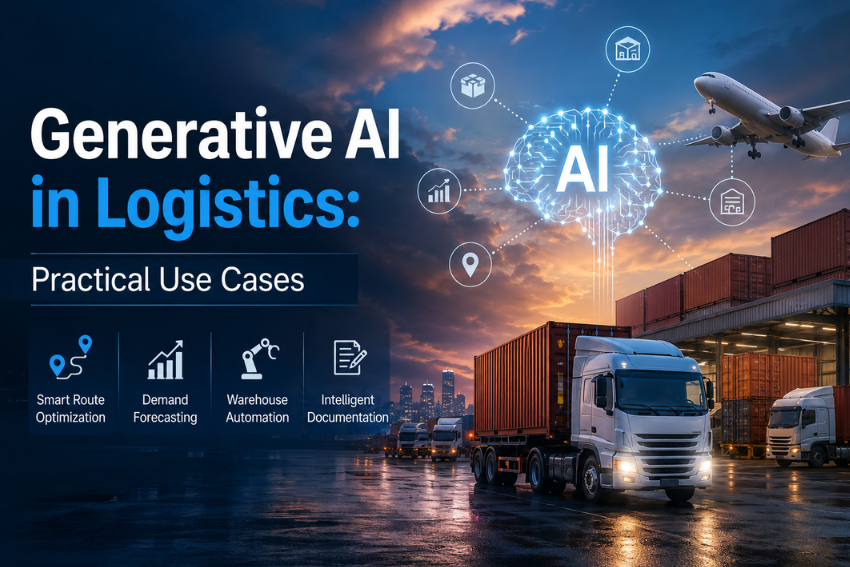
Why generative AI matters in logistics
Traditionally, logistics systems are built upon static operations and predefined rules. They may be able to automate repetitive processes satisfactorily but experience difficulty adapting as quickly to new operational conditions.
In contrast, generative AI utilizes operational data (also known as “big data”) to understand and analyze patterns and based upon these analyses, generates Recommendations and adjusts its behavior in real time to match changing supply chain conditions.
This becomes especially valuable in logistics environments affected by:
- Traffic disruptions
- Fluctuating fuel prices
- Warehouse congestion
- Supplier delays
- Weather conditions
- Changing customer demand
Logistics companies are using generative artificial intelligence to help them quickly resolve their operational complexities, make decisions faster, and work with less manual coordination. The generative AI is being rolled out from testing into a standard operational system.
AI-powered route optimization
Logistics continues to face one of the greatest challenges in planning the transportation of goods and materials. Traditional route optimization approaches use predominantly fixed models that cannot adapt quickly to the rapidly changing environment of logistics operations. Generative AI changes this by constantly analyzing:
- Traffic patterns
- Weather forecasts
- Delivery schedules
- Fuel costs
- Warehouse activity
- Driver availability
AI does not just create a one-off delivery route, but rather one that can dynamically be recommended throughout the day based on real-time operational conditions.
Logistics companies help organizations minimize the time spent between placing an order and receiving the product. Sometimes this is accomplished by improved fleet activity, reduced fuel usage, and improved delivery performance.
For companies to successfully complete last-mile delivery, they must have access to current data to make routing adjustments based on changing delivery times and current traffic conditions.
Automated logistics documentation
Logistics operations create a high volume of paper documents each day. There are numerous documents utilized in logistics (shipping manifests, customs declarations, invoices, warehouse reports, compliance forms, delivery confirmation) that require continual processing and validation.
Operating with the current manual methodologies limits operational efficiency, as well as increases your potential for operational errors. Generative AI can help automate many processes within the logistics industry.
For instance, with generative AI you can generate, classify, summarize and validate all types of documentation utilized by your logistics operation. You can also use the unstructured data located in those documents to create standard reports for all areas of your operations — significantly reducing the amount of manual data entry time required (and substantially decreasing your administrative workload) through automation.
The documentation of processes within the logistics operation also provides operational process consistency for the business by accelerating the document processing timeframe and creating an automated document creation process in order to establish a documented workflow process.
With the ongoing increase in the amount of data required for logistics operations, the value of document automation will continue to increase significantly.
AI-assisted warehouse management
Warehouse processes have become much more complicated as a result of greater volumes of orders and more rigorous delivery expectations.
Generative artificial intelligence (AI) supports warehouse groups in analysing inventory movements, predicting necessary demand fluctuations, pinpointing operational bottlenecks, and enhancing inventory allocation decisions.
AI systems are able to take into account past inventory movements, fluctuations due to seasonality, supplier activities, and fluctuations in customer demand in order to create improved demand forecasting recommendations.
Warehouse managers may also use operational summaries produced by AI to risk profile congestion points, optimize picking procedures, and boost workforce productivity through better human resource allocations.
Warehouse technology, which is increasingly integrating robotics and automated systems, is also providing AI with more opportunities to serve as a coordinating element that connects operational data from all of the different warehouse environments.
Predictive maintenance for logistics fleets
A logistics fleet downtime problem is one of the highest operational costs.
Unexpected mechanical failures of vehicles will cause missed delivery schedules, increased operation costs and reduced transportation.
Old maintenance processes used a predetermined set of inspections, whereas generative AI allows for the predicted to continually check the performance of vehicles.
- Vehicle diagnostics
- Engine performance
- Sensor data
- Maintenance history
- Driver behavior
- Environmental conditions
By providing predictive maintenance recommendations before a failure occurs, AI systems enable logistics to maximize operational reliability by reducing downtime.
Predictive maintenance will also enhance resource planning since companies can schedule repairs more effectively by avoiding disruption of their delivery operations.
AI-powered customer communication
Customer expectations around shipment visibility continue increasing rapidly.
Modern logistics customers expect:
- Real-time delivery updates
- Accurate arrival estimates
- Proactive notifications
- Fast support responses
- Transparent communication during delays
Logistics firms use generative AI to provide automated communication processes. Additionally, generative AI offers enhanced customer experience.
For instance, AI-generated capability can provide shipment summaries, identify and explain delivery issues or disruptions in delivery, and respond to frequently asked questions and provide operational updates automatically.
In comparison to conventional scripted chatbots, generative AI systems have a larger knowledge base and can generate more natural-sounding responses based on an operational data set. Therefore, communication consistency will improve and the burden on support staff will be lessened.
Supply chain risk management
Logistics operations around the world are still experiencing hurt from supply chain disruption.
Inefficient shipping port, geopolitical instability, labor shortages, extreme weather events and supplier delays have all contributed to the unpredictable operation of logistics networks.
Generative AI provides organizations with the ability to quickly identify and analyze the risk associated with supply chains, by processing a large quantity of both structured and unstructured information (operational) data simultaneously.
Generative AI systems are created to generate risk summaries, identify at-risk operational segments and make logistic managers scenario-based recommendations on what action to take.
Logistics managers have quick decision-making ability even when in a high-pressure operating frequency.
Organizations have also used AI-developed predictive models to support decisions about enhancing supply chain resiliency and creating contingency programs.
Inventory forecasting and demand planning
Forecasting is critical to logistics operating effectively.
Historically based methods of forecasting have difficulty responding to rapidly changing market conditions without continuing to rely on the past.
When combining both internal operations and external signals, Generative AI offers an improvement in demand forecasting through the use of the following:
- Seasonal trends
- Supplier performance
- Purchasing behavior
- Economic indicators
- Regional demand fluctuations
Logistics companies can use this to optimize their inventory allocation so that they minimize risks associated with over- or under-stocking their products.
This also results in improved efficiency of their warehouses and the planning of transporting products within their supply chain.
As supply chains are becoming more complex and changing quickly, forecasts based on artificial intelligence provide improved operational flexibility within an organisation.
Multimodal logistics coordination
Today’s logistics are increasingly complex, involving many different ways of moving goods and materials including trucking, rail, ocean and air. Elimination of the manual processes for coordinating these types of transportation becomes harder to manage as logistical complexity increases.
To help better coordinate multimodal transportation logistics, generative AI can analyze schedules, cargo availability, customs requirements, transportation capacity, and delays in one single effort.
Using AI-generated operational summary reports creates greater visibility throughout a logistics supply chain as well as helping teams react more quickly to operational disruptions and scheduling conflicts.
This is especially critical for international logistics that are managing high volumes of shipments across multiple regions of the world.
AI in warehouse robotics and automation
Logistics operations very quickly continue the expansion of warehouse automation.
AI is being used in Generative AI as a means to assist the coordination of robotic activities, such as determining priorities for workflow, optimizing the order of completing tasks, and dynamically improving the efficiency of the operations.
As the robots operate, AI systems will continue to evaluate the activity in the warehouse and will make suggestions on how to improve pick routes, decrease congestion and optimize how inventory is organized.
As the use of robotics increases, AI with Generative AI will serve as a coordination layer to provide a connection between warehouse automation systems, analytical infrastructure, and inventory management environments.
Thus, this will allow to create agile warehouses that can react dynamically to any changes in operational demand.
Why data quality determines AI performance
Generative AI Systems rely heavily on data quality to operate successfully.
Data quality is essential in ensuring the accuracy of generative AI and the benefits of using automation to execute many logistics processes. Many freight forwarders are still using disparate operational databases and disconnected systems to manage freight.
Therefore, it is often necessary for businesses to modernize their infrastructure, centralize operational data, and improve visibility into their analytics across their supply chain systems before they can implement generative AI successfully.
The importance of scalable cloud architecture continues to be critical for business because generative AI solutions require large amounts of operational data to be processed in real-time and are built on top of existing data architectures.
Companies that prioritize the modernization of their infrastructures early tend to have higher levels of generative AI performance and operational reliability at later dates.
Challenges businesses face during AI adoption
Even though it has its benefits., implementing a generative AI solution continues to pose a number of operational challenges.
For example, integration is a significant challenge because many logistics environments have multiple existing legacy systems that were never designed for AI-enabled workflows
I operate in the best possible shape. Therefore, to mitigate the risk of misrepresents during a busy operating environment; AI generated outputs must be corected evaluated at a analytic level.
The most significant operational governance challenge is that while AI will continue to make recommendations based on data collection from IoT sensors; substantial human intervention will still be required during all critical logistics decision-making processes including, compliance/regulatory, safety, and financial risk assessments.
Given the continuous flow of sensitive operational and customer data within logistics systems, the importance of Cyber Security will continue to increase; however, risk of cyberattack via freight transportation will likely be reduced; but any loss of this will not be recoverable.
Careful implementation planning will help to mitigate these risks.
Why cloud infrastructure matters for logistics AI
Cloud infrastructure plays a major role in modern AI-powered logistics operations.
Generative AI systems require scalable computing resources capable of processing:
- Transportation data
- Warehouse activity
- Analytics pipelines
- Customer communication
- Predictive forecasting models
AI systems can be dynamically scaled based on operational demand using a native cloud framework. Using a Cloud framework means that you improve visibility into your location-independent logistics ecosystem.
Organizations that are creating AI-based logistics environments now put scalable cloud architecture where possible at the start of their implementation.
Future trends shaping AI in logistics
Generative AI will be adopted widely throughout logistics operations in many areas over the next several years. Operational assistants powered by generative AI, autonomous coordination for warehousing, intelligent analytics with respect to supply chain performance and predictive logistics capabilities will all become increasingly prevalent within organizations. Organizations will also place a greater emphasis on measurable performance metrics rather than on doing experimental deployments of generative AI.
Businesses increasingly expect AI systems to improve:
- Operational efficiency
- Delivery speed
- Forecasting accuracy
- Warehouse productivity
- Customer communication
- Infrastructure visibility
As adoption grows, generative AI is gradually becoming part of the operational backbone of modern logistics ecosystems.
Final thoughts
Generative AI is altering logistics through better operational visibility, automating workflows and allowing companies to respond to supply chain disruptions more quickly.
By implementing AI within the logistics system in a strategic manner, companies will achieve increased scalability, faster operational coordination, improved adaptability throughout their transportation and warehouse operations, and so on.
The successful implementation of Generative AI is dependent on the architecture of the system being scalable in nature, having a structure for operational data, reliable integration with other systems and planning for long-term infrastructure.
The most effective Generative AI Logistic Systems are not stand-alone automation applications. They are all part of a larger intelligent operational ecosystem, and provide increased efficiency, visibility and responsiveness for all components of the supply chain.