The logistics sector operates on thin margins. Fuel costs fluctuate. Driver shortages persist. Port delays ripple across continents for weeks. A single supply chain disruption can erase months of operational efficiency.
Consider this statistic. Businesses face supply chain disruptions lasting more than one month every 3.7 years on average. Over ten years, these disruptions have had the potential to wipe out as much as 45% of annual profits.
Traditional logistics tools cannot keep pace. Spreadsheets do not predict delays. Manual tracking identifies problems only after customers complain. Legacy systems lack the intelligence to reroute shipments proactively.
This is where artificial intelligence changes the equation. AI-powered logistics platforms allow to identify disruptions before they happen, reroute shipment in real time, and constantly advance delivery accurateness.
This article examines how AI-powered logistics platforms actually improve delivery speed and accuracy.
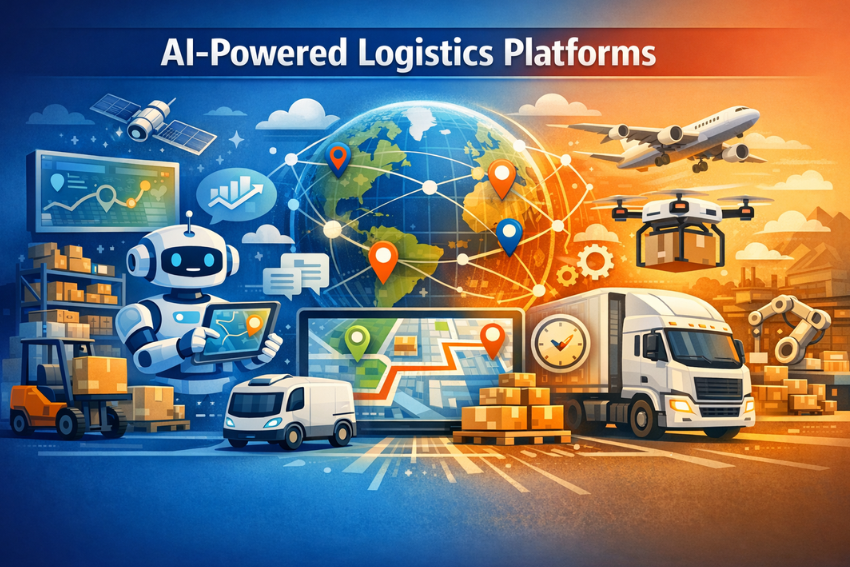
What is AI-Powered Logistics Management?
The system of AI-powered logistics management inserts artificial intelligence into the logistics machine. The technology automatizes predictions and real-time tracking, along with optimization of routes.
Here is how it works. The AI simulates live traffic data, weather conditions, and delivery windows together. It then determines the most efficient path to all the drivers on the road. In case of an accident or road closure, the system automatically reroutes vehicles before delays can affect customers.
Predictive analytics adds another layer. The AI studies historical delivery patterns to identify shipments at risk of delay. Logistics managers receive alerts early enough to intervene.
For supply chain leaders, artificial intelligence in supply chain translates to measurable outcomes.
Business Metrics to Check for AI-Powered Logistics
Testing AI performance will move beyond costly experimentation and true change. Logistics leaders need to follow particular numbers to understand how they can measure efficiency, justify cost reduction, and determine the improvement of service quality.
Key metrics for AI-enhanced logistics include the following:
- Reduction in delivery time (hours or days saved per shipment)
- Shipment cost per route/mode
- Forecast accuracy for demand and delivery windows
- Inventory turnover rate across warehouses
- Measured carbon footprint per delivery
- Real-time feedback customer satisfaction scores
Key Logistics Operations That Can Be Automated
Order Management
Integrated order capture ensures the e-commerce, retail, and B2B data are sent to ERP systems. Verifies without human innovation of accuracy of AI-based validation checks and stock availability. The result includes faster processing and fewer errors.
Warehouse Management
RPA handles repetitive data entry and stock updates. Computer vision tracks inventory in real time. Predictive analytics predicts demand and sets stock levels to ensure that there is less overstock and shortages.
Transportation Management
AI in transportation management simplifies the fleet management process by optimizing routes, monitoring in real time, and dispatching automatically. Predictive maintenance will avoid expensive failures before they happen.
Supply Chain Planning
Predictive models’ processes examine past trends and data and predict future requirements. Scenario modeling enables the planners to model disruptions and proactively adjusts.
Customs Documentation
RPA robots complete shipping manifests and custom paperwork. OCR digs out information in hardcopy documents. Automated compliance checks save time and risk.
Last-Mile and Returns
The AI route optimization assures effective delivery paths. Reverse logistics is made easier with automated return labels and AI inspection systems, which transforms returns into a cost liability on the business into a customer trust offer.
Key Benefits of Using AI-Powered Logistics Management
| Benefit | What AI Delivers |
| Dynamic route planning | Route optimization AI analyzes traffic, vehicle capacity, and delivery windows to reduce travel distance and time. Fuel use drops. Fleet capacity optimizes. Businesses handle more deliveries without adding resources. |
| Improved delivery accuracy | Real-time data continuously updates routes based on traffic and weather conditions. Missed deliveries and delays decrease. Customer satisfaction and trust improve. |
| Increased operational efficiency | AI automates routine tasks and optimizes resources. The system analyzes historical data for smarter decisions. Workflows streamline. Higher throughput requires fewer resources. |
| Real-time tracking | Real-time tracking AI provides businesses and customers with up-to-date shipment status. Proactive communication about potential delays becomes possible. Transparency improves. Customers appreciate live order tracking. |
| Cost reduction | Optimized routes and improved efficiency lower fuel consumption and labor costs. Optimized driving patterns minimize vehicle maintenance expenses. Long-term savings follow. |
| Enhanced customer experience | Timely deliveries and accurate tracking keep customers satisfied. Predictive analytics anticipates customer needs, enabling personalized services. Repeat business increases. |
| Predictive analytics for demand forecasting | AI studies historical data to predict future demand trends. The system identifies peak times and seasonal changes. Inventory and staffing are optimized accordingly. |
| Sustainability | Intelligent supply chain operations reduce fuel use through efficient routing. Travel distances shorten. Vehicle loads optimize. Carbon footprint lowers. Eco-conscious consumers take notice. |
| Reduced human error | AI automates route planning and scheduling. Data-driven insights replace manual input. Common mistakes from human judgment disappear. Operational accuracy improves. |
The Future of AI-Powered Logistics
The logistics sector is at the edge of paradigm shift. New AI features will transform the nature of goods transportation, warehouse behavior, and customer service strategies of the companies.
Emerging Trends
High tech robotics will revolutionize the warehouse. Robots equipped with greater dexterity and decision-making capabilities driven by AI will be utilized in collaboration with human workers in the future and will innovate on complex tasks that demand precision and adjustability.
Enterprise AI logistics platform adoption will speed up throughout the supply chain. AI-powered logistics platforms operate on real-time information to optimize the procurement, manufacturing, distribution, and delivery on a single system.
Machine learning and predictive analytics will become a commodity to predict demand, handle risks, and optimize inventory.
Pilot projects will expand to self-driving cars and drones. These technologies will prove highly beneficial to last-mile delivery, where speed and flexibility are paramount.
Potential Developments
The improvement of IoT and AI integration will result in better real-time tracking. Firms will track orders with the precision of granules and react to the breakdowns in real time.
AI logistics software solutions will yield more insights into customers, providing the ability to offer services in personal ways. Forecasting models will decide on the customer’s needs in advance.
Sustainability will drive AI adoption. Optimization of routes conserves fuel. Inventory management minimizes waste. The AI-driven planning makes greener transportation options conceivable.
The combination of the two technologies, blockchain and AI, will contribute to the increased transparency and security of the supply chain. AI analytics and non-repudiable records of the transactions will stop fraud and apply sanctions.
Long-Term Impact
The industry will adopt logistics automation services as a standard. The AI-based systems will handle the order processing and tertiary delivery, minimizing the number of people employed and the expenses of work.
Demand forecasting logistics will achieve unprecedented accuracy. AI responds to immense amounts of data to create insights that can be used in actions and assists the corporations to remain competitive in the ever-evolving market.
Customer experience will transform completely. The improved delivery times, increased transparency, and customized services will be considered as the counterparts but not the differentiators.
The same companies investing in AI now will dominate the logistics business tomorrow. The waiters run the risk of being permanently left behind.
Conclusion
AI-powered logistics platforms are transforming the delivery landscape when they make unpredictable supply chains intelligent and adaptive. With the integration of artificial intelligence into order management, warehouse management, transportation, and the last-mile delivery, businesses can predict disruptions, reroute shipments on the fly, and make precise resource optimization. The quantifiable advantages are shorter delivery times, decreased costs, increased accuracy, and increased customer satisfaction.
In the future, robotics, predictive analytics, IoT, and blockchain will transform further into a highly automated and transparent ecosystem of logistics. Businesses that adopt AI today not only ensure efficiency in operations but also gain competitiveness in the long-term in a world where success is determined by speed, accuracy and sustainability. The decision to wait risks being left behind in a fast moving towards intelligent automation industry.
Essentially, AI in logistics is no longer a fictional notion. It is a viable remedy that enables companies to provide more intelligible, quicker, and dependable delivery to ensure resilience amidst global supply chain challenges.