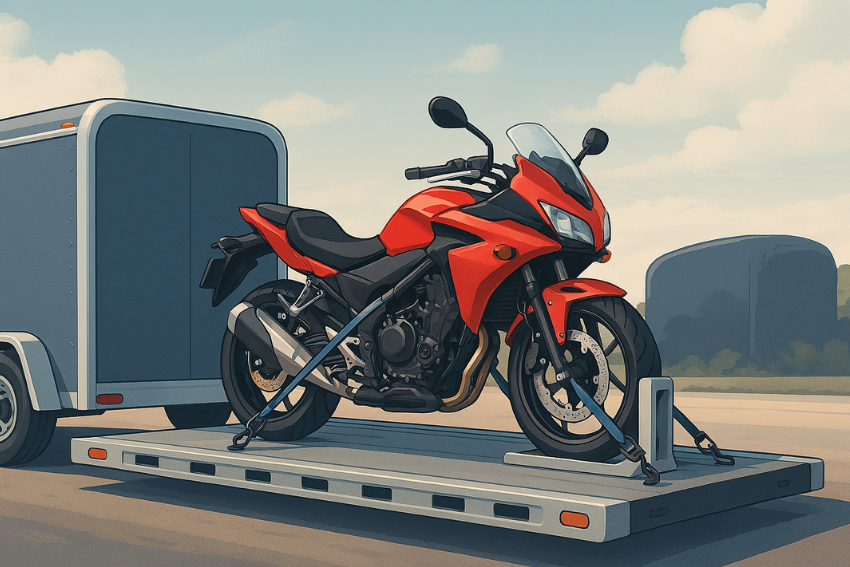
Motorcycle transport works by hiring a specialized carrier that uses wheel chocks, soft-tie straps, and enclosed or open trailers to transport bikes across distances. The process involves obtaining a quote, preparing the bike (cleaning and fluid checks), a detailed condition inspection at pickup via a Bill of Lading, and final delivery to a residential address or terminal.
The Reality of Moving Two Wheels
Let’s be honest: handing over the keys to your pride and joy whether it’s a vintage Triumph or a brand-new Harley feels a bit like sending a kid off to camp. You’re nervous. Unlike a car, a motorcycle is top-heavy, delicate, and has a lot of exposed parts that don’t like being bumped.
Understanding how the process works is the best way to quiet that “what if” voice in your head. The industry isn’t just a guy with a pickup truck and some rope. It’s a coordinated logistical dance involving specialized equipment, legal contracts, and professional handlers who know exactly where a bike’s center of gravity lies. Whether you are moving for a job or you’ve just followed a guide to buying motorcycles online to score a deal in another state, the mechanics of shipping remain the same.
Phase 1: The Booking Ecosystem (Brokers vs. Carriers)
The first thing you’ll notice when searching for a nationwide motorcycle transport service is that you aren’t always talking to the person who owns the truck.
Most of the time, you are dealing with a broker. Think of a broker as a high-end concierge. They have a massive database of vetted carriers and know which drivers are currently heading from, say, Phoenix to Chicago with an empty spot on their trailer.
- The Broker: Manages the paperwork, verifies the carrier’s insurance, and handles the “where is my bike?” calls.
- The Carrier: The person behind the wheel. They own specialized trailers and perform the actual physical labor.
For a first timer, a broker is often a safer bet because they act as a buffer. If a specific truck breaks down, a good broker can quickly find a replacement. If you go directly to a small carrier and their engine blows, your bike might sit in a garage for two weeks while they wait for parts.
Phase 2: Choosing Your “Shield” (Open vs. Enclosed)
You have two main ways to move a bike, and the price difference usually reflects the level of “pampering” your motorcycle receives.
Open Transport
This is the budget-friendly workhorse. Your bike is loaded onto a trailer that is open to the sky.
- The Good: It’s significantly cheaper. If you’re moving a dirt bike or a daily commuter, this is often “good enough.”
- The Bad: Your bike is exposed to rain, road salt, and wind. If the truck drives through a storm in the Rockies, your bike goes through it too.
Enclosed Transport
This is the gold standard for enthusiasts. The bike is housed inside a hard-sided trailer.
- The Good: Complete protection from the elements. Most specialized motorcycle movers use enclosed trailers exclusively. They often have lift gates (hydraulic platforms), so the bike stays perfectly level during loading, rather than being pushed up a steep, narrow ramp.
- The Bad: It costs about 30–50% more than open transport.
Phase 3: The “Pre-Flight” Preparation
The driver isn’t going to do the prep for you. If you show up with a bike that isn’t ready, you might face delays or even a refusal to load.
The Essentials Checklist:
- The Quarter-Tank Rule: Most carriers require the gas tank to be at 1/4 capacity or less. This is a safety regulation for fire prevention and weight management.
- Clean the Bike: This sounds like a chore, but it’s actually a legal safeguard. You cannot document scratches or dents on a bike covered in mud. Wash it so the pickup inspection is 100% accurate.
- Unlock the Steering: The driver needs to be able to roll the bike. If your steering is locked, they can’t maneuver it into the wheel chock.
- Remove Personal Items: Those saddlebags are for your gear, not for shipping your heavy winter coats or spare parts. Carriers aren’t licensed to move household goods, and their insurance won’t cover items left in the bags.
Phase 4: The Inspection Ritual (The Bill of Lading)
When the truck pulls up, the most important part of the day begins: the inspection. The driver will produce a document called the Bill of Lading (BOL).
Do not rush this. You and the driver will walk around the bike and mark down every single existing scratch, paint chip, or ding.
- Photos are King: Take 360-degree high-resolution photos of the bike in front of the driver.
- Close-ups: Get shots of the odometer and the specific areas where the straps will go.
- The Signature: When you sign that BOL, you agree to the bike’s current condition. This is your “before” evidence. If the bike arrives with a new scratch on the tank and it wasn’t on the BOL, the carrier’s insurance is on the hook.
Understanding the Pricing Logic
Why does it cost $600 to ship a bike 500 miles but only $900 to ship it 1,500 miles? It comes down to “route density.”
| Factor | Description |
|---|---|
| Distance | The raw mileage, though the “price per mile” drops as the distance increases. |
| Route Popularity | Shipping between LA and Miami is cheaper than shipping between two small towns in North Dakota. |
| Bike Size | A Honda Grom takes up less “real estate” than a fully dressed Honda Goldwing. |
| Season | Prices spike in the spring (“Snowbird” season) and during major rallies like Sturgis. |
The Mechanics of Security: How a Bike Stays Upright
Once the paperwork is signed, the “heavy lifting” begins. How a motorcycle is secure determines whether it arrives as a machine or a pile of expensive scrap metal. In the professional world, we don’t just “tie it down”; we engineer the bike into the trailer.
Soft-Ties and Four-Point Compression
Most high-end carriers use an E-track system embedded in the floor of the trailer.
- The Wheel Chock: The front tire is rolled into a metal cradle (the chock) that prevents the handlebars from twisting or the bike from sliding forward during braking.
- Soft-Ties: These are nylon loops that go around the handlebars or triple trees. Unlike raw metal hooks, they won’t scratch your paint or gouge your chrome.
- The Suspension Balance: The driver will attach straps to four points and pull the bike down slightly. The goal isn’t to bottom out the suspension which can blow your fork seals but to compress it just enough so the bike doesn’t “bounce” when the truck hits a pothole.
Specialized Motorcycle Pallets (Skids)
For ultra-high-value exotics or international hauls, the bike might be bolted to a specialized steel or wooden skid. This makes the bike a self-contained unit that can be moved with a forklift. While incredibly secure, it’s also the most expensive method and is usually overkill for a standard interstate move.
Insurance: The “Safety Net” You Hope Never to Use
Every carrier tells you they are “fully insured.” In their mind, that might mean they have the minimum legal requirement. In your mind, it means if a meteor hits the truck, you get a check for a new bike. These two things are rarely the same.
Cargo Insurance vs. Liability
- Liability Insurance: This covers the truck hitting a fence or another car. It has nothing to do with your motorcycle.
- Cargo Insurance: This is what covers your bike. You need to ask for the “Certificate of Insurance” and look at the “Cargo” line.
- If a carrier is hauling 10 bikes worth $30,000 each, they need at least $300,000 in cargo coverage. If they only have $100,000, you are functionally underinsured. A professional practitioner will always be transparent about these limits.
The “Acts of God” Clause
Read the fine print. Most standard policies do not cover “Acts of God” (hail, floods, tornadoes) or road debris damage on open trailers. This is why enclosed shipping is actually a form of “secondary insurance” you’re paying to remove the risks that the insurance company won’t cover anyway.
Timeline Realities: Why Logistics is a Slow Dance
If you’re used to Amazon Prime, the auto transport industry is going to be culture shock. Motorcycle transport is a slow-motion process. When a broker tells you, “5 to 7 days,” that is an estimate based on “route density.”
- The Pickup Window (1–5 days): The truck has to finish its current route and navigate to you.
- The Transit Time: A truck driver is legally limited in how many hours they can drive (ELD mandates). They cover about 500 miles a day. If your bike is going 2,500 miles, that’s 5 days of pure driving.
- The Delivery Window: The driver will usually call you 24 hours in advance. Be ready. If you aren’t there, the driver might have to put your bike in a terminal, which will cost you “storage fees.”
Delivery Day: The Grand Finale
When the truck pulls up to your new home (or a nearby parking lot), don’t let the excitement cloud your judgment.
The Post-Trip Inspection
Pull out your original Bill of Lading and your “before” photos.
- Check the Fluids: Look for new leaks that might have started from the vibration of the road.
- Check the Fairings: Look for “rub marks” from the straps.
- Check the Odometer: It should match the pickup reading (within a tenth of a mile for loading).
If you find damage: Do not get into a shouting match. Simply note the damage clearly on the Bill of Lading before you sign it. Take photos of the new damage with the driver’s truck in the background. Most legitimate companies will handle the claim professionally as long as the paperwork is in order.