LIMS order booking is important in simplifying the workflow of a laboratory as it will speed up the process of creating tests orders, registering samples, and assigning tasks. Digitizing and automating the order entry process allows laboratories to negate the existence of manual paperwork, decrease risks of data duplication, and the possibility of errors that tend to slow down the process of collecting samples.
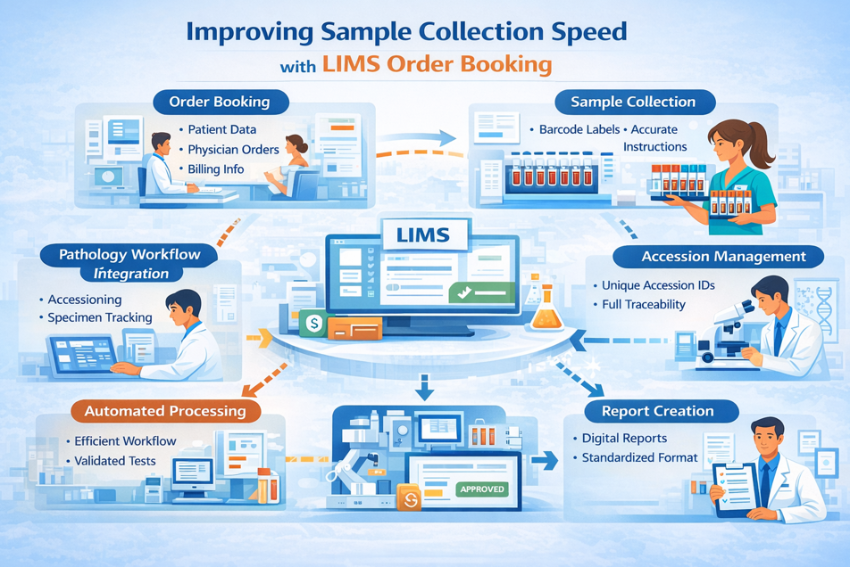
An effective LIMS order booking system allows the smooth organization of work between front-desk employees, phlebotomists and laboratory personnel, so that the requests regarding sample collection are received immediately and continued to work without postponements.
Moreover, LIMS order booking facilitates standard workflows and pre-set test panel, which enables the collection teams to use the same procedure and eliminate confusion during collection. It is further integrated with barcode labelling, mobile collection devices and scheduling systems to hasten sample processing and cut down waiting time by patients.
With the growing number of samples and the growing demands placed on the laboratories in terms of the turnaround time, an effective process of ordering booking a test into the laboratory will be needed to enhance the efficiency of the operations, enhance the control over the quality and ensure that the accurate test results are delivered in a timely manner.
What Is LIMS Order Booking?
The first step in initiating the whole process of diagnostic workflow in a Laboratory Information Management System (LIMS) is known as Order Booking. It is the organized computerization of patient data, physician orders, test orders, clinical orders, and billing data.
The laboratory information management system makes sure that all data is properly captured once at the place of the first point of contact, be it the order is created by a hospital, clinic, collection center, or even a patient.
A LIMS laboratory information management system standardizes the Order Booking process across departments or regions so that standard processes can be followed despite staff or facilities size. Such uniformity removes uncertainty and reliance on paperwork.
Among the key advantages of implementing the laboratory information management system is the reduction of errors at the initial stage of diagnosing the patient, which has a significant positive impact on the downstream efficiency.
Importance of LIMS Order Booking in Laboratory Process
Order Booking is a strategic role outside data entry in administration. The laboratory information management system, when combined with Laboratory Billing Software, will verify the pricing, insurance eligibility, discounts, and payment status prior to the collection of the samples. This proactive validation helps to avoid interruption in the workflow.
Order Booking is also compatible with Pathology Lab Software, which would automatically start a preset workflow based on various diagnostic fields. Since LIMS are a key element in healthcare, Order Booking serves as the focal point of coordination that serves to coordinate clinical will, operational performance, and financial adherence. This match is among the most effective advantages of the application of laboratory information management systems in the high-volume diagnostic setting.
Order Booking Enabled by LIMS Sample Collection
Application of LIMS in Sample Collection
One of the most sensitive and patient-facing processes in laboratory operations is sample collection. An Information Management Office system makes sure that the order booking information is immediately provided to the sample collection personnel via the lab management information system. This removes the process of re-checking, making of calls, or manual cross-checking.
The laboratory information management system offers precise and uniform guidelines on the type of samples to be used, sample volume, preparation of the patient, the need to take fasting, and safety measures. The LIMS laboratory information management system provides the consistency of all collections irrespective of the experience and the workload of the staff since it has automated all these instructions.
The Way Order Booking Enhances the Speed of Collecting Samples
LIMS order booking speeds up the process of collecting samples as it automates several duties at the same time. The laboratory information management system produces barcoded labels immediately, so that there are accurate identification and traceability of the patients. Connection with Laboratory Billing Software ensures that there is financial clearance during financial clearance prior to collection, thus removing delays during billing.
Pathology Lab Software also checks against test specifics, so the correct sample container, preservative, and handling procedure is observed. Since LIMS are beneficial in the medical field, laboratories receive a better flow of patients and the waiting time is minimized, and the quality of service is enhanced. These are some of the most evident gains of the application of laboratory information management systems.
The Major Enhancements in Sample Collection
- Laboratory Information Management System allows instant barcode creation.
- Delaying collection due to billing is avoided by Laboratory Billing Software.
- Pathology Lab Software makes sure that there are proper sample handling procedures.
- The benefits of LIMs in healthcare include enhancement of patient throughput/ patient experience.
The LIMS laboratory information management system also minimizes the recollection rates saving time, resources, and patient discomfort. These enhancements are a clear indication of the operational improvement of the adoption of the laboratory information management systems.
Pathologic Role in LIMS Order Booking Workflow
Data Flow of the LIMS Pathology
Pathology procedures require full clinical history and proper specimen information. To provide real time flow of patient history, clinical notes, test priorities and specimen details, a Laboratory Information Management System is needed to ensure that the data of order booking is transferred to the Pathology Lab Software.
The laboratory information management system does not involve the use of manual data transfer, or handwritten notes; thus, the chances of misinterpreting data are reduced. With the role of LIMS in healthcare, the workflow in the field of pathology is improved in terms of speed, transparency, and documentation, which favor high diagnostic accuracy.
Advantages of Order Booking to Pathology Teams
LIMS order booking makes sure that the samples obtained by the pathology teams are labeled properly, accessed and ranked based on clinical urgency. Connection with Laboratory Billing Software will make sure that the pathology services are billed properly without requiring extra administrative work.
The management information system in the laboratory facilitates the specialized processes like histopathology, cytology and molecular diagnostics. The LIMS laboratory information management system enhances traceability and audit preparedness and compliance, which are some of the key advantages of using laboratory information management systems in pathology-oriented labs.
Entry Using Laboratory Information Management System
What Is Accession in LIMS?
The formal process of registering and accepting samples into the laboratory system is called accessioning. Laboratory Information Management System A Laboratory Information Management System will be used to automate accession when accession is done during the order booking process by giving each sample a distinct accession number. The information management system in the laboratory is designed to provide end to end traceability of the collected information to its processing and subsequent reporting.
The manual system of accessioning causes duplication, labeling mistakes and delay. The LIMS laboratory information management system removes these inefficiencies, and this has been one of the most operationally valuable gains of adoption of the laboratory information management system.
The Assistance of LIMS in Enhancing the Accuracy of Accession
Connection to Laboratory Billing Software will make sure the accession will take place on financial validation. Pathology Lab Software is notified of accession with real time information and, as such, the test is allocated immediately. With the play of LIMS in healthcare, the accession workflow is made to be standardized, quicker and more dependable.
The management information system of the lab offers real-time monitoring of the location and status of the samples and enhances accountability and operational control.
Productivity in Processing with LIMS Order Booking
Automated LIMS Processing
Laboratory processing is a complicated coordination of instruments, personnel, and test procedures. LIMS order booking data are used by a Laboratory Information Management System to automate the workflow of processing. The laboratory information management system provides tests to the correct analyzers, depending on the availability, priority, and workloads.
Automation minimizes human interference, bottlenecks, and lacks uniformity. Since LIMS are efficient in the medical field, work laboratories stay efficient even at the highest levels.
Minimizing Spreadsheet Processing Time
- The Laboratory Information Management System is used to optimize the use of the analyzers.
- Pathology Lab Software provides compliance of protocols.
- The Laboratory Billing Software stops unwarranted processing.
- LIMS are beneficial in the medical field as they enhance turnaround time.
The LIMS laboratory information management system provides real-time processing visibility, which aids in the informed decision-making process and continuous improvement. These are the capabilities that can be measured as the advantages of the efficiency of the laboratory information management system.
Laboratory Information Management System Report Creation
In LIMS, Digital Report Generation
The last and the most perceived result of laboratory services is the report creation. A Laboratory Information Management System is an automated system that aggregates the test results into standard reports. The laboratory information management system is used to provide consistency in the formatting, terminology, and reference range.
This automation minimizes the errors that could be caused in the transcription and enhances reliability of the diagnostic. With the role of LIMS in healthcare, the clinicians are given timely and reliable reports that enable them to make quicker treatment choices.
Safeguard Report Approval and Delivery
Integrated Pathology Lab Software provides the ability to review, verify and approve reports digitally. The Laboratory Billing Software is used to guarantee that reports are not released until it is clear of billing.
The LIMS laboratory information management system facilitates electronic delivery through patient portals and hospital systems in a secure manner. These attributes underpin the long-term positive effects of adoption of laboratory information management systems.
The Role of LIMS in Healthcare Transformation
LIMS as a Digital Backbone of Healthcare
LIMS is used in healthcare across all hospitals, diagnostic chains, and even individual laboratories to facilitate end-to-end digital transformation. Laboratory Information Management System is a system that unites clinical, operational, and financial processes to one platform.
The laboratory information management system enhances communication among clinicians and laboratory teams as well as administrators. Pathology Lab Software and Integrated Laboratory Billing Software are better at improving diagnostic accuracy and revenue management respectively.
Prolonged Salaries of LIMS Adoption
The LIMS laboratory information management system promotes compliance, analytics, scalability and interoperability. These functions will guarantee future preparedness and sustainable development, which will obviously show the long-term values of the implementation of laboratory information management systems.
Approval Method in Laboratory Information Management System (LIMS)
Multi-Level Approval Workflow in LIMS
The Laboratory Information Management System facilitates the use of multi-level approval techniques to make sure that the reports are checked and authenticated at varying levels.
- Technical Check: After the sample has been processed, the technicians perform a check-up to evaluate whether the results are complete and correctly entered into the laboratory information management system.
- Pathologist Review: The pathology lab software module allows the pathologists to super-check and verify the results thus guaranteeing that clinical results are truly valid.
- Senior Consultant Approval: Senior consultants or quality assurance personnel give final authorization to keep things in line and minimize errors.
Such systematic approval technique offers one of the most significant advantages of laboratory information management systems, which ensures that all outcomes are of a clinical and regulatory standard.
Laboratory Billing Software Integration
Laboratory Billing Software is closely connected with the approval method in a Laboratory Information Management System. Any release of reports is upon financial validation, which avoids illegal access and billing anomalies. This combination guarantees clear coordination among laboratory processes and financing processes, which indicates that LIMS are very essential in providing healthcare in terms of operational efficiency.
Online Audit Records and Adherence
The LIMS laboratory information management system records all of the steps of the approval in a complete digital record. Audit trails are used to trace who signed what results and at what date, this is to be used to trace the resultant audit in relation to regulatory compliance. This improves accountability, minimizes the errors and shows the usefulness of laboratory information management systems in ensuring high standards in laboratory operations.
Live Feed and Push Notifications
A Laboratory Information Management System has automated messages to remind staff of outstanding approvals. This saves time and decreases the turnaround time as well as faster delivery of reports. The Pathology Lab Software and Laboratory Billing Software integration are two ways of monitoring the clinical and financial approvals concurrently, where the LIMS are used in healthcare to automate lab-related processes.
The Major Benefits of Approval Methods in LIMS
- Make sure the results are verified and correct.
- It Eliminates delays and errors.
- LIMS improves trust and clinical reliability in patients.
- The system offers full audit reports on compliance.
- It is compatible with Pathology Lab Software and Laboratory Billing Software.
One of the most crucial advantages of laboratory information management systems in present-day diagnostics is the possibility of the laboratories conducting faster, correct, and compliant workflows by using a well-developed approval method within a Laboratory Information Management System.
Conclusion
The high speed of sample collection via LIMS order booking is a necessary component of efficient work of the lab and patient-centered care. A Laboratory Information Management System connects the order booking and sample collection with pathology, accession, and processing to the creation of reports into a digital workflow that is seamless. Implemented with Laboratory Billing Software, Pathology Lab Software, and the growing significance of LIMS to healthcare, laboratories can reach a faster turnaround time, lower errors, and patient satisfaction. The laboratory information management system is the key to the current diagnostic services, as it provides long-term operational and clinical advantages of the laboratory information management system implementation.