If you are moving out of a high school and stepping into college, there are several aspects to think about, like what type of college would you like to attend. Students find themselves confused or struggling to choose between community colleges or universities. This choice between community colleges vs universities education is crucial as it shapes student’s academics experiences, social life, finances, career opportunities, and personal growth as well.
Universities attract students looking for specialized programs and advanced degrees, whereas community colleges are gaining significant popularity for its career-focused and practical education at affordable costs.
Now the real question, which is better? community colleges or universities.
Let us understand the differences between community colleges vs universities and help you understand which pathway aligns best with your goals and aspirations in this blog.
What are Community Colleges?
Community colleges offer two-year associate degrees and certification courses, preparing you for work or move on to university for further education. Anyone with high school education or equivalent can enroll to community college. In fact, courses at community colleges are designed to provide accessible and affordable education to people irrespective of backgrounds.
The thought of community colleges is meant only for the students or individuals with lower academic performance is outdated. Over time, community colleges have started attracting working professionals, career changers, international students, and high scoring students.
Key Features of Community Colleges
Affordable Cost
In community colleges, tuition costs are comparatively lower than universities. This affordability reduces student debt, letting students focus on learning rather worrying about further finances.
Flexibility
Another major benefit of choosing community college is, the flexibility it provides.
Community colleges offer:
- Part-time study options
- Online courses
- Weekend schedules
- Evening classes
This flexibility is an ideal option for those who want to work while balancing their academic and support their families financially.
Transfer Opportunities
Students can complete first two years at a community college and later transfer to a university to earn a bachelor’s degree at a fraction of cost. And, this approach combines financial affordability along with academic progression.
Career Focused Programs
Programs/courses at community colleges are typically designed to prepare students for quick entry into career with job ready programs, such as:
Vocational and technical certifications
- Healthcare
- Business and IT
- Trades and Industry
Continuing Education and Personal interest
- Yoga, life skills, and wellness
- Foreign languages
- Culinary arts and photography
Associate degrees
- Associate of Arts
- Associate of Science
Smaller Class Sizes
Class size is comparatively smaller than those at universities. And, this creates a broader scope for personalized teaching and develops stronger relationships with lecturers. Students feel quite comfortable in asking doubts and participating in discussions.
What are Universities?
Universities are typically larger institutions that offers various degrees. such as bachelors, masters, and doctorate programs across a wide range of disciplines. It provides broader academic opportunities, specialized subjects, scope for research, and vibrant campus life.
Key Features of Universities
Advanced Degrees
Universities offer bachelors, masters, and doctorate degree programs, thereby allowing students to continue their further education.
Research Opportunities
In addition to master’s degree programs, universities are also well known for their research activities. However, students can take part in:
- Lab work
- Research internships
- Academic conferences
- Faculty-led projects
Campus Life
University campus life includes opportunities for research, campus events, networking activities, sports teams, cultural activities, vast libraries. Having all the essential resources under a single roof make it easier to stay organized, develop leadership skills beyond classroom, and focus on achieving their goals.
Alumni Network
Usually, universities have large alumni network that continue to thrive even long after graduation. This network supports students through providing career advice, internships, and mentoring.
Array of Degree Programs
Universes offer extensive academic courses for both Bachelors and Masters degrees, including
- Engineering
- Arts
- Science
- Business
- Media Studies
- Research Programs
- Medicine
- Nursing
- Data Science, and more
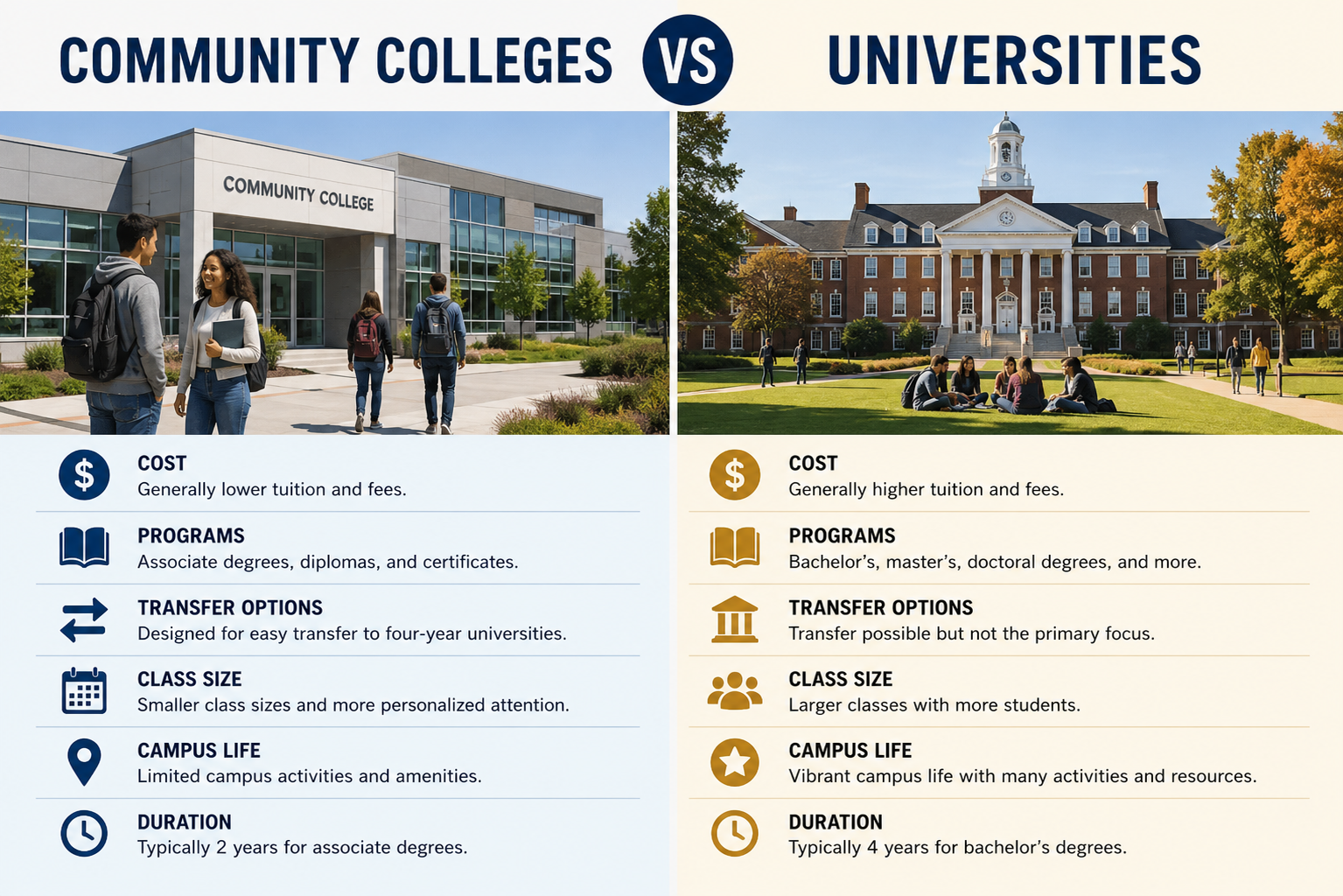
Comparison Between Community Colleges vs Universities
Cost
Community Colleges
Community college offers lower tuition fees and fewer additional expenses as many students commute from home regularly. Moreover, these college allow students to save money, work while studying, avoid excessive debt, and explore other academic and career options without taking much financial risks.
Universities
Education at universities/university affiliated colleges can be expensive, especially while you choose private institutions and specialized programs. Other costs include:
- Hostel expenses
- Transportation
- Students’ activities fees
- Books and supplies
And, for many students considering educational loan has become inevitable.
Faculty
Community Colleges
Faculty members at community colleges teach on part-time basis and continue to work in their field. Instructors here are more responsible for teaching practical and career-oriented programs.
Professors/instructors have more direct interaction with students due to smaller class size. And, most importantly, they focus on employability and skill development.
Universities
Faculty members at universities teach on full-time basis. Universities requires its faculty to have doctoral degree programs in their field. Here, instructors majorly focus on research and innovation.
Academic Environment
Community Colleges
Education at community colleges is less research intensive, and more practical and career oriented.
Community college environment can be suitable for students who:
- Prefer interactive classroom environment
- Feel nervous in competitive environment
- Want personalized/direct interaction with instructors.
Universities
Academic atmosphere at universities includes large lecture halls and students. Here the main emphasize is on academics and research activities.
University education is suitable for students who:
- Ready to take up academic challenges
- Explore research opportunities
- Thrive in competitive environment
Social Life
Community Colleges
These colleges have typically smaller campus, minimal residential opportunities, and fewer on-campus experiences. As a result, students feel less socially active in community colleges than universities.
Universities
Beyond academics, diverse career opportunities, and scope for research, university is also well known for its vibrant social life. Students can take part in on-campus activities, such as-
- Student clubs and organizations
- Sports and cultural activities
- Networking events
- Leadership programs
Most students studying at universities value these experience as it contributes to their emotional growth and lifelong memories.
Admission requirements
Both universities and community colleges have varying admission requirements. Let’s understand each in detail-
Community Colleges
Community colleges usually allow candidates having high school diploma or equivalent to enroll to these courses.
- Flexible entry requirement
- Easy admission process
Universities
Unlike community colleges, universities have stricter admission requirements for students.
Aspiring students must have completed higher secondary education., i.e., 10+2 or equivalent and minimum required percentage.
- Course specific eligibility criteria
- High academic standards
- Competitive admissions
Career Opportunities
Community Colleges
By now, we all have understood that community colleges basically offer practical oriented courses and prepare their students job ready. And, these courses are designed considering the current requirements of the industry.
Students at community colleges gain:
- Practical skills (Irrespective of domain)
- Internship opportunities
- Industry certifications
Students graduating from community colleges can enter into workforce quickly.
Universities
In contrast, university colleges provide broader academic options and career opportunities.
Students at universities get benefit from:
- Internship opportunities
- Career guidance
- Advanced academic course specialization
- Research programs
Some of the careers requires degrees from recognized universities, such as Medical, Engineering, Nursing, and Law.
However, making the right choice depends on your career goals.
For example:
Students aspiring to pursue healthcare education, joining a recognized university. University education for healthcare domain helps to understand stable career options after graduation.
Mental Health and Pressure
Community Colleges
At community colleges, students may experience:
- Flexible schedule
- Better work-study balance
- Lower student debt
Universities
Though studying at a university seems exciting, but it is equally stressful. Students have to experience:
- Academic competition
- Balance studies and personal like
- Financial stress
- Social pressure
Which Category of Students Benefit from Community Colleges?
- Those who wants to stay away from huge student loan.
- Those who want to continue their education in flexible schedules.
- Those who want career focused education.
- Those prefer staying close proximity to their home.
- Those who want to balance work and academics.
- Those who are unsure about major academic subjects.
Overall, community colleges provide opportunities for further education and also prepare students employment ready.
Which Category of Students Benefit from Universities?
- Those who seek research opportunities.
- Those who want extensive networking.
- Those who want to pursue advanced degrees.
- Those who want to explore vibrant university campus life.
- Pursue career that require bachelor’s and master’s qualification
Overall, University education is suitable for those who want to explore broader academic opportunities and traditional college experiences.
What’s the Future of Education System?
The future of education system is rapidly evolving. And, employers value candidates with:
- Relevant skills
- Certification
- Experience portfolios
Thus, alternative educational pathways, such as “community colleges” are becoming widely accepted by the employers globally.
In fact, today’s students have more flexible educational options than ever before. And, there is no universally accepted pathway to pursue education. The future belongs to those adaptable learners who improve their skills continuously regardless of their domain.
Tips for the Students Trying to Decide their Education Pathway
Understand Your Career Goals
At the initial stage, assess whether your desired career requires graduation and post-graduation degrees, or associate degrees, or add-on certifications. Ensure your educational choice influence your career path.
Analyze Total Expenses
No matter whether you choose community colleges or universities, there are additional expenses included beyond tuition cost. Additional expenses include transportation, accommodation (if a student is relocating), books, educational loan (if required), and more.
So, having an idea about complete financial picture is essential.
Know Your Learning Style
No matter whichever the college you choose, but prior to choosing know learning style.
Ask yourself the following questions:
- Am I comfortable learning in smaller or larger classrooms?
- Do I need complete academic support from instructor?
- Do I learn better through self-study or hands-on learning?
Ultimately, before choosing any college, knowing your learning style matters.
Think About Your Mental Health
Choose an academic atmosphere, wherein you can succeed both emotionally and academically.
Never Compare Yourself to Others
Every student learning style is unique, has different goals, and financial conditions. An educational path that works best for one, may not work for another one.
Prioritize Long-Term Goals
Long-term success doesn’t depend on the educational institution you choose, instead, it depends on skills, networking, professional growth, and consistent learning.
Conclusion
When it comes to choosing between community colleges or universities, there is no one-size-fits-all answer and one should not focus on which institution is superior.
The question is – which educational route supports your goals, aspirations, finances, and future plans?
Community colleges provide flexibility, lower tuition costs, or a gradual kickstart to further education. In contrast, universities provides campus experience, networking opportunities, and diverse and specialized courses.
Education is not a competition; it’s a personal journey of learning. Ultimately, the right educational pathway is the one that allows you to grow professionally, personally, academically, emotionally, and financially, and most importantly, helping you to become the person you want to be.