Embeddings in Generative AI are the hidden force that powers actions like ChatGPT’s smooth interactions and Midjourney’s stunning visuals. If they didn’t exist, generative models would basically be a far more complex version of a pattern matcher, which would be unable to understand context, meaning or nuance. For most, however, even folks who work closely with AI, the term “embeddings” remains a mystery, its inner workings are unexplainable, and its significance to the generative revolution around us is only too profound to be fully appreciated.
Let’s go through this from the beginning. By the end of this article, you will not only comprehend what embeddings are but you’ll also see just how they drive the generative AI apps you use every day.
What Are Embeddings?
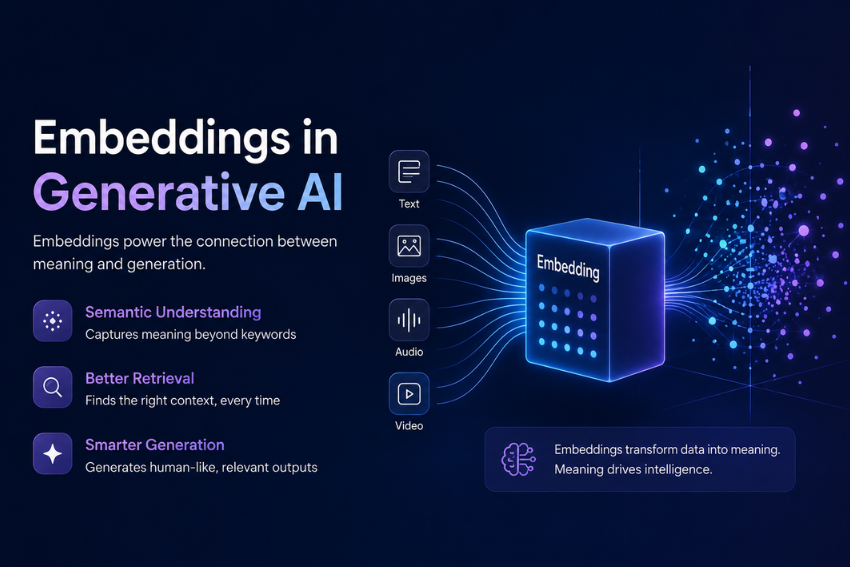
Embeddings are actually numerical vector representations of data – long arrays of numbers that encode the meaning and essence of words, images, audio, or even entire documents, that machines can process. Imagine that they are like mathematical translations of human language into the language that computers can read.
Suppose that you want to explain what a dog is to someone who can’t understand your language. This could be a picture, a real dog or a description. Embeddings do likewise for AI. They take some word, say dog, and transform it into a list of numbers, maybe 768 or 1536 long, that together sum up the model’s knowledge about what a dog is.
What’s so magical about embeddings: similar concepts get grouped together in this mathematical space. The vector for ‘dog’ is close to the vector for ‘puppy’ and ‘canine’, and is far from the vector for ‘car’ and ‘democracy’. That geometric relationship helps machines to know what to do based on proximity and distance rather than having a strict rule or keyword match.
Why Numbers Instead of Words?
You may ask yourself why I am putting the entire thing in numbers? The answer is straightforward: neural network is a mathematical machine. They do billions of calculations on numbers, not on letters and pixels. We transform text, images, and audio into numerical vectors to unleash the full power of deep learning.
This transformation is not arbitrary. Embedding models learn these representations by analyzing massive amounts of data, identifying patterns, and adjusting the numbers until similar things cluster together. The result is a dense, information-rich representation that captures far more nuance than any human-engineered feature set ever could.
How Embeddings Are Created
Embedding has undergone tremendous development in the last decade. Initially, Word2Vec and GloVe models were developed by studying word co-occurrence data from very large text collections to produce static word representations. Again, these were innovative at the time, but had a major drawback, each word was assigned a single vector, irrespective of context. The term “bank” was synonymous, regardless of whether it referred to river banks or banks of financial institutions.
The challenge is addressed by modern embedding models that aim to represent language in the context of the task at hand. For example, transformer models such as BERT, GPT, and their successors produce different word embeddings for a given word based on its context. This contextual understanding is the key that makes modern generative AI so much more powerful than what came before it.
The Technical Workflow
When you send text to an embedding model, it goes through the following steps:
- Tokenization: The input text is segmented into smaller parts, known as tokens, which are either words, subwords, or even individual characters based on the model.
- Encoding: The tokens go through layers of mathematical transformations in the neural network. Each layer reflects a certain level of significance: simple syntax, complex semantics.
- Pooling: The model combines all the token-level representations into a single fixed-length vector. Different models use different pooling strategies—some take the average, others use special CLS tokens, and some employ more sophisticated approaches.
- Normalization: Many modern embedding models apply L2 normalization to ensure all vectors have the same length, making similarity calculations more consistent.
The output is a dense vector (usually 384 to 3072 dimensions) that is a summary of the semantic meaning of your input. OpenAI’s text-embedding-3-large model returns a vector of 3072 dimensions, while the smaller one returns a vector of 1536 dimensions.
Types of Embeddings in Generative AI
Not all embeddings are created equal. In fact, various use cases require specific kinds of representations, and there is a huge taxonomy of embedding approaches emerging in the generative AI ecosystem.
Word Embeddings
These are the basic components. Instead, word embeddings model each word as a vector, which will capture semantic properties such as synonymy, analogy, and even grammatical properties. While Word2Vec, GloVe and FastText are still relevant benchmarks, they have been largely replaced in modern applications by contextual models.
Sentence & Document Embeddings
However, if you have to encode the meaning of a whole sentence, a paragraph or a whole document, you have to look beyond the use of word-level embeddings. Embedding sentences and documents provides an embedding for longer text chunks. This is well suited for models such as Sentence-BERT and the different universal sentence encoders which are able to create vectors that could be directly compared to determine the similarity in meaning between two texts.
Image Embeddings
It’s the same with visual content. The convolutional neural networks and vision transformers transform images into vectors that represent shapes, colours, textures, and spatial hierarchy. These image embeddings can be used for a variety of applications such as reverse image search and visual understanding capabilities of multimodal generative models.
Multimodal Embeddings
Now it gets really interesting. Multimodal embeddings: Embed different types of data (text, images, audio and video) into the same vector space. For instance, Google’s Gemini Embedding 2 supports up to 8,192 tokens of text, 6 images, 120 seconds of video, and 180 seconds of audio in a single call, generating embeddings that connect the dots between all these modalities.
The power of multimodal embeddings lies in their ability to enable cross-modal understanding. Look for pictures with text, find videos with audio, or create AI agents that reason through documents, images and code together.
Graph Embeddings
Graph embeddings are used to embed structured data, where nodes and edges are represented in a vector space. They are useful in a variety of applications such as recommendation systems, knowledge graphs and any other application where the relationship between entities is as important as the entities themselves.
Why Embeddings Matter for Generative AI
Generative AI cannot be built without embeddings. They form the backbone of things.
Retrieval-Augmented Generation
In enterprise AI, RAG has emerged as one of the most significant patterns, and, unsurprisingly, RAG is impossible without embeddings. Here’s a typical sequence:
- You break your documents into smaller pieces and create embeddings for those pieces.
- These embeddings are stored in a vector database with the original text.
- When a user asks a question, you create an embedding for their question.
- You identify document chunks with embeddings which are closest to the query embedding.
- You provide those relevant chunks to the generative model as context.
This way, generative AI is anchored in the most current and accurate data, but retains the natural flow and creativity of the AI itself. RAG without embeddings would be impossible because then you wouldn’t have an effective method for finding relevant documents out of millions or billions of documents.
Semantic Search and Information Retrieval
The traditional keyword search does not capture the subtleties of natural language. If you are searching for “car repair,” you won’t find any results for “automotive maintenance” or vehicle service.” Embedding-based semantic search resolves this issue by returning meaningful results, rather than merely matching them word-for-word.
This functionality can be used to enable anything from enterprise search to e-commerce product discovery. A user gets what he got, not what he typed.
Content Recommendation
Embeddings were used in the recommendation systems for years, even before the era of generative AI. These systems can be used to match users to content that they will likely enjoy by placing the user and content in the same vector space and allowing the user to share preferences and characteristics of items. Generative AI goes a step further with embeddings to condition the generation process itself: the output becomes content shaped by specific user preferences or contexts.
Clustering and Classification
For millions of documents and organizing them, embeddings are a natural solution. Groups of vectors can be automatically clustered together, themes can be found and patterns can be recognized that could not be seen by the human eye if the documents were processed individually.
The Vector Database Ecosystem
Embeddings are not useful if there is no way to efficiently store and search them. This is where vector databases come in.
These are special databases designed to store high-dimensional vectors and do similarity searches at scale. These algorithms include HNSW (Hierarchical Navigable Small World) and IVF (Inverted File Index), which are designed to efficiently identify nearest neighbors in large datasets and even with billions of vectors.
Common choices include Pinecone, Weaviate, Milvus, Qdrant, and vector search extensions to the mainstream databases such as PostgreSQL with the pgvector extension. The performance and scalability of a generative AI application can greatly rely on the type of vector database used.
Challenges and Considerations
Embeddings can be powerful, but they also have their challenges that practitioners should be ready to deal with.
Dimensionality and Storage
High-dimensional vectors take up space. The embedding of a 1536-dimensional vector, stored in 32-bit floats, requires more than 6 KB per vector. Add millions or billions of documents, and storage is an issue. This overhead can be managed by compression techniques, dimensionality reduction, careful model selection etc.
The Curse of Dimensionality
The more dimensions there are, the more space there is, and the farther apart data points are. This renders distance measures less meaningful and may lower the quality of the search. Modern embedding models are more sophisticated, trading off between the dimensions and the performance of the embedding; they generally choose to embed either between 384 and 3072 dimensions.
Chunking Strategies
The way in which you structure your text is highly significant when it comes to document embeddings. If the chunks are too small, information is lost in translation; if the chunks are too big, information will be lost in meaning. For most applications, different strategies are required, and the correct strategy may take experimentation to determine.
Bias and Fairness
Embeddings “learn” from the training data; they will contain the biases of the training data. Word embeddings have been found to capture stereotypes by gender, racial biases and more that are problematic. Solving these challenges necessitates the careful selection of training data, debiasing methods, and continuous monitoring.
Model Selection
Some embedding models are better than others. Some are good at semantic similarity, other retrieval tasks, and the others multilingual applications. The model you select will depend on your use case, language needs, and budget, as well as being either OpenAI’s text-embedding-3, Google’s Gemini Embedding 2, Cohere’s embed models, or an open-source option like BGE or GTE.
The Future of Embeddings in Generative AI
The field has been rapidly changing, and a number of trends have taken root.
Generative Embeddings
Typically, embeddings are computed by performing a single forward pass over an embedding model. However, researchers are now investigating generative methods which involve iteratively refining the semantic representation using autoregressive generation. They can model hidden concepts and implicit semantics, which is often overlooked by encoder-only models, and they have emergent scaling properties—the more tokens they are generating at inference, the better their embeddings will be.
LLMs as Embedders
Tasks are commonly tackled using large language models, and they are becoming more common. Tasks are being widely integrated with LLM’s. Instead of using LLMs as generic feature extractors, researchers are finetuning the LLMs specifically for embedding quality, and are exploiting the powerful knowledge that the LLMs have about language to generate richer representations. The convergence of these two models is indicative of what the future may look like: a model that can do both generative and embedding tasks.
Agentic Multimodal Understanding
Multimodal embeddings are getting increasingly more advanced, allowing for a more integrated approach to reasoning across text, images, video, and audio. These agents can retrieve hundreds of files to repair codebases, cross-reference between various PDFs and perform multi-step reasoning tasks with better understanding and accuracy.
Specialized Task Prefixes
New embedding APIs are bringing in task-specific optimizations. You can optimize the embedding model to generate vectors optimized for your specific use case by adding prefix to your queries, such as “task: question answering” or “task: fact checking. This level of granularity is a major step towards embedding utility.
Practical Advice for Getting Started
For anyone developing applications with embeddings, this is my recommendation:
- Begin with a tried and tested model. OpenAI, Cohere, Google and open-source models like BGE are all good baseline models. Select depending on the price range, language requirements and latency.
- Be conscious of chunking. Try various chunking and overlap techniques. One application may not be suitable for another.
- Pick the appropriate vector database. Take into account scale, query latency requirements, and budget. In some situations, you can get away with a basic pgvector implementation; in other situations, you will need a vector database.
- Monitor performance. If the language has changed, and your data has changed, the embedding will eventually become degraded. Evaluating and updating regularly is key.
- Consider task-specific optimization. If needed, fine-tune and use task prefixes to get the best performance from your embedding pipeline.
Wrapping Up
Embeddings in Generative AI are much more than a feint technical detail. The translator is the building block that connects human language and machine computation, the bridge that makes generative AI possible. From constructing a RAG system to developing a semantic search engine, or a multimodal AI agent, embeddings will be the core of your operations.
Technologies are changing rapidly. A year ago, all these were cutting edge, but today they are table stakes. However, the basic law is always the same: meaning must be represented meaningfully in order to be generated meaningfully. That’s what embeddings are.
When you ask ChatGPT a question, create an image using Midjourney, or search a document via natural language, keep that work in the background in mind. The numbers are doing the work and the vectors are dense and float in higher dimensional space. The unsung heroes of the generative AI revolution.