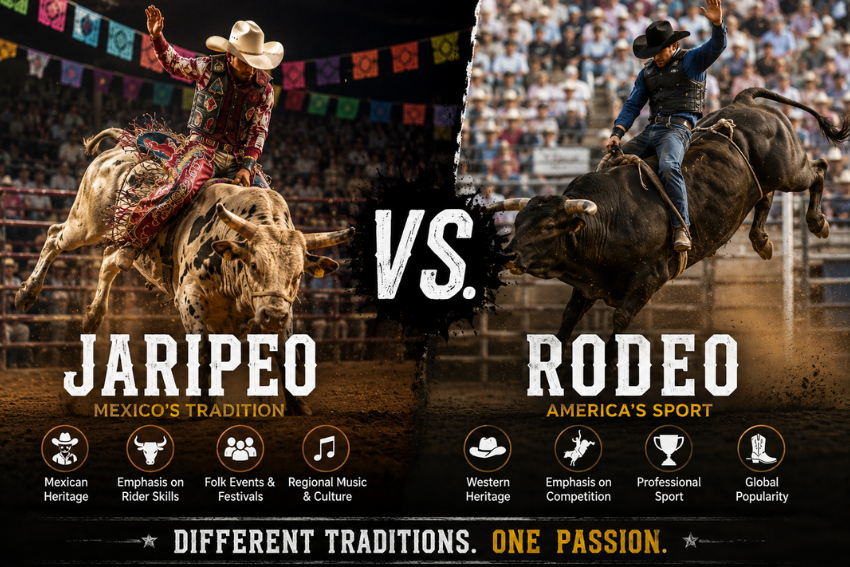
If you have ever typed “Jaripeo vs. Rodeo” into a search bar, you probably noticed both events involve bulls, dust, and daring riders. But lumping them together is like comparing a folk concert to a heavy metal show. They share a heartbeat of adrenaline, yet their souls sing completely different songs.
I have stood at the rail of both a Mexican Jaripeo and an American rodeo. The smells are similar: sweat, dirt, and livestock. But the atmosphere? Night and day. Let me walk you through what sets these two traditions apart, so you will never confuse them again.
What is a Jaripeo?
Jaripeo started as a Mexican ranching tradition, specifically in the states of Jalisco, Michoacán, and Guerrero. Originally, it was not a public spectacle. Ranch hands would test their skill by riding a bull bareback until the animal tired out. No timer. No judges. Just grit.
Today, Jaripeo have exploded into massive community festivals. You will find them at fairgrounds, rodeo arenas, and even temporary palenques (wooden bullrings). The main event is bull riding, but the rider holds on with a leather handhold strapped around the bull’s chest. No flank strap. No spurs digging in for a “mark out” score.
Key features of a Jaripeo:
- Bareback riding only – no saddle, but a simple leather grip (called a manea)
- Music is live – a full banda or norteño band plays while riders compete
- No timed rides – riders stay on until they fall or the bull stops bucking
- More entertainment – clowns (called payasos), horse dancing (called escaramuza), and food stalls with tacos and tequila
Jaripeo feels like a block party on steroids. Families spread out on blankets. Kids run around. The band never stops playing. And the rider’s goal? Not just to last eight seconds, but to put on a show that makes the crowd cheer.
What is a Rodeo?
American rodeo grew out of cattle ranching in Texas, Colorado, and Wyoming after the Civil War. Cowboys from different ranches would gather to show off roping and riding skills. By the early 1900s, rodeo became a structured competition with standardized rules, prize money, and time limits.
Modern rodeo includes multiple events: bareback bronc riding, saddle bronc, steer wrestling, tie down roping, team roping, and barrel racing. Bull riding is usually the final and most dangerous event.
Key features of a rodeo:
- Timed and judged events: Bull rides must last at least eight seconds for a score
- Flank strap used: A soft, fleece lined strap goes around the bull’s flank to encourage bucking (not painful, but annoying)
- Scoring system: Two judges give 0 to 25 points for the rider and 0 to 25 for the bull
- Announcer driven: A loudspeaker calls out scores, times, and upcoming events
- Shorter, intense bursts: Each event lasts seconds, then moves to the next contestant
Rodeo feels like a sports playoff. There is a strict order. The crowd watches scoreboards. Riders wear numbers on their backs. Winning means qualifying for the National Finals Rodeo in Las Vegas.
Head-to-Head: Jaripeo vs. Rodeo
Let me break down the biggest differences so you can spot them instantly.
Origin and Purpose
Jaripeo began as a simple ranch test of balance and bravery. Rodeo began as a competition between cowboys. One stayed a community party. The other became a professional sport.
Riding Equipment
Jaripeo riders use only a leather handhold (manea) strapped around the bull’s chest. No spurs required. Rodeo bull riders use a flat braided rope with a handle, plus rosin for grip. They wear spurs, but cannot touch the bull with them before the eight second whistle.
Music and Atmosphere
Walk into a Jaripeo, and your chest vibrates from a live banda. Trumpets, tubas, and drums fill the air. The band plays even while the bull bucks. Walk into a rodeo, and you hear country music over speakers between events, but silence during the ride. The announcer’s voice leads everything.
Animal Treatment
This is where opinions get loud. In Jaripeo, bulls are not flank strapped or prodded excessively. Riders fall off, and the bull typically trots to an exit gate. In rodeo, the flank strap is standard, and some bulls receive electric prods in the chute (though many pro rodeos restrict this now). However, both traditions have moved toward better care. Many Jaripeo now use rubber tipped spurs, and the PRCA has strict animal welfare rules.
Prize Money
Top rodeo bull riders earn millions. The 2023 PBR World Champion took home over $1 million. Jaripeo prize money rarely exceeds a few thousand dollars. Most Jaripeo riders compete for local fame, a belt buckle, or a percentage of ticket sales.
Length of Event
A professional rodeo finishes all events in two to three hours. A Jaripeo often runs four to six hours. Why? Because the band plays long sets. The dancing horses perform. Families eat dinner in the stands. The bull riding itself might only take 30 minutes total, but the whole show stretches out like a festival.
Which One Is More Dangerous?
Both carry serious risk. Broken bones, concussions, and spinal injuries happen in both. But rodeo statistics show more injuries per ride because of the higher bucking intensity. Rodeo bulls are bred and trained to spin and kick with explosive force. Jaripeo bulls are often regular ranch bulls, still dangerous but less athletic. That said, falling from any bull onto dirt from six feet up hurts no matter what you call the event.
Cultural Roots Matter
Here is what most articles miss. Jaripeo is not trying to be rodeo. It never was. Jaripeo ties directly to Mexican identity, to charrería (the national sport of Mexico), and to family land. When a young rider climbs onto a bull, he honors his grandfather who did the same thing fifty years ago on the same ranch.
Rodeo celebrates the American cowboy mythos. Independence, individualism, and winning. The buckle is a trophy. The score is a number. Both are beautiful. They just answer different questions. Jaripeo asks, “Can you make the crowd feel alive?” Rodeo asks, “Can you beat the clock and the bull?”
Why People Confuse Them
Easy. Both involve bulls. Both involve riders holding on. And in the last ten years, Mexican Jaripeo have grown huge in the US states with large Latino populations: California, Texas, Arizona, Nevada. So you might see a billboard for “Jaripeo y Rodeo” and think they are the same. They are not. Promoters sometimes combine them to draw bigger crowds. But inside the gate, you can tell instantly.
What About Women and Kids?
In rodeo, women compete in barrel racing and breakaway roping. In Jaripeo, you see women in escaramuza (precision horse riding) and occasionally bull riding, though it is still rare. Kids in rodeo enter mutton busting (riding sheep). Kids in Jaripeo often ride small bulls called novillos with a chaperone nearby. Both families’ welcome young riders, but Jaripeo feels more integrated. A 12-year-old might ride, then go eat elote with his cousins right after.
Which One Should You Attend?
If you want a loud, music filled, all day cultural experience with great food and a party vibe, go to a Jaripeo. Bring cash. Eat the carnitas. Stay till the band plays the last song.
If you want a tight, competitive, edge of your seat sports event where you can track scores and see top athletes, go to a rodeo. Check the PRCA or PBR schedule. Know the rules before you arrive.
Or do both. I have. And honestly, I love each for completely different reasons.
Final Take
Jaripeo vs. Rodeo is not about which is better. It is about recognizing that two cultures looked at a bull and built completely different worlds. One built a fiesta. The other built a sport. Respect both. But never call a Jaripeo a rodeo to a Mexican rider’s face unless you want a long, passionate lecture over a cold cerveza.
Now go find an event near you. Sit in the dusty stands. Listen for the trumpets or the announcer’s drawl. You will know within five seconds which tradition you walked into. And that is the whole point.
Frequently Asked Questions
Is Jaripeo the same as charreada?
No. Charreada is the Mexican national sport of horse roping and reining, with nine events. Jaripeo is only bull riding, plus music and dancing. But Jaripeo grew out of charro culture.
Do Jaripeo use a flank strap?
Usually not. Most Jaripeo rely on the bull’s natural bucking instinct. Some smaller events use a loose flank strap, but it is not standard like in rodeo.
Can Americans compete in Jaripeo?
Yes. Many American riders travel to Mexico and US Jaripeo. But you need to learn bareback style, not the rodeo rope grip. The technique is different. Your legs squeeze tighter. You cannot rely on spurs the same way.
Are Jaripeo legal in the United States?
Yes, absolutely. They happen every weekend in states like California, Texas, Oregon, and Washington. Most are held at county fairgrounds or dedicated arenas under animal welfare inspections.
Which is older, Jaripeo or rodeo?
Jaripeo is older. Its roots trace to the 1500s with Spanish haciendas. Rodeo as we know it started in the 1880s. So Jaripeo has roughly 300 more years of history.