Smart contract development is transforming how businesses create secure, automated, and transparent digital agreements on blockchain networks. From decentralized finance platforms to NFT marketplaces and enterprise applications, smart contracts now power some of the most innovative solutions in the tech industry.
This complete guide explains how smart contracts work, which blockchain platforms support them, the tools developers use, and the security practices that matter most. You will also learn how businesses use smart contracts to reduce costs, improve efficiency, and build trust without relying on intermediaries.
Whether you are a startup founder, blockchain enthusiast, or developer exploring decentralized applications, understanding smart contract development can help you stay ahead in the rapidly evolving blockchain ecosystem.
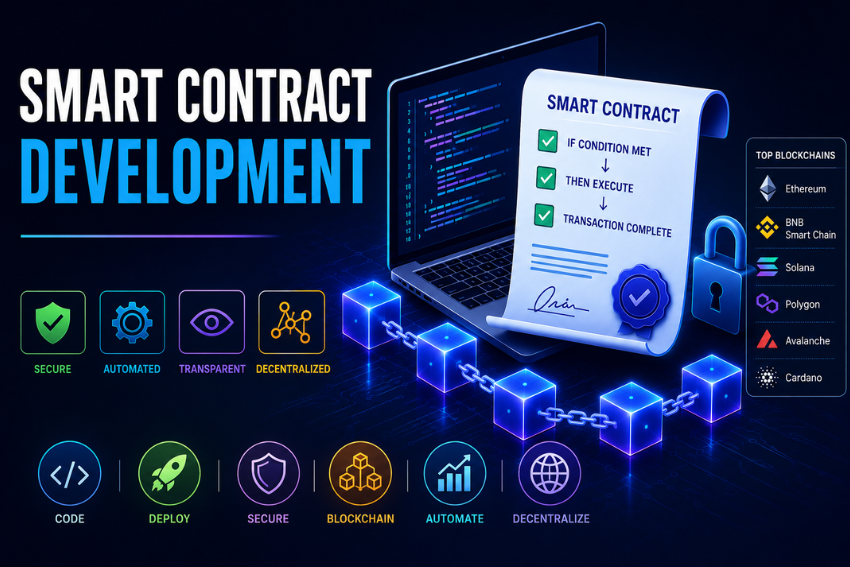
What is a Smart Contract?
An automatically executed piece of code stored on a blockchain is called a smart contract. It removes the need for economic organization, lawyers, traders, and various intermediaries to administer and enforce the terms of the agreement between multiple parties.
Think of it like a vending machine. After entering a payment and selecting your item, your smartphone will display it in front of you in standard form. There is no cashier involved. Such smart contracts operate autonomously once the requirements are met.
These contracts are written in code, executed on the blockchain (especially Ethereum), and are immutable, meaning the code cannot be changed after it is created. They are relatively trustworthy for this reason.
The Importance of Smart Contracts
Smart contracts are more than just innovations in technology. They are changing industries:
- Decentralized Finance (DeFi): Lending, borrowing, and trading outside of banks.
- Supply Chain: Automated invoicing when goods are moved.
- Health Care: Automated insurance claims and protectively shared personal records.
- Real Estate: Makes transferring property faster and less complicated.
- NFTs and Gaming: Boosting the in-game economy and virtual ownership.
Businesses are rushing to implement smart contracts for sincere purposes that reduce costs, remove human error, and foster consensus through transparency.
Operation of Smart Contracts
This is a true explanation of the life cycle:
- Agreement: Terms are agreed through both events (e.g., “Payment of X if Y is delivered”).
- Coding: A language like Solidity is used to write the code of the concepts.
- Installation: The blockchain community is used to execute the agreement.
- Trigger: Success on a specific need or occurrence (along with getting coins or meeting a closing date).
- Performance: The agreed offer is regularly completed according to the agreement.
- Record: Blockchain stores a permanent record of transactions.
No one is able to intervene tactically. No one can stop that. It actually runs.
Well-liked Blockchains for Developing Smart Contracts
While Ethereum is the most well-known platform, smart contracts are supported by a few different blockchains:
- Ethereum: The gold standard. Huge tooling support and a sizable developer community
- BnB Smart Chain: Lower costs, faster transactions, and compatibility with voting machines
- Solana: Rust is used for contract development, so it’s surprisingly fast and cheaper.
- Polygons: Ethereum-compatible Layer 2 solution with low gas costs
- Avalanche: Blockchain settings with higher throughput and optimization
- Cardano: It uses the security-focused Plutus language, which is totally based on Haskell.
Your use case, project size, and budget all play a role in choosing the best blockchain.
Smart Contract Programming Languages
Blockchain determines the language you operate on:
- Solidity: It was perfectly compatible with Ethereum and EVM and was mostly used in chains. It is quite accessible in everything due to its compatible syntax with JavaScript.
- Vyper: Ethereum’s Python-like language focuses on maintainability and ease of use.
- Rust: Used in Proximity Protocol and Solana; Known for performance and safety
- Move: Specifically designed to manage safe assets, it is used in Aptos and Sui.
Most tutorials, tools, and process postings are centered on Solidity, which is still the most famous language.
The Smart Contract Development Process
Building a smart contract takes more time than just writing code. The methodological outline is:
- Describe the Use Case: Before you write a line of code, make sure you understand exactly what the settlement is supposed to do. What are the requirements? What are the effects? What statistics are needed?
- Select the Right Blockchain: Choose a platform that adequately matches your preferences based on elements including transaction speed, pricing, and environmental assistance.
- Write the Contract: Coding begins at this point. The logic was built, field tested, and the use of Solidity (or a better language) took place.
- Testing: Since smart contracts cannot be changed once deployed, they have to go through a big box. Before going live, developers carefully review contracts for the use of tools such as Hardhat, Truffle, and Foundry.
- Security Audit: This is a non-negotiable point. Huge financial losses can be the very result of exploiting a flawed smart contract. Expert audits are aware of vulnerabilities such as integer overflow, reentrant attacks, and the introduction of control problems.
- Deployment: After the agreement is audited and approved, it is deployed to the main network. The development is clogged with fuel charges, and the contract gets a great blockchain deal.
- Integration: Next, APIs and tools like Web3.js or Ethers.Js are used to connect the contract to the front-end utility or back-end tool.
Common Smart Contract Vulnerabilities to Avoid
The first problem with the development of smart contracts is protection. Known weaknesses include:
- Reentrancy Attacks: Before a function completes its logic, it calls an external contract (this led to the infamous DAO compromise).
- Integers Overflow/Underflow: When the numbers exceed their limits, unexpected values arise.
- Access Control Problems: Sensitive tasks may be named via unauthorized recipients due to improper restrictions.
- Timestamp Dependency: Relying on the block timestamp, which can be mutable by miners.
- Gas Limit Issues: Complex logic or loops that go beyond gas limits and cause failed behavior.
Prioritizing conservation and running with a decent smart content production facility significantly reduces these risks.
Tools Every Smart Contract Developer Uses
A solid toolkit is crucial.
| Tool | Purpose |
|---|---|
| Remix IDE | A browser-based IDE for writing and testing Solidity |
| Hardhat | Development environment for compiling, testing, and deploying |
| Truffle | Another popular framework for Ethereum development |
| Foundry | Fast, Rust-based toolkit gaining rapid popularity |
| OpenZeppelin | Library of secure, reusable smart contract templates |
| MetaMask | Wallet used to interact with deployed contracts |
| Etherscan | Blockchain explorer to verify and monitor contracts |
Should You Build In-House or Hire Externally?
The majority of companies need to solve this question. Internally, smart contract development requires:
- Skilled development of rust or solidity.
- Radical understanding of blockchain architecture.
- Opportunities for security auditors.
- Planning for continuous innovation and improvement.
You can hire an enterprise team or hire smart contract developers, which is a good deal for most companies, especially startups and medium-sized companies. These experts can deliver audit-ready code somewhat faster than a scratch-formed in-house team because they have demanding expertise with many blockchains around the common thread of blockchain.
Hiring smart contract developers with a track record of success entails paying for security, reliability, and speed to market in addition to coding.
What to Look for in a Smart Contract Development Partner?
Here are some things you shouldn’t forget about partnering with a blockchain-focused smart contract development company:
- Case Studies & Portfolios: Have they created contracts that are compatible with your use case?
- Safety Procedures: Do they conduct internal audits before transportation?
- The Technology Stack: Are they proficient in the requirements of OpenZeppelin, Hardhat, and Solidity?
- Transparency: What do they build and why do they advertise it?
- Post-Deployment Support: Blockchain contracts cannot be changed, which is why it’s important to plan and monitor improvements.
In fact, don’t choose the cheapest option. Smart contracts process real money and real data, and their quality justifies the price.
The Future of Smart Contracts
Technology continues to evolve rapidly. Below are a few trends that affect the future.
- Layer 2 Solutions: Rising interest rates and fees for Ethereum contracts.
- Cross-Chain Contracts: Contracts that could operate simultaneously on many blockchains.
- Smart Contracts + AI: Bringing Real Intelligence to the Series with AI Oracles.
- Zero-Knowledge Proof: Allow unique transactions while maintaining verifiability.
- Updatable Contracts: Patterns of agents allowing logical changes without redirection.
As smart contract approvals spread at some point in industries, the need for certified smart negotiators simply increases.
Wrapping It Up
One of the most modern technologies of our time is smart contracts. By replacing parts with trust codes, they remove the need for trust; it is a significantly new approach to running the business.
Smart contracts are in the middle of the whole segment, whether you are empowering the DeFi protocol, NFT marketplace, supply chain solutions, or tokenized asset platform.
If you are a newbie with a high-risk appetite, the best approach is to invest money to master the basics yourself, or partner with a reliable smart contract development company that can successfully and accurately realize your imagination and vision.
Additionally, don’t be afraid to hire smart contract developers who specialize in this when you’re ready to grow. It all depends on having the right development team.
Those who stand out with goals and understanding will be rewarded in the blockchain field. You have now both.